
Free AI summary of this YouTube video by SumTube
Zakat Konsumtif dan Zakat Produktif
TL;DR
In this religious educational video, Ustadz Abdul Wahid Al Faizin discusses the best ways to distribute Zakat mal according to the Shafi'i school of thought. He explains that Zakat should ideally empower recipients by providing working capital or business tools, allowing them to become self-sufficient rather than dependent on ongoing aid. Direct consumable aid should generally be reserved for those who are unable to work or disabled.

Key takeaways
- 2:20Zakat for individuals capable of working is best distributed as productive capital or work equipment to foster long-term self-reliance
- 8:32Consumable zakat aid is primary reserved for recipients who are physically or practically unable to work
- 5:04The overarching goal of Zakat empowerment is to transform Zakat recipients (mustahik) into Zakat givers (muzakki)
Tap to enlarge
Most valuable section
For whom
Muslims seeking to understand the jurisprudential guidelines and best practices for distributing Zakat effectively.
Productive Zakat in the Shafi'i School2:20
It outlines the foundational ruling from Imam Nawawi on giving working capital instead of temporary consumable aid.
Detailed summary
1. Introduction: Consumable vs. Productive Zakat
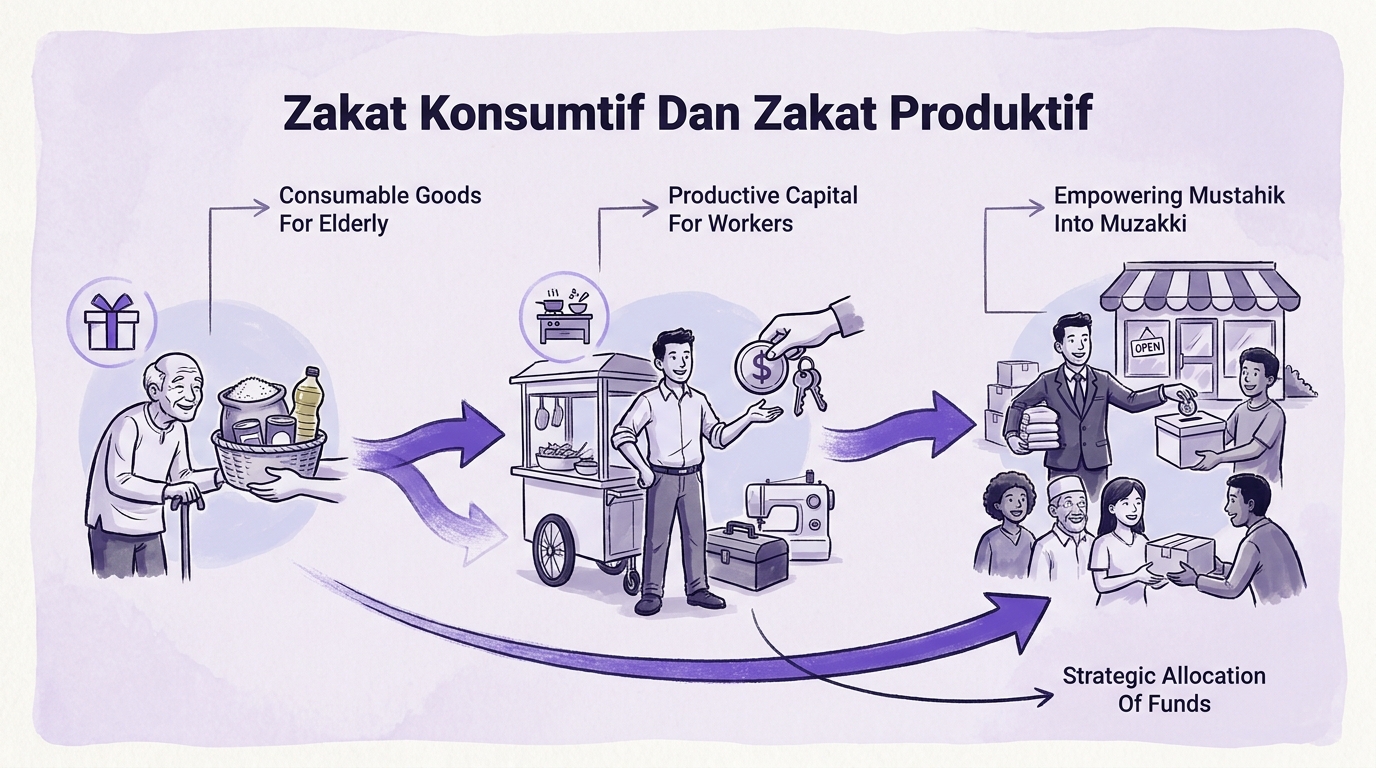
0:00Ustadz Abdul Wahid Al Faizin introduces a common question regarding whether Zakat is better distributed as consumable goods like basic food supplies (sembako) or as productive working capital. He uses the analogy of giving someone a fish versus teaching them to fish, emphasizing that giving tools enables long-term self-sufficiency.
He stresses that Zakat should not create dependency. Rather than receiving temporary relief year after year, recipients should be equipped with the means to generate their own income.
2. Productive Zakat in the Shafi'i School
2:20Referencing Imam Nawawi's Al-Majmu' and standard literature in the Shafi'i school, Ustadz Abdul Wahid explains that Zakat mal for recipients who are capable of working should be provided in the form of business capital or trade tools suited to their skills.
Examples include providing a food cart and ingredients for a food vendor, or a vehicle for a transport worker. The objective is to grant sufficient resources so that the profit generated covers their family's basic needs into the future.
3. Empowering Mustahik into Muzakki
4:55The core spirit of Zakat distribution according to classical scholars is to avoid making recipients addicted to charity. The ultimate goal is to empower mustahik (zakat recipients) so that they become independent and eventually become muzakki (zakat givers) in future years.
Ustadz Abdul Wahid notes that consumable zakat is mainly prescribed for those who lack the physical capacity or skill to work, such as the disabled or elderly. For everyone else, productive empowerment takes priority.
4. Strategic Allocation of Zakat Funds
10:08Citing Imam Al-Mutawalli, the speaker highlights that Zakat can even be converted into productive income-generating assets. He advises donors and zakat institutions to strategically pool funds to meaningfully empower fewer families rather than dividing small sums among many that only last a day or two.
By providing substantial capital to a targeted number of individuals each year, those families can permanently exit poverty, allowing future Zakat funds to be directed toward new beneficiaries.
Questions this video answers
Is it better to distribute zakat as basic necessities or business capital?
According to the Shafi'i school of thought as explained by Imam Nawawi, zakat is ideally given as working capital or business tools for recipients who are capable of working. This empowers them to earn an income and meet their ongoing living needs independently.
Who should receive zakat in the form of consumable food or direct cash?
Consumable zakat (such as basic necessities or direct cash for immediate living expenses) is primarily intended for individuals who are elderly, disabled, or otherwise unable to work or conduct business.
How is the amount of productive zakat determined for a recipient?
The amount provided depends on the recipient's specific trade, skill, locality, and market needs. The target is to provide sufficient capital or equipment so that their business earnings can sustainably support their family.
Ask a follow-up Premium
About this summary
SumTube AI wrote this recap from the video's words and chapters. Credit and the original belong to NU CARE.