
Free AI summary of this YouTube video by SumTube
Mengenal Jenis Jenis Motor Listrik Industri, Karakteristik, Kelebihan, Kelemahan dan Aplikasinya
TL;DR
This video provides an overview of the primary types of electric motors used in industrial applications, including DC, AC, Servo, and Stepper motors. It outlines their key characteristics, advantages, disadvantages, and common use cases to help viewers select the right motor for their specific needs.

Key takeaways
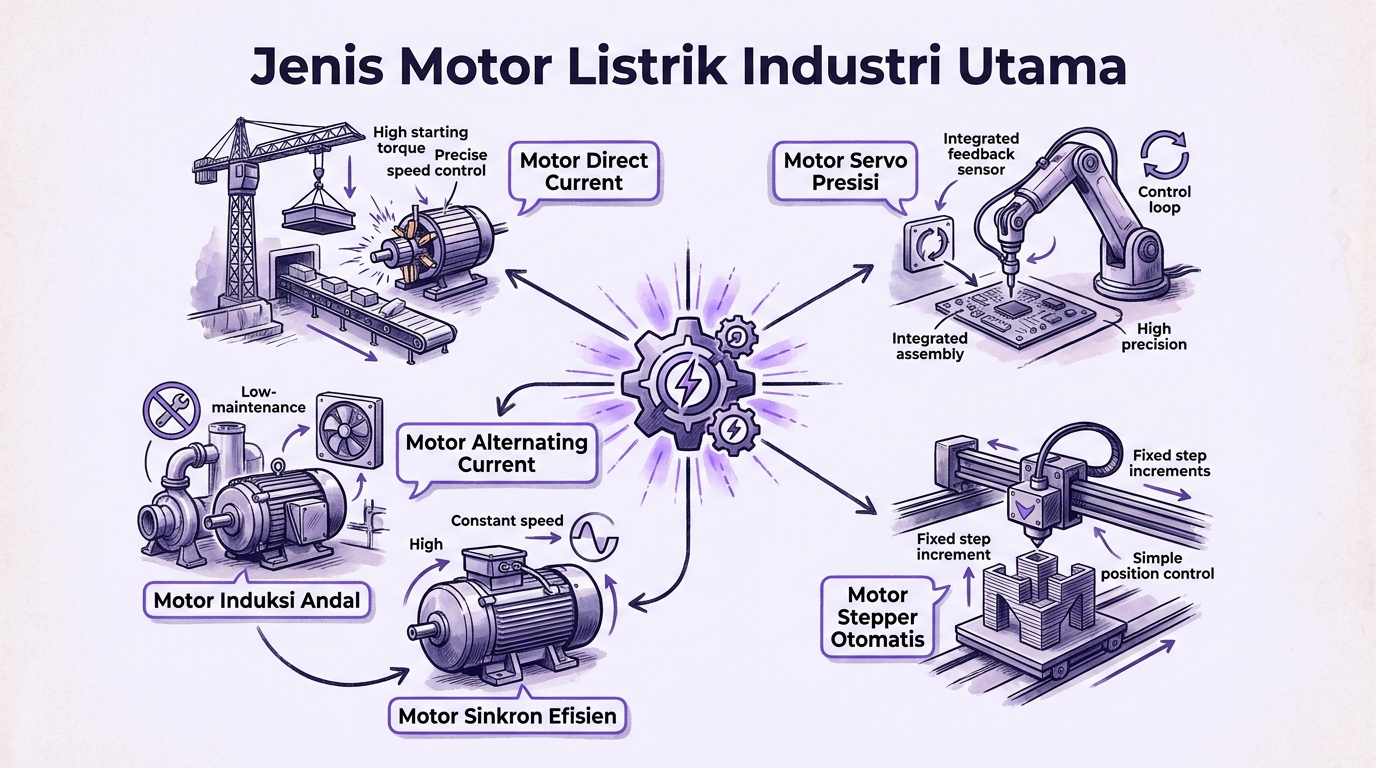
- 0:20DC motors provide high starting torque and precise speed control, making them ideal for heavy loads like cranes and conveyors despite high maintenance needs
- 0:51Induction AC motors are the most popular industrial choice due to their durability, low cost, and minimal maintenance requirements
- 2:13Servo motors offer high precision using feedback sensors, whereas Stepper motors achieve precise positional control through discrete steps without feedback
Tap to enlarge
Most valuable section
For whom
Automation engineers, robotics hobbyists, and industrial technicians needing a quick reference for electric motor selection.
It clearly contrasts high-precision servo feedback systems with open-loop stepper mechanisms, helping you choose the right control precision for technical projects.
Detailed summary
1. Direct Current (DC) Motors
0:03DC motors are widely used in heavy-duty industrial applications and are primarily divided into series and shunt types. They feature high starting torque and easily adjustable, precise speed control, making them extremely effective for moving heavy industrial loads.
However, DC motors are relatively expensive and require significantly more maintenance over time due to the wear on their commutators and brushes. Common applications include belt conveyors, cranes, and heavy elevators.
2. Alternating Current (AC) Motors
0:51AC motors fall into two main categories: synchronous motors and induction motors. Synchronous motors maintain a precise, constant speed matching the power supply frequency and are highly efficient for steady loads like large compressors and generators, though they require an auxiliary excitation source.
Induction motors are the most ubiquitous motor type across industrial settings due to their ruggedness, low cost, and minimal maintenance needs. Their primary drawback is that speed control requires specialized external hardware like Variable Frequency Drives (VFDs). They are typically used in pumps, industrial fans, and production machinery.
3. Servo and Stepper Motors
2:13Servo motors excel in high-precision position and speed control due to integrated feedback sensors that provide high accuracy and quick responsiveness. Their main drawbacks include high costs and the need for sophisticated external controllers, making them ideal for high-end robotics, CNC machines, and precision automation.
Stepper motors operate by moving in fixed, discrete steps, enabling simple position control without needing external sensors. While cost-effective for small precision devices like 3D printers and valve controls, stepper motors suffer from reduced torque when operated at higher speeds.
Questions this video answers
What is the main difference between synchronous and induction AC motors?
Synchronous motors maintain a constant speed tied directly to the power supply frequency and offer high efficiency for fixed loads, though they require an additional excitation source. In contrast, induction motors are cheaper, highly durable, and low-maintenance, though their speed cannot be easily adjusted without a variable frequency drive (VFD).
When should you choose a servo motor over a stepper motor?
A servo motor should be chosen for high-speed, dynamic applications requiring high precision and continuous feedback control, such as industrial robotics or CNC machines. Stepper motors are better suited for simpler, cost-effective applications that move in small, discrete steps, like 3D printers, though their torque drops at higher speeds.
Why do DC motors require more maintenance than AC induction motors?
DC motors use mechanical commutators and brushes that experience physical wear and tear over time, requiring periodic inspection and replacement. AC induction motors lack these wearing mechanical contacts, making them far more robust and low-maintenance.
Ask a follow-up Premium
About this summary
SumTube AI wrote this recap from the video's words and chapters. Credit and the original belong to Eko Aris.