
Free AI summary of this YouTube video by SumTube
Your Life at Every Level of Buying an Abandoned Farm.
TL;DR
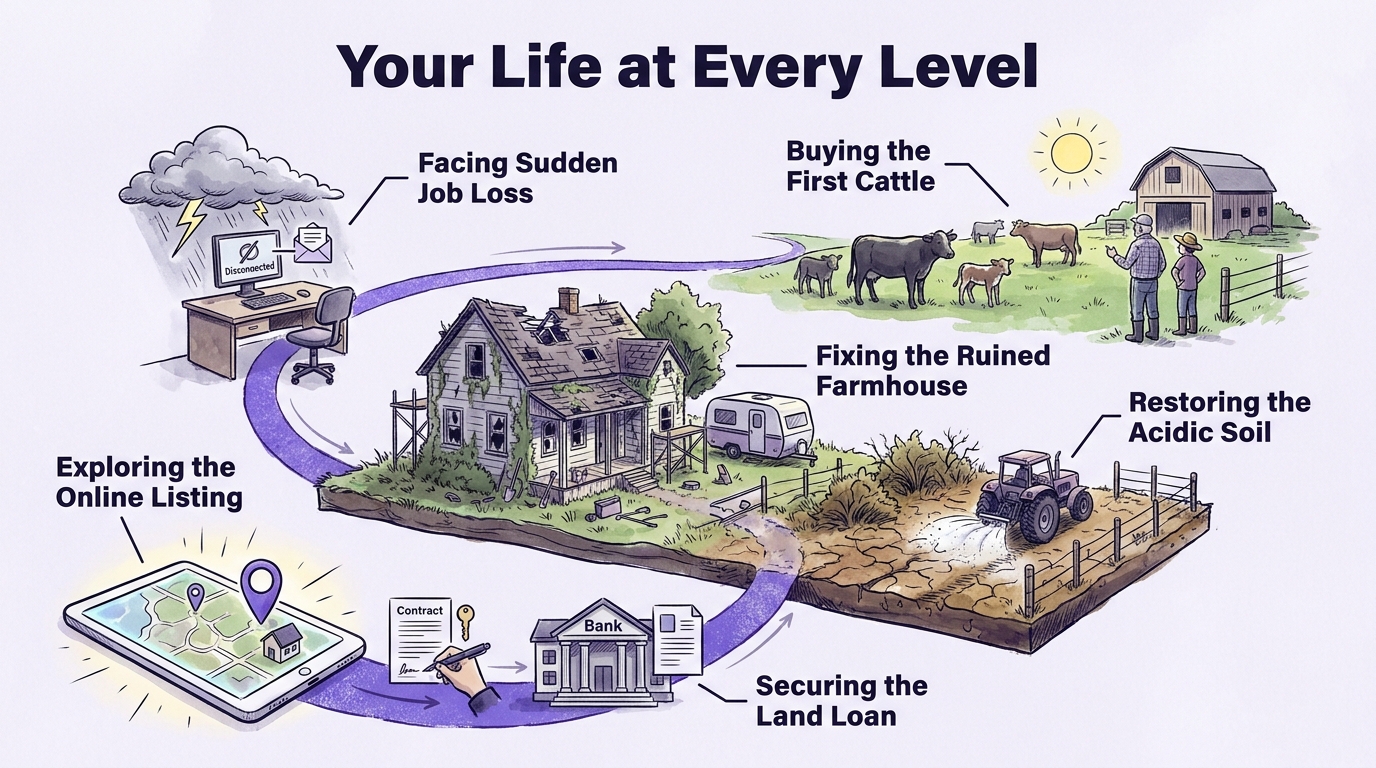
A 31-year-old remote worker leaves a comfortable apartment to buy a derelict 38-acre farm in the Ozarks for $146,000. Over nearly a decade, through trial, error, mentorship from an elderly neighbor, and relentless sweat equity, they restore the ruined farmhouse and land. The story chronicles a multi-year journey of financial risk, intense physical labor, community integration, and ultimate personal fulfillment.

Key takeaways
- 15:06Restoring land and property requires strict priority triage: roof and water rot demand immediate action, while aesthetic finishes can wait
- 29:42Success in rural homesteading often depends heavily on local community networks, mentorship, and emergency services involvement
- 39:57USDA and FSA beginning farmer programs provide essential financial leverage for acquiring land and livestock without traditional mortgages
- True homesteading is an ongoing relationship with constant maintenance rather than a finished end state
Tap to enlarge
Most valuable section
For whom
Anyone considering buying low-cost rural land or tackling a major fixer-upper homestead
It shows the gritty reality of living out of a travel trailer while systematically fixing critical infrastructure like water pumps, roofs, septic lines, and hazardous wiring on a tight budget.
Detailed summary
1. Level One, The Listing
0:00A 31-year-old corporate remote worker stumbles upon an online real estate listing for an abandoned 38-acre farm in the Ozarks priced at $159,000. Tired of a repetitive apartment lifestyle and driven by childhood memories of their grandfather's sold farm, they schedule a viewing. Upon arrival, the property shows severe neglect—a collapsed porch, leaning barn, and fields overgrown with invasive cedar trees.
During the visit, an elderly neighboring cattle farmer named June checks in on the property. June questions whether the protagonist understands the damage cedar trees cause to pastures and whether they intend to actually live on the land or just hold it as an investment. After calculating the tight financial numbers in a motel room that night, the prospective buyer decides to move forward.
2. Level Two, The Paperwork
7:22The protagonist negotiates a purchase price of $146,000 on the condition that all abandoned household items remain on site. A professional home inspection reveals critical issues: broken roof, rotted floors, dead well pump, failed septic drain field, outdated knob-and-tube wiring, lead paint, and raccoons in the attic, deeming the house officially uninhabitable. Consequently, conventional banks deny traditional mortgage applications.
To close the deal, the buyer secures a rural land loan requiring a 30% down payment ($43,800) at 7.25% interest over 25 years. Lacking the three years of farming experience required for specialized government loans, they drain almost all savings. Leaving the closing office with only $9,850 in cash reserves, they officially take possession of the degraded 38 acres.
3. Level Three, The House
12:35To eliminate rent expenses, the buyer moves into a used $4,800 travel trailer on the property, trades their car for an old pickup, and sets up temporary utilities including Starlink internet. Guided by June's advice to address water damage first, they tarp the roof and begin clearing decades of left-behind personal belongings with help from local community members. Over sixteen months, monthly income covers a new steel roof, well pump, septic drain field, drywall, and complete re-wiring.
The renovation involves grueling lead-safe plaster demolition, learning proper winter trailer maintenance after pipes freeze, and coping with the social isolation of moving away from old friends. After spending thousands of dollars and doing extensive personal manual labor, the protagonist finally sleeps inside the actual house for the first time with just $1,200 remaining in bank savings.
4. Level Four, The Land
20:45With the house stabilized, attention shifts to restoring the degraded pasture land. Soil tests reveal strongly acidic, nutrient-deficient dirt that requires heavy lime applications. To tackle thousands of overgrown cedar trees, the owner applies for federal assistance through the USDA EQIP program, securing financial assistance for conservation work available to beginning farmers.
The owner spends evenings and weekends clearing brush with a chainsaw and burning slash piles, complemented by professional skid-steer labor for heavy thickets. Next, they build a mile of five-strand barbed wire fencing with guidance from June's grandson on constructing proper H-braces. The effort pays off when native clover naturally re-emerges, allowing June to lease 25 acres of pasture for her cattle.
5. Level Five, The Hard Year
27:13A corporate return-to-office mandate forces the owner to resign from their remote job, eliminating their primary financial cushion and health insurance. To adapt, they pick up low-wage employment at a local farm supply store, assist June with cattle work, build fences for neighbors, and join the local volunteer fire department to build strong community ties.
Environmental hardships compound the financial stress, including a four-day winter power outage during an ice storm and a severe summer drought that causes local grass to wither. Reading old farm journals left by the previous owner provides historical perspective and emotional resilience, helping the protagonist persevere through extreme loneliness and shifting relationships with city friends.
6. Level Six, The Herd
33:30Having accumulated four years of hands-on agricultural experience, the owner finally qualifies for an FSA Microloan designed for new farmers. Accompanied by June to a local livestock auction, they purchase six bred heifers for $23,400 to establish their own cattle operation, ending the pasture lease to run their own stock.
The initial calving season brings intense emotional highs and lows, including assisting a difficult midnight delivery over the phone and losing a calf during a sleet storm. Selling steer calves in autumn yields their first real farm income, which is immediately reinvested into loan payments, veterinary care, and emergency savings while retaining top heifers to steadily build herd size.
7. Level Seven, The Lights Back On
38:43By age 40, the owner is approached by an 85-year-old June, who offers to sell her adjacent 60 acres for $240,000 so the land remains agricultural. Leveraging the FSA Down Payment Program for beginning farmers, the buyer puts down 5% to secure low-interest government financing and bank support, expanding their total holding to 98 acres and 16 cows.
Fully integrated into the local community through fence-building and volunteer firefighting, the owner encounters a young prospective buying couple inspecting a nearby rundown property. Passing along the practical wisdom acquired over nine hard years, the protagonist reflects on their journey as the light stays on over a once-dark porch.
Questions this video answers
How can you finance a property that is declared not habitable?
Traditional home mortgages will reject uninhabitable houses. Instead, buyers can use rural land loans through agricultural credit agencies (like Farm Credit) to finance the land itself, often requiring a larger down payment such as 30%. Government programs like FSA microloans or down payment programs can also help cover livestock and additional acreage.
What is the biggest mistake people make with abandoned pasture land?
Ignoring invasive species like Eastern Red Cedar is a major hazard. Cedar trees quickly move into neglected pastures, shading out grass and starving the soil, making them exponentially harder and more expensive to clear every year they are left untouched.
How do you handle sudden job loss while restoring a remote farm?
Adapting local side-hustles is essential when remote corporate work ends. In this narrative, taking local employment at a farm supply store, helping neighbors work cattle, and offering freelance fencing services covered basic living expenses during lean years.
Ask a follow-up Premium
About this summary
SumTube AI wrote this recap from the video's words and chapters. Credit and the original belong to Honest Life POV.