
Free AI summary of this YouTube video by SumTube
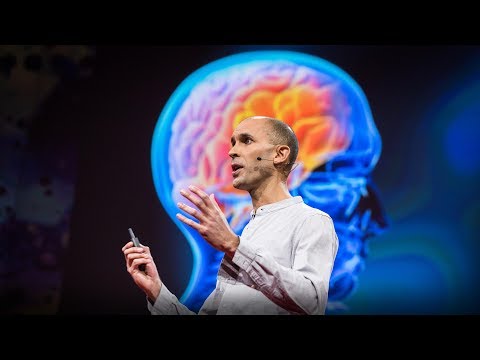
Your Brain Hallucinates Your Conscious Reality | Anil Seth | TED
TL;DR
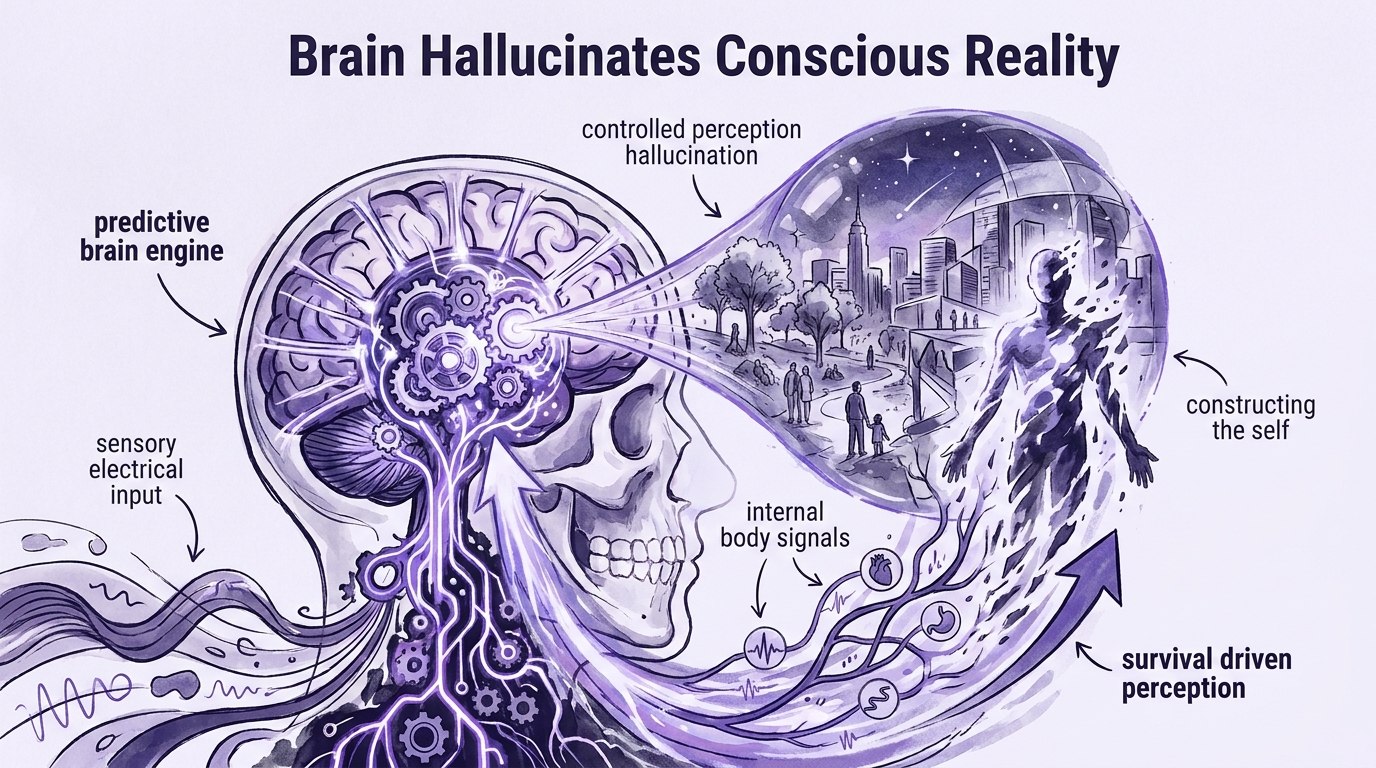
Neuroscientist Anil Seth explains how the brain functions as a prediction engine, constructing our conscious experiences of both the external world and ourselves. He argues that perception is a form of 'controlled hallucination' deeply tied to our biological drive to stay alive, rather than pure intelligence. Consequently, human consciousness is uniquely rooted in living biology, shaping how we view technology, mental health, and our place in nature.
Key takeaways
- 0:12Anil Seth begins by recalling his experience under general anesthesia, describing it as a total oblivion distinct from normal sleep
- 5:31Seth draws a parallel between the scientific understanding of life and the pursuit of understanding consciousness
- 6:24Locked inside a dark, silent skull, the brain relies entirely on indirect electrical signals to interpret the environment
- 10:29Seth argues that perception flows from the inside out rather than from the outside in, with the brain actively generating the world we experience
- 12:44The sense of being a unified self seems solid, but it is actually a complex, fragile construction formed by the brain
Tap to enlarge
Most valuable section
The Brain as a Predictive Engine6:24
Visual cues force the brain to perceive identical shades of gray differently based on shadow expectations, while distorted audio becomes understandable only after the brain is supplied with the correct words.
Detailed summary
1. The Mystery of Consciousness and Anesthesia
0:12Anil Seth begins by recalling his experience under general anesthesia, describing it as a total oblivion distinct from normal sleep. Unlike deep sleep, which leaves a vague sense of passing time, anesthesia completely erases conscious experience, turning a person briefly into an object. This contrast highlights one of science and philosophy's greatest remaining mysteries: how billions of biological neurons combine to generate a subjective, conscious reality.
Understanding consciousness is crucial because it encompasses everything we experience, including joy and suffering. Seth suggests that consciousness is not tied to high intelligence, meaning conscious artificial intelligence is unlikely. Instead, consciousness stems from our nature as living biological organisms, where experiences of the world and self are controlled hallucinations generated by our bodies.
2. Explaining Consciousness Like Life
5:31Seth draws a parallel between the scientific understanding of life and the pursuit of understanding consciousness. Historically, people believed that living organisms possessed a magical force or vital essence that could not be explained by chemistry and physics. However, as biologists gradually mapped out metabolic and reproductive mechanisms, the mysterious concept of a vital force vanished.
Similarly, Seth proposes that as science breaks down consciousness into its specific properties and underlying brain mechanisms, the grand mystery will resolve naturally. He divides consciousness into two main categories to investigate: the immersive, multisensory experience of the surrounding world and the specific internal experience of being a continuous self.
3. The Brain as a Predictive Engine
6:24Locked inside a dark, silent skull, the brain relies entirely on indirect electrical signals to interpret the environment. To make sense of these signals, the brain acts as a prediction engine, combining incoming sensory data with prior expectations to guess the causes behind the stimuli. Thus, what we consciously experience is not raw sensory input, but the brain's best informed guess of reality.
Optical and auditory illusions demonstrate how prior expectations reshape perception. Visual cues force the brain to perceive identical shades of gray differently based on shadow expectations, while distorted audio becomes understandable only after the brain is supplied with the correct words. In both cases, conscious experience changes dramatically even though the raw sensory information remains completely unchanged.
4. Perception as Controlled Hallucination
10:29Seth argues that perception flows from the inside out rather than from the outside in, with the brain actively generating the world we experience. When top-down perceptual predictions become excessively strong and ungrounded by sensory input, the brain experiences visual hallucinations similar to those reported in psychedelic states or psychosis.
This insight leads to the conclusion that normal perception is simply a controlled hallucination where predictions are continually constrained by external sensory input. When people share the same controlled hallucinations, they define it as reality. Seth asserts that this predictive process applies equally to the experience of being a self.
5. Constructing the Experience of Self
12:44The sense of being a unified self seems solid, but it is actually a complex, fragile construction formed by the brain. It consists of multiple distinct elements, including body ownership, a first-person perspective, agency, and a continuous personal identity built on memories. Neurological disorders show that these individual components can easily break apart.
The brain continually generates best guesses about what belongs to its physical body. The rubber hand illusion demonstrates this: when a person sees a fake hand stroked in sync with their hidden real hand, the brain integrates the visual and tactile agreement and adopts the fake hand as part of the body, illustrating that body ownership is itself a predictive construction.
6. Interoception and the Biological Purpose of Consciousness
16:47Beyond perceiving the body as an external object, consciousness relies heavily on interoception—the perception of internal bodily signals like heart rate and blood pressure. Experiments show that syncing visual feedback with a person's heartbeat heightens their sense of body ownership, demonstrating how deeply self-awareness is tied to internal physiological feedback.
Unlike external perception, which aims to identify objects, internal perception functions to control and regulate the body to ensure survival. Because predictive processing originally evolved to keep physiological systems within life-sustaining limits, all conscious experiences are ultimately rooted in the basic biological drive to stay alive.
7. Implications for Medicine, AI, and Humanity
20:09Seth concludes by summarizing three key implications of understanding consciousness as a biological, predictive process. First, understanding psychiatric and neurological disorders as prediction failures offers targeted paths for treatment. Second, because consciousness is inherently tied to living biological machinery, it cannot be reduced to or duplicated by software in AI or smart computers.
Finally, human consciousness represents just one small variation within a vast landscape of possible conscious states shared with other living creatures. Seth reflects that realizing our deep connection to nature brings a sense of wonder, offering reassurance that the end of consciousness is nothing to fear.
Questions this video answers
What does this video say about The Mystery of Consciousness and Anesthesia?
Anil Seth begins by recalling his experience under general anesthesia, describing it as a total oblivion distinct from normal sleep. Unlike deep sleep, which leaves a vague sense of passing time, anesthesia completely erases conscious experience, turning a person briefly into an object. This contrast highlights one of science and philosophy's greatest remaining mysteries: how billions of biologica
What does this video say about Explaining Consciousness Like Life?
Seth draws a parallel between the scientific understanding of life and the pursuit of understanding consciousness. Historically, people believed that living organisms possessed a magical force or vital essence that could not be explained by chemistry and physics. However, as biologists gradually mapped out metabolic and reproductive mechanisms, the mysterious concept of a vital force vanished. Sim
What does this video say about The Brain as a Predictive Engine?
Locked inside a dark, silent skull, the brain relies entirely on indirect electrical signals to interpret the environment. To make sense of these signals, the brain acts as a prediction engine, combining incoming sensory data with prior expectations to guess the causes behind the stimuli. Thus, what we consciously experience is not raw sensory input, but the brain's best informed guess of reality.
What does this video say about Perception as Controlled Hallucination?
Seth argues that perception flows from the inside out rather than from the outside in, with the brain actively generating the world we experience. When top-down perceptual predictions become excessively strong and ungrounded by sensory input, the brain experiences visual hallucinations similar to those reported in psychedelic states or psychosis. This insight leads to the conclusion that normal pe
What does this video say about Constructing the Experience of Self?
The sense of being a unified self seems solid, but it is actually a complex, fragile construction formed by the brain. It consists of multiple distinct elements, including body ownership, a first-person perspective, agency, and a continuous personal identity built on memories. Neurological disorders show that these individual components can easily break apart. The brain continually generates best
Ask a follow-up Premium
About this summary
SumTube AI wrote this recap from the video's words and chapters. Credit and the original belong to TED.