
Free AI summary of this YouTube video by SumTube
Why AI Makes You 100x Faster but Not Your Company - Mitchell Troyanovsky, Basis
TL;DR
Mitchell Troyanovsky, co-founder of Basis, explores how to build reliable AI agent systems capable of long-horizon work by implementing process supervision rather than relying solely on outcome evaluations. He demonstrates that scaling enterprise productivity requires structured, opinionated processes—such as behavior specifications, forking, and simulations—to bridge competency and process gaps. By supervising the intermediate step-by-step behavior of agents, organizations can ensure consistency, trust, and continuous self-improvement in production.

Key takeaways
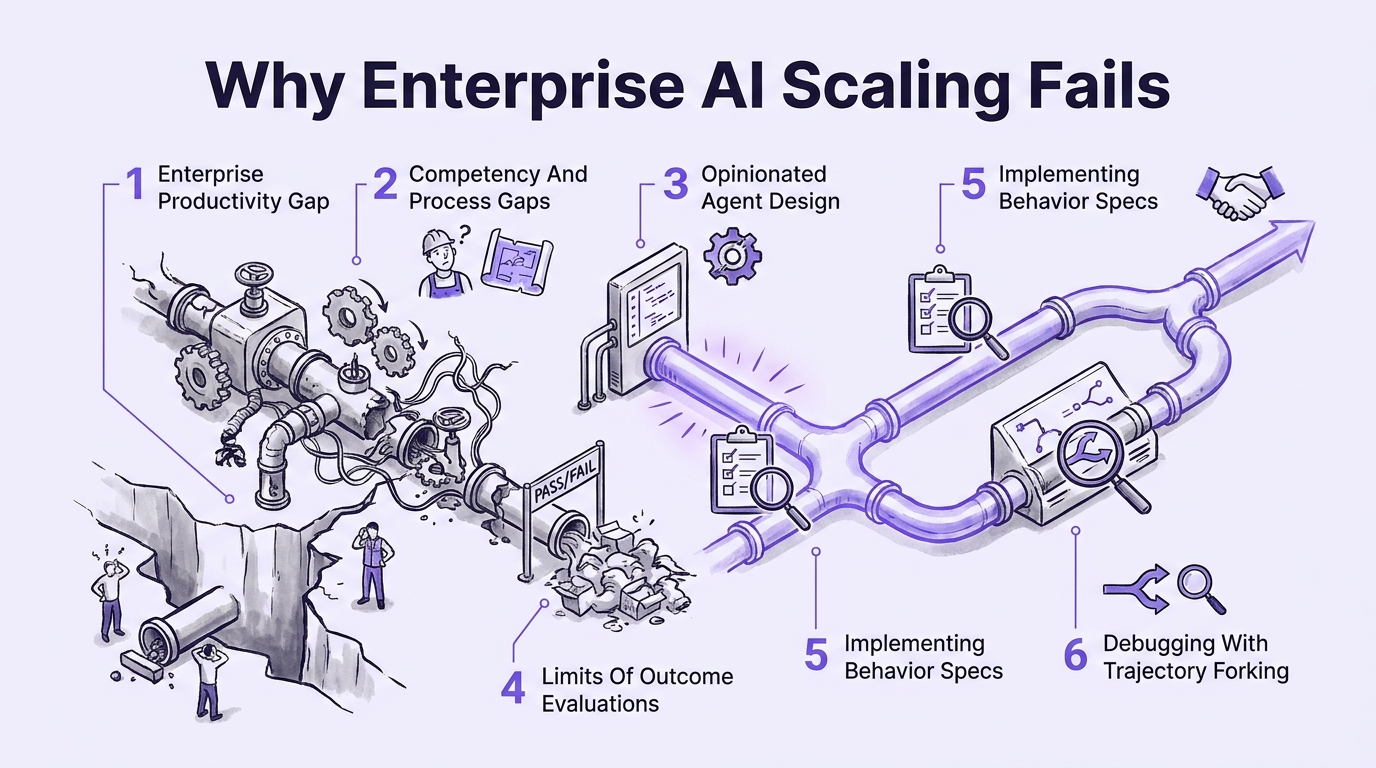
- 3:28Enterprise productivity has not scaled with AI because current coding agents outsource complexity to the user, creating competency and process gaps
- 6:27Reliability comes from embedding opinionated processes into agents rather than expecting them to invent workflows on the fly
- 9:32Process supervision via behavior specs, forking, and simulations provides fine-grained signals to evaluate agents when outcome ground truth is unavailable
- 16:51Combining process supervision with outcome evaluations creates a continuous feedback loop for self-improving production agents
Tap to enlarge
Most valuable section
For whom
AI engineers and software architects building autonomous agents for complex enterprise workflows
Simulations as Smoke Tests15:15
It explains a practical, cost-effective technique using sub-agents to mock and debug production agent behaviors without expensive full-environment re-runs.
Detailed summary
1. Introduction & The Enterprise Productivity Gap
0:00Mitchell Troyanovsky, co-founder of Basis, introduces his company's mission: building reliable, production-scale AI agents for enterprise workflows like accounting. While individual developer productivity has surged with tools like Cursor and Claude Code, overall organizational productivity has not scaled proportionally.
To understand why agent productivity has lagged in enterprise settings, Mitchell examines how human organizations scale. Companies succeed by establishing standardized, trusted processes signed off by leadership, ensuring consistent quality even when senior executives do not oversee daily execution.
2. The Competency Gap and Process Gap
3:28Mitchell highlights two major flaws in typical coding-agent-style products: the competency gap and the process gap. These products outsource operational complexity to the end-user, requiring them to manage memory, context, and theory of mind over AI systems, which most knowledge workers cannot do effectively.
Furthermore, letting individual users dictate how agents work creates inconsistent, unstandardized processes across an enterprise. To build viable production agents, systems must solve the competency gap by remaining simple to use and solve the process gap by staying reliable across diverse real-world situations.
3. Why Agents Must Be Opinionated
5:57To achieve reliability, agents must be embedded with 'opinions'—explicit, standardized rules on how tasks should be executed. Using PDF extraction as an example, Mitchell shows that choosing between vision-language models, custom OCR, or code parsing shouldn't be left to random agent choices or user prompts.
Getting tasks right reliably at scale requires consistent behavior rather than occasional strokes of brilliance. Just as human workers build trust by following established guidelines, agents gain organizational trust through predictable, opinionated execution.
4. The Limits of Outcome Evals in Production
9:03Standard outcome-based evaluations only test a narrow sample of scenarios where true ground truth exists. In long-horizon production environments, agents encounter an exponential long-tail distribution of edge cases where ground truth is unavailable.
Relying solely on outcome evaluations fails to explain why an agent succeeded or failed across multi-hour trajectories. Process supervision bridges this gap by testing whether the agent maintained required behaviors across all production runs, regardless of whether a final ground-truth rubric exists.
5. Implementing Behavior Specs and Judges
11:58Mitchell presents 'behavior specs'—written specifications defining desired agent actions in specific situations, separate from system prompts and tools. An LLM judge evaluates agent execution logs against these specs to confirm compliance.
Using an accounting reconciliation example, he demonstrates how a behavior spec ensures an agent investigates line-item discrepancies rather than creating dummy adjustment entries. This approach provides fine-grained signal without requiring predefined answer keys.
6. Debugging Trajectories with Forking
13:43When an agent fails a behavior evaluation in a long-horizon task, identifying the root cause can be difficult. Mitchell introduces 'forking,' a technique that saves the agent's exact state right before a flawed decision.
By branching the trajectory at the failure point, developers can test modified system prompts, skills, or tool descriptions. This precise debugging reveals that failures are often caused by poor tool design rather than context prompt deficiencies.
7. Simulations as Smoke Tests
15:15To speed up iteration without the high cost of full environment re-runs or complex state forking, Mitchell describes using LLM-driven simulations. Developers prompt a sub-agent to pretend to be the production agent given a specific file context and scenario.
This serves as a cheap, rapid smoke test to observe how harness changes affect decision-making before running full production trials. Basis used this method for over a year to iterate on agent architecture efficiently.
8. Closing the Loop and Building Trust
16:22Combining behavior specs, forking, and simulations transforms process supervision into an active feedback loop. This structural signal acts as a higher-level reward function, enabling agents to self-improve systematically in production environments.
Ultimately, process supervision replicates human organizational trust: as agents demonstrate reliable execution on low-risk tasks, teams comfortably delegate higher-stakes, long-horizon work. Mitchell closes by summarizing four core takeaways for building enterprise-ready agent systems.
Questions this video answers
Why hasn't AI agent adoption dramatically increased enterprise productivity yet?
Current AI agent products outsource task complexity and decision-making to individual users, creating a competency gap and a process gap. Organizations scale by establishing standardized, trusted processes rather than letting every worker invent their own workflow, which open-ended agents currently force users to do.
What is process supervision for AI agents?
Process supervision evaluates and guides an agent's intermediate step-by-step behavior against established procedural rules (opinions) rather than evaluating only the final outcome. This allows developers to verify that agents act reliably across millions of ungrounded edge cases in production.
How do behavior specs, forking, and simulations improve agent reliability?
Behavior specs define explicit expectations for how an agent should handle specific scenarios. Forking allows developers to branch an agent's run at a specific step to test alternative prompts or tools, while simulations create fast, low-cost mock environments to smoke-test behavior before deployment.
Ask a follow-up Premium
About this summary
SumTube AI wrote this recap from the video's words and chapters. Credit and the original belong to AI Engineer.