
Free AI summary of this YouTube video by SumTube
Tahun 1942, Belanda dan Sekutu Menyerah kepada Jepang di Hindia-Belanda (Indonesia)
TL;DR
This video details the Japanese invasion of the Dutch East Indies (modern-day Indonesia) during World War II in 1942. Driven by the need for critical war resources like oil, rubber, and tin following U.S. embargos, Japanese forces rapidly expanded through Maluku, Kalimantan, and Sumatra before launching a multi-pronged assault on Java. Despite resistance from the Allied ABDACOM forces, the Japanese secured a swift victory, culminating in the unconditional surrender of Dutch forces at the Kapitulasi Kalijati on March 8, 1942.

Key takeaways
- 1:14Japan invaded Indonesia primarily to secure critical industrial war resources, especially oil, to sustain its Pacific war effort following Western trade embargos
- 3:32The Allied joint command (ABDACOM) failed to halt the rapid Japanese advance due to superior Japanese numbers, coordination, and naval dominance in the Battle of the Java Sea
- 6:54The signing of the Kalijati Capitulation on March 8, 1942, ended Dutch colonial rule and initiated the Japanese military occupation of Indonesia
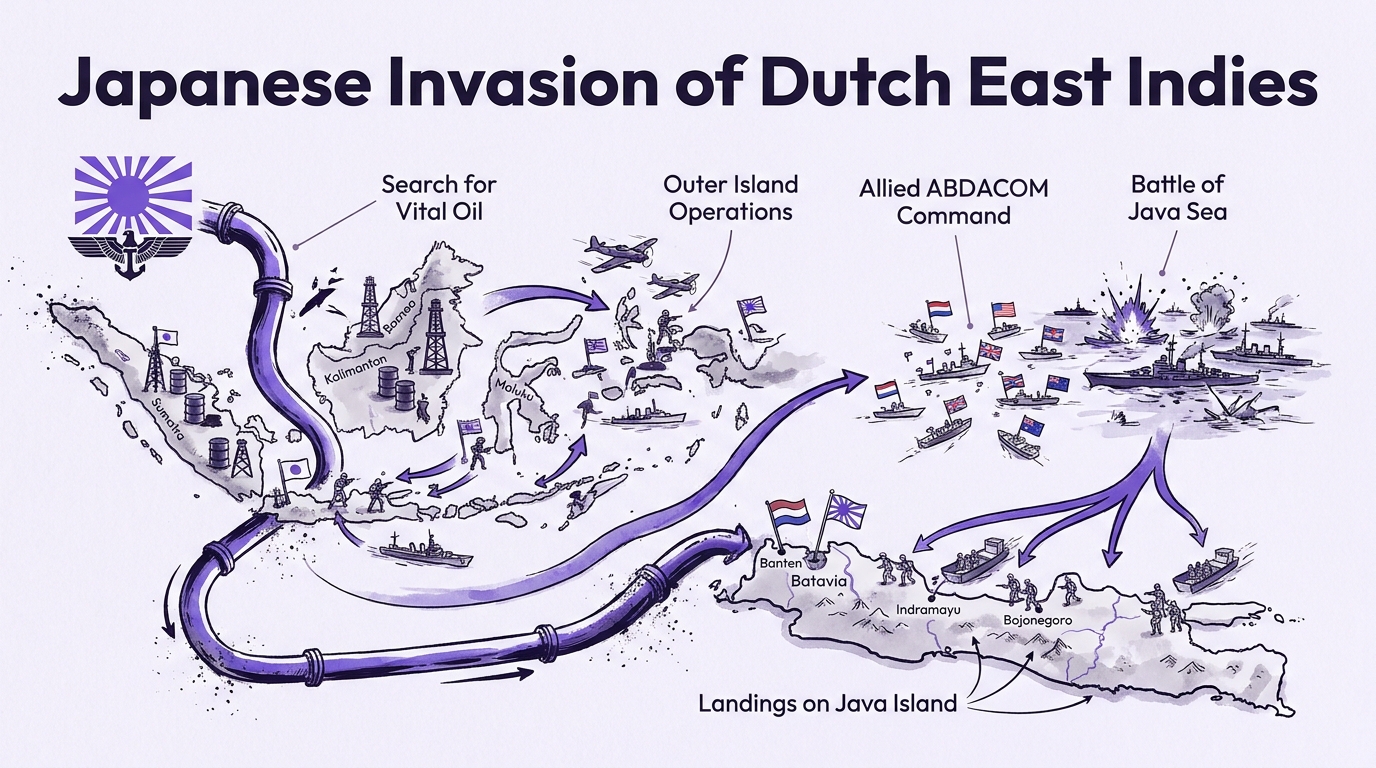
Tap to enlarge
Most valuable section
For whom
Military historians and students interested in World War II in Southeast Asia and the Pacific Theatre
Landing on Java and the Fall of Batavia4:37
It illustrates the strategic landings across Banten, Indramayu, and Bojonegoro that overwhelmed Allied positions and led directly to Batavia's capture.
Detailed summary
1. Introduction & Strategic Motivation
0:00Following the attack on Pearl Harbor on December 8, 1941, Japan expanded its offensive into Southeast Asia. The Dutch East Indies became a primary target due to its rich reserves of strategic resources including oil, rubber, tin, and malaria medication.
Japan's war economy desperately required these materials, particularly oil, to survive Western embargos. Framing itself as an 'older brother' coming to liberate Asian nations, Japanese propaganda initially sought local cooperation while preparing for total conquest.
2. Japanese Entry and Early Advances (Jan 1942)
2:01In January 1942, Japanese forces launched their campaign into Indonesia by landing at Ambon in Maluku. Despite resistance from Allied garrisons composed of Dutch and Australian troops, Japanese units quickly secured control over the Maluku island chain.
Simultaneously, Japanese forces targeted key resource zones in Borneo. They seized Tarakan and Balikpapan in East Kalimantan by mid-January to secure vital oil fields, setting the stage for further operations into Sumatra and Pontianak.
3. The Strategic Push Towards Java
3:07Recognizing Java as the administrative and military center of the Dutch colonial government, the Imperial Japanese Command focused on isolating the island. After capturing outer regions, Japanese air and naval assets systematically dismantled Allied regional defenses.
By February 1942, Japanese troops had gained footholds in Sumatra and prepare comprehensive offensive movements across the Java Sea to strike the heart of the Dutch administration.
4. Allied Defense and ABDACOM Operations
3:32To counter the swift Japanese offensive, Allied nations established ABDACOM (American-British-Dutch-Australian Command) under Dutch Lieutenant General Ter Poorten. This joint force aimed to build a defensive line known as the Malay Barrier across the East Indies archipelago.
Despite assembling infantry units, cadet battalions, and naval assets in Java, ABDACOM suffered from disorganized command structures and insufficient equipment compared to the seasoned Japanese forces.
5. Battle of the Java Sea & Naval Defeat
4:08In late February 1942, Allied naval forces under Dutch Rear Admiral Karel Doorman engaged the Imperial Japanese Navy in the Battle of the Java Sea. The Japanese fleet delivered a decisive blow, destroying key Dutch and British warships.
The defeat shattered Allied naval dominance in the region. Remaining Allied ships fled toward Australia, leaving Java largely defenseless against upcoming amphibious landings.
6. Landing on Java and the Fall of Batavia
4:37On March 1, 1942, Japanese General Hitoshi Imamura executed coordinated landings at three unexpected sites on Java: Banten, Indramayu, and Bojonegoro. Outmaneuvered, Allied troops were unable to block these simultaneous amphibious assaults.
Japanese forces bypassed heavily fortified lines and rapidly advanced toward urban centers. Batavia fell to Japanese control on March 5, 1942, after Dutch authorities declared it an open city to prevent its destruction.
7. The Kalijati Capitulation and Aftermath
6:20With major cities falling and defenses collapsing, General Ter Poorten signed an unconditional surrender to General Imamura at Kalijati, Subang on March 8, 1942. This event, known as the Kapitulasi Kalijati, marked the end of Dutch rule in Indonesia.
Governor-General Tjarda was taken prisoner, while Dutch officials in exile established a government-in-exile in Australia under Hubertus van Mook. Indonesia subsequently entered a three-and-a-half-year period of Japanese military occupation.
Questions this video answers
Why did Japan invade the Dutch East Indies during World War II?
Following the U.S. oil embargo and military escalations in late 1941, Japan needed natural resources to maintain its war effort. The Dutch East Indies possessed vast reserves of oil, rubber, tin, and aluminum, which were crucial for sustaining Japanese military operations across the Pacific.
What was ABDACOM, and why did it fail to stop Japan?
ABDACOM (American-British-Dutch-Australian Command) was a unified Allied force formed to defend Southeast Asia against Japanese invasion. Despite combining ground, naval, and air assets under Dutch Lieutenant General Ter Poorten, the command suffered from inadequate coordination and heavy naval losses in the Battle of the Java Sea, allowing Japanese troops to land largely unimpeded.
What was the significance of the Kalijati Capitulation?
Signed on March 8, 1942, by Dutch General Ter Poorten and Japanese General Hitoshi Imamura, the Kalijati Capitulation marked the unconditional surrender of Dutch forces in Java. This event formally ended over three centuries of Dutch colonial domination and established the Japanese military occupation of Indonesia.
Ask a follow-up Premium
About this summary
SumTube AI wrote this recap from the video's words and chapters. Credit and the original belong to Military History.