
Free AI summary of this YouTube video by SumTube
Oumuamua - A mysterious object from another star | DW Documentary
TL;DR
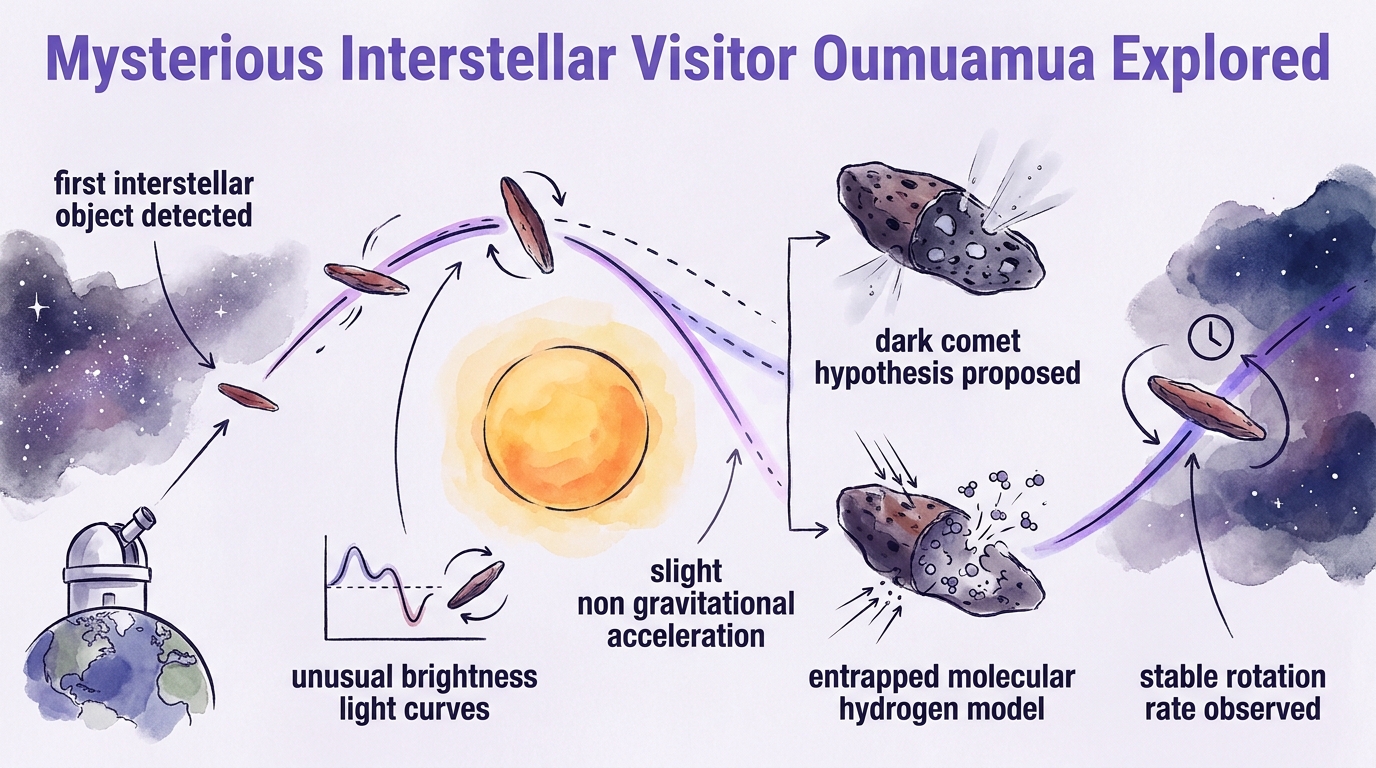
In October 2017, astronomer Robert Weryk discovered 'Oumuamua, the first detected interstellar object passing through our solar system. This documentary explores the scientific debate and rigorous investigations into its unusual shape, composition, non-gravitational acceleration, and origins. Through observational data and chemical modeling, scientists debate whether 'Oumuamua is a dark comet, an icy fragment, or potentially artificial debris.

Key takeaways
- 5:12Observatories around the world focused on 'Oumuamua to gather precise light curves, rotation metrics, and color data
- 10:30As researchers calculated 'Oumuamua's orbit, they discovered a slight but distinct non-gravitational acceleration pushing the object away from the Sun
- 20:24Astrophysicist Darryl Seligman analyzed known near-Earth asteroids and identified several bodies that exhibit non-gravitational acceleration without visible coma, coining the term "dark comets."
- 23:58Astrochemist Jennifer Bergner proposed that cosmic radiation during 'Oumuamua's long interstellar travel split water ice trapped within its porous, powdery matrix, producing entrapped molecular hydrogen
- 25:46Astrophysicist Roman Rafikov raised doubts about the outgassing hypothesis, pointing out that uneven gas emission on an irregular body should drastically alter its spin rate
Tap to enlarge
Most valuable section
The "Dark Comet" Hypothesis20:24
This theory offered a potential natural explanation for 'Oumuamua's non-gravitational push.
Detailed summary
1. Discovery of 'Oumuamua
0:00On October 19, 2017, astronomer Robert Weryk analyzed data from Hawaii's Pan-STARRS telescope and noticed an unusual celestial object accelerating on an unexpected trajectory. Further analysis confirmed that the object was not gravitationally bound to the Sun, marking it as the first detected interstellar object passing through our solar system.
The discovery ignited immediate global interest, with major observatories turning their telescopes toward the object to track its trajectory and determine its composition. Named 'Oumuamua—Hawaiian for "messenger from afar"—the visitor presented scientists with unprecedented characteristics that sparked intense scientific debate.
2. Observational Insights and Shape Analysis
5:12Observatories around the world focused on 'Oumuamua to gather precise light curves, rotation metrics, and color data. Astrophysicists noted significant fluctuations in brightness every seven to eight hours, indicating an extreme aspect ratio and highly elongated, non-spherical shape.
Astronomers initially modeled 'Oumuamua as a cigar-like cylinder roughly ten times longer than it is wide, though later infrared data suggested it could also be a flattened, disk-like object. Despite its comet-like acceleration, the object displayed no visible dust, gas, or coma.
3. The Trajectory Anomaly
10:30As researchers calculated 'Oumuamua's orbit, they discovered a slight but distinct non-gravitational acceleration pushing the object away from the Sun. Such forces are common in comets, where outgassing gases act like thrusters, but 'Oumuamua showed no outgassing or tail.
This discrepancy created a major puzzle for astrophysicists. While comets naturally accelerate due to sublimating ice, 'Oumuamua appeared completely dry and rocky, challenging traditional models of solar system bodies.
4. The "Dark Comet" Hypothesis
20:24Astrophysicist Darryl Seligman analyzed known near-Earth asteroids and identified several bodies that exhibit non-gravitational acceleration without visible coma, coining the term "dark comets." He proposed that 'Oumuamua might belong to this newly recognized class of hidden comets.
Using a hands-on demonstration with ice, sand, and organic materials, researchers illustrated how hidden water and carbon dioxide sublimation could propel an object without generating a visible dust trail. This theory offered a potential natural explanation for 'Oumuamua's non-gravitational push.
5. Hydrogen Outgassing Model
23:58Astrochemist Jennifer Bergner proposed that cosmic radiation during 'Oumuamua's long interstellar travel split water ice trapped within its porous, powdery matrix, producing entrapped molecular hydrogen. Upon approaching the Sun, heating freed this hydrogen, causing invisible thrust.
This hydrogen outgassing mechanism accounts for the non-gravitational acceleration without requiring exotic physics or visible dust tails. The model provided a compelling, natural explanation that satisfied many in the astronomical community.
6. Rotational Stability Counterargument
25:46Astrophysicist Roman Rafikov raised doubts about the outgassing hypothesis, pointing out that uneven gas emission on an irregular body should drastically alter its spin rate. Such rotational torque would cause the object to speed up or break apart within days.
Because observations over 30 days showed 'Oumuamua's rotation remained remarkably stable, Rafikov argued that standard outgassing models fail to fully explain the phenomenon, keeping the mystery open.
7. The Artificial Origin Speculation
27:24Harvard astronomer Avi Loeb proposed that 'Oumuamua's extreme shape, reflectivity, and tail-free acceleration could be explained if it were an artificial object, such as an alien light sail propelled by radiation pressure. This hypothesis generated massive global media coverage.
While the broader scientific community largely rejected the alien probe theory due to a lack of techno-signatures, researchers acknowledged that even speculative hypotheses push astronomy to test existing paradigms and refine detection techniques.
8. The Threat of Interstellar Objects
32:28Scientists evaluated the potential impact risks if an interstellar object like 'Oumuamua or 2I/Borisov were on a collision course with Earth. Due to their high velocity, the kinetic energy of an impact would be devastating, far exceeding that of typical solar system asteroids.
NASA's DART mission successfully demonstrated kinetic deflection on asteroid Dimorphos, but researchers emphasize that detecting fast-moving interstellar objects early enough remains a critical challenge for planetary defense.
9. Future Missions and Interstellar Exploration
37:00To solve the mystery of interstellar visitors, scientists look to next-generation facilities like the Vera C. Rubin Observatory, which will detect interstellar objects much earlier in their trajectories. Additionally, the European Space Agency's Comet Interceptor mission, planned for 2029, aims to wait in orbit to intercept a newly discovered comet or interstellar object.
Projects like Project Lyra explore the feasibility of sending high-speed, light-sail-propelled probes to catch up with 'Oumuamua itself. Studying these pristine interstellar messengers provides unprecedented insight into the chemical building blocks of other planetary systems.
Questions this video answers
What does this video say about Discovery of 'Oumuamua?
On October 19, 2017, astronomer Robert Weryk analyzed data from Hawaii's Pan-STARRS telescope and noticed an unusual celestial object accelerating on an unexpected trajectory. Further analysis confirmed that the object was not gravitationally bound to the Sun, marking it as the first detected interstellar object passing through our solar system. The discovery ignited immediate global interest, wit
What does this video say about Observational Insights and Shape Analysis?
Observatories around the world focused on 'Oumuamua to gather precise light curves, rotation metrics, and color data. Astrophysicists noted significant fluctuations in brightness every seven to eight hours, indicating an extreme aspect ratio and highly elongated, non-spherical shape. Astronomers initially modeled 'Oumuamua as a cigar-like cylinder roughly ten times longer than it is wide, though l
What does this video say about The Trajectory Anomaly?
As researchers calculated 'Oumuamua's orbit, they discovered a slight but distinct non-gravitational acceleration pushing the object away from the Sun. Such forces are common in comets, where outgassing gases act like thrusters, but 'Oumuamua showed no outgassing or tail. This discrepancy created a major puzzle for astrophysicists. While comets naturally accelerate due to sublimating ice, 'Oumuamu
What does this video say about The "Dark Comet" Hypothesis?
Astrophysicist Darryl Seligman analyzed known near-Earth asteroids and identified several bodies that exhibit non-gravitational acceleration without visible coma, coining the term "dark comets." He proposed that 'Oumuamua might belong to this newly recognized class of hidden comets. Using a hands-on demonstration with ice, sand, and organic materials, researchers illustrated how hidden water and c
What does this video say about Hydrogen Outgassing Model?
Astrochemist Jennifer Bergner proposed that cosmic radiation during 'Oumuamua's long interstellar travel split water ice trapped within its porous, powdery matrix, producing entrapped molecular hydrogen. Upon approaching the Sun, heating freed this hydrogen, causing invisible thrust. This hydrogen outgassing mechanism accounts for the non-gravitational acceleration without requiring exotic physics
Ask a follow-up Premium
About this summary
SumTube AI wrote this recap from the video's words and chapters. Credit and the original belong to DW Documentary.