
Free AI summary of this YouTube video by SumTube
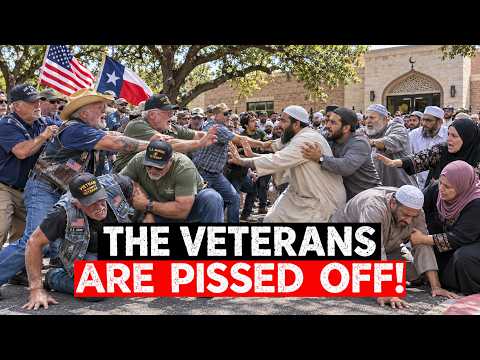
Islamists NEVER Expected American Veterans To RECLAIM Texas!
TL;DR
Following Texas Governor Greg Abbott's 2025 proclamation designating CAIR and the Muslim Brotherhood as foreign terrorist organizations, a complex legal fight unfolded across Texas and Florida. While a historic 2026 political shift in Texas brought in a Democratic governor who promised to rescind Abbott's executive order, Florida successfully enacted robust legislation that led to the shutdown of CAIR's Florida operations. Post-9/11 military veterans are actively advocating for permanent legislative measures in Texas to institutionalize these anti-terror network restrictions.
Key takeaways
- 0:27Texas became the first state to label CAIR a terrorist organization via executive proclamation, restricting its land acquisition rights
- 27:56Unlike executive orders, Florida's legislative approach (HB 1471) created enforceable criminal penalties for material support that survived federal court challenges
- 8:58Post-9/11 military veterans view 'Attack the Network' legal tactics as essential for countering political Islam's institutional influence
- Executive designations remain vulnerable to gubernatorial transitions unless codified into state statute
Tap to enlarge
Most valuable section
For whom
Legal analysts, state policy researchers, and citizens interested in counter-terrorism policy and First Amendment litigation
Florida's Legislative Approach and Court Upheld Ban27:36
This section explains the contrast between executive orders and legislative statutes, detailing how Florida successfully defended its statutory ban in federal court to halt CAIR operations.
Detailed summary
1. Abbott's Designation of CAIR in Texas
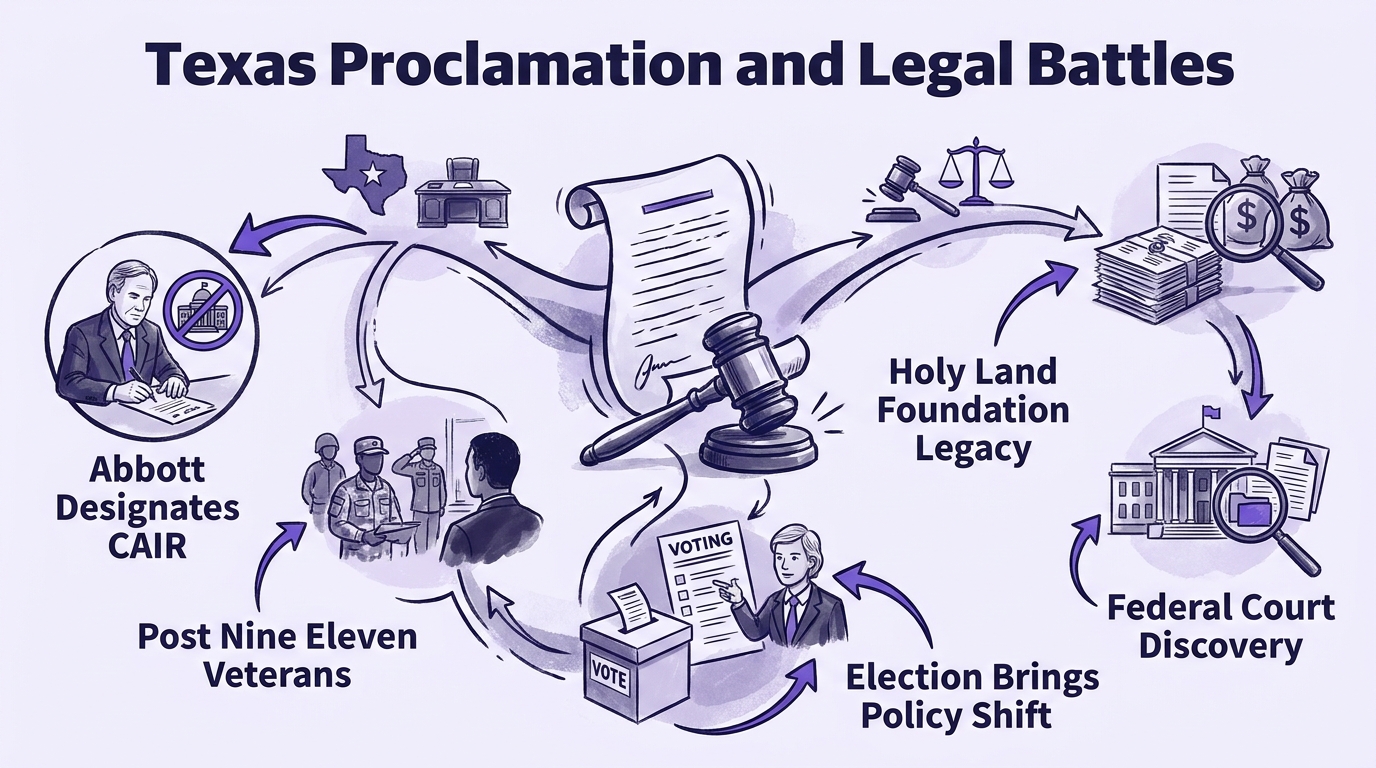
0:00In November 2025, Texas Governor Greg Abbott issued a proclamation declaring the Council on American-Islamic Relations (CAIR) and the Muslim Brotherhood foreign terrorist organizations under state law. This action prohibited both groups from acquiring land in Texas and cited past convictions of individuals associated with CAIR for terror-financing offenses.
Following the declaration, Abbott instructed the Texas Department of Public Safety to initiate criminal investigations alongside FBI task forces. CAIR responded immediately by filing a federal defamation lawsuit against Abbott, asserting the designation was unconstitutional and founded on false statements.
2. Post-9/11 Veterans and the Fort Hood Context
3:22The transcript highlights the perspective of Texas's large post-9/11 veteran population, many of whom felt early federal responses to radical ideology were inadequate. Veterans pointed to President George W. Bush's 2001 statement that 'Islam is peace'—delivered alongside CAIR co-founder Nihad Awad—as a policy line that stifled necessary scrutiny of political groups.
This sentiment was reinforced following the 2009 Fort Hood shooting carried out by Major Nidal Hasan. Veterans criticized the Department of Defense's initial classification of the attack as 'workplace violence,' arguing it demonstrated a pattern of prioritizing political narrative over soldier safety.
3. State Lawsuits and the Holy Land Foundation Legacy
6:52Following Texas's move, Florida Governor Ron DeSantis issued an executive order against CAIR, and federal agencies designated several international branches of the Muslim Brotherhood. Texas Attorney General Ken Paxton subsequently filed a lawsuit in Collin County seeking to permanently bar CAIR and the Muslim Brotherhood from operating within the state.
Paxton's lawsuit relied on evidence from the 2008 Holy Land Foundation trial in Dallas, where charity leaders were convicted of funneling millions to Hamas. Although CAIR was named an unindicted co-conspirator rather than a criminal defendant in that case, state officials argued the historical ties justified full legal proscription.
4. Federal Court Developments and Pre-Trial Discovery
11:43While CAIR initially won an injunction against DeSantis's executive order in Florida on First Amendment grounds, Florida lawmakers began drafting statutory legislation to replace the order. Meanwhile, a federal judge in Austin handed Texas a procedural victory by ordering CAIR to produce unredacted records regarding major foreign donors and international travel by leadership.
The discovery order required CAIR to disclose details regarding travel to regions like Gaza, Egypt, and Iran. State attorneys cited historical FBI wiretaps and internal strategy documents from the early 1990s to justify probing the organization's funding and leadership network.
5. Perspectives from Reformers and Public Officials
16:46The narrative covers insights from Dr. Zuhdi Jasser, a Navy veteran and founder of the American Islamic Forum for Democracy, who has consistently challenged political Islam and criticized CAIR's influence in the US. Jasser defended lawmakers who formed congressional caucuses to scrutinize radical ideology, arguing that labeling such oversight as anti-Muslim amounts to enforcing blasphemy rules.
Additionally, federal officials like Senator Ted Cruz pushed for federal terrorist designations during Senate committee hearings. FBI representatives acknowledged maintaining a policy that excludes CAIR as an official community liaison partner due to legacy financing concerns.
6. The 2026 Texas Election and Legal Reversals
20:54The political landscape shifted dramatically during the November 2026 Texas elections when Democrat Gina Hinojosa won the governorship, alongside Democratic victories in executive offices and the state House. Exit polls indicated a sharp divide, with non-veterans supporting the political shift while military veterans voted predominantly for the conservative platform.
Following her election, Hinojosa pledged to rescind Abbott's executive designation against CAIR. Shortly thereafter, the Texas Attorney General's office filed a nonsuit in Collin County, dropping its state lawsuit against CAIR without prejudice before the incoming administration took office.
7. Florida's Statutory Framework (HB 1471)
27:36In contrast to executive proclamations, Florida passed House Bill 1471, creating a formal statutory procedure for designating domestic terrorist entities. Signed by Governor Ron DeSantis alongside veteran lawmakers, the statute made providing material support—including office space, advice, or transportation—to designated groups a first-degree felony.
Unlike executive orders, the legislative act provided structured administrative notices and explicit legal standards designed to withstand judicial review. State leadership promptly recommended CAIR and its local chapters for formal inclusion under the new law.
8. Judicial Rulings and CAIR Operations Suspended
30:40In late 2026, Florida's executive cabinet officially designated the Muslim Brotherhood and CAIR under HB 1471. CAIR filed suit in federal court to block the designation, warning that the label would force the immediate shutdown of its regional operations.
Chief U.S. District Judge Allen Winsor refused to issue an injunction, ruling that the novel statute did not violate constitutional protections. Consequently, CAIR-Florida posted an official notice on its headquarters door suspending all operations in the state, while veteran groups in Texas began organizing campaigns to pass similar statutory laws.
Questions this video answers
Why did Governor Greg Abbott label CAIR a terrorist organization in Texas?
Governor Abbott issued a proclamation in November 2025 citing CAIR's alleged ties to the Muslim Brotherhood and historical connections to the 2008 Holy Land Foundation trial in Dallas. He asserted that the group's goal was to promote Sharia law and highlighted past board members convicted of terror-related offenses. The order barred the organization from purchasing land and initiated state crimina
How did Florida successfully force CAIR to shut down operations while Texas struggled?
Florida passed House Bill 1471, establishing a formal legislative process to designate domestic terrorist organizations and making 'material support' a first-degree felony. When federal judges upheld the statute against First Amendment challenges, the threat of criminal prosecution forced CAIR-Florida to officially suspend its operations.
What role did post-9/11 military veterans play in this political movement?
Veterans strongly backed Abbott's and DeSantis's actions, viewing the counter-CAIR efforts through the military framework of 'Attack the Network'—targeting administrative, financial, and political support structures. Outraged by early government rhetoric after incidents like the 2009 Fort Hood shooting, veteran groups are organizing to push for statutory bans through future legislative elections.
Ask a follow-up Premium
About this summary
SumTube AI wrote this recap from the video's words and chapters. Credit and the original belong to Allied Nations.