
Free AI summary of this YouTube video by SumTube
FISIKA KELAS X - HUKUM GERAK NEWTON (PART 1) || Hukum I, II, III Newton dan Macam-macam Gaya
TL;DR
This educational video introduces Grade 10 Physics students to Newton's Laws of Motion and the various types of forces in classical mechanics. It covers the definitions, mathematical formulas, and directional behaviors of weight, normal force, tension, and friction. Finally, it demonstrates how to draw free-body diagrams and solve a practical physics problem involving a stationary block.

Key takeaways
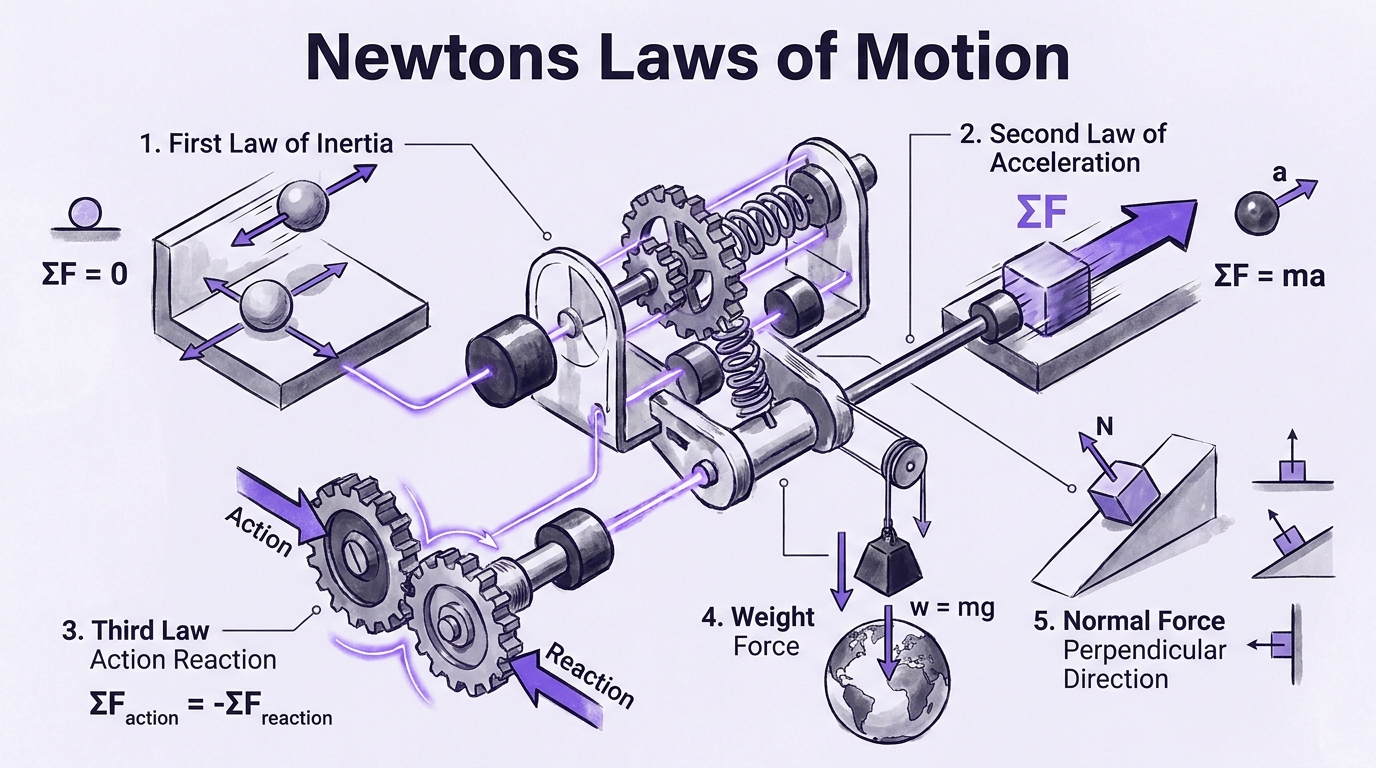
- 2:21Newton's First Law describes inertia (ΣF = 0), the Second Law links force to acceleration (ΣF = ma), and the Third Law governs action-reaction pairs
- 7:21Normal force is always perpendicular to the surface of contact, while weight always points downward toward Earth's gravitational center
- 13:42Frictional force opposes motion, with static friction applying before movement occurs and kinetic friction applying during motion
Tap to enlarge
Most valuable section
For whom
High school physics students needing a clear conceptual overview and step-by-step problem-solving guide for Newton's Laws
Sample Problem & Solution22:20
It walks through an actual numerical example, demonstrating how to apply Newton's First Law and frictional force equations step by step.
Detailed summary
1. Introduction & Topic Overview
0:00The instructor welcomes viewers to Part 1 of the Grade 10 Physics series on Newton's Laws of Motion. An outline of the main themes is presented, dividing the material into Newton's three laws, various types of forces, and their practical applications.
The lesson previews specific force types like weight, normal force, tension, and friction. It also notes upcoming application contexts such as flat planes, inclined surfaces, pulley systems, and elevators.
2. Newton's First Law of Motion
2:21This section explains Newton's First Law, also known as the Law of Inertia. It states that an object will remain at rest or continue moving in a straight line at constant velocity unless acted upon by an external net force.
The mathematical representation is introduced as ΣF = 0. This equilibrium condition forms the basis for analyzing stationary systems and uniform linear motion.
3. Newton's Second Law of Motion
2:26The presentation covers Newton's Second Law, which describes the relationship between net force, mass, and acceleration. Acceleration is directly proportional to the net force applied and inversely proportional to the mass of the object.
The formula is given as ΣF = ma (or a = ΣF / m). The video defines each variable and its SI units: acceleration in m/s², net force in Newtons (N), and mass in kilograms (kg).
4. Newton's Third Law of Motion
3:35Newton's Third Law of Motion governs action and reaction forces. It specifies that for every action force exerted on a body, there is an equal and opposite reaction force exerted back by that body.
Mathematically, this is expressed as ΣF_action = -ΣF_reaction. The negative sign indicates that while the magnitudes of the forces are identical, their directions are opposite.
5. Weight Force (w)
7:21The concept of weight force is defined as Earth's gravitational pull on a mass m directed toward the planet's center. Visual examples demonstrate that weight always acts vertically downward regardless of whether the object rests on a flat, inclined, or vertical surface.
The formula w = mg is established. Here, w represents weight in Newtons, m is mass in kilograms, and g is the acceleration due to gravity in m/s².
6. Normal Force (N)
8:53Normal force is defined as the contact force exerted by a surface on an object pressing against it. Unlike weight, normal force does not have a fixed universal formula; its magnitude depends on the object's orientation and external applied forces.
Diagrams show that the direction of normal force is always perpendicular to the contact surface, pointing away from the plane whether the surface is horizontal, tilted, or vertical.
7. Tension Force (T)
10:45Tension force is introduced as the pulling force transmitted along a string, rope, or cable when pulled by an external load. Like normal force, tension lacks a single static formula and depends on the physical setup of the system.
The video illustrates connected block systems, showing that tension vectors always pull away from the body being analyzed along the direction of the string.
8. Frictional Force (f)
13:36Frictional force arises from the contact and microscopic roughness between two surfaces. Its direction always opposes the motion or attempted motion of the object across the surface.
Friction is categorized into static friction (f_s = μ_s * N) for stationary objects on the verge of movement and kinetic friction (f_k = μ_k * N) for objects already in motion, where μ represents the coefficient of friction.
9. Drawing Free-Body Diagrams
16:39This section demonstrates how to combine individual force vectors into free-body diagrams across four representative scenario models: flat surfaces, inclined planes, vertical surfaces, and connected multi-block pulley systems.
Step-by-step illustrations show how to correctly align weight, normal force, friction, and tension vectors according to physical surface angles and motion dynamics.
10. Sample Problem & Solution
22:20A practical example problem is solved step-by-step: a 20 kg block resting on a rough horizontal floor with a static friction coefficient of 0.2. The video calculates weight (w = 200 N), normal force (N = 200 N via ΣF = 0), and maximum static friction (f_s = 40 N).
The teacher concludes the lesson by encouraging viewers to practice drawing force diagrams and apply these formulas to solidify their understanding.
Questions this video answers
What is the key difference between static friction and kinetic friction?
Static friction acts on an object when it is at rest or just on the verge of moving, maintaining its stationary position. Kinetic friction comes into play once the object is actively sliding across a surface. Static friction generally has a higher maximum threshold than kinetic friction.
Does the normal force always equal the weight of an object?
No, the normal force does not always equal weight. Its magnitude depends on the orientation of the surface and any additional applied vertical forces; for instance, on an inclined plane or when pushing vertically against a wall, normal force and weight differ.
Why does Newton's Third Law formula include a negative sign?
The formula ΣF_action = -ΣF_reaction includes a negative sign because action and reaction forces are equal in magnitude but opposite in direction. The negative sign mathematically represents this opposing direction.
Ask a follow-up Premium
About this summary
SumTube AI wrote this recap from the video's words and chapters. Credit and the original belong to Yusuf Ahmada.