
Free AI summary of this YouTube video by SumTube
Data Pribadimu Dijual Dan Mungkin Kamu Sudah Setuju | Donny Budhi Utoyo - PORTAL SEASON 3
TL;DR
This episode of the PORTAL podcast features digital literacy expert Donny B.U. discussing personal data protection, digital footprints, and privacy risks. The discussion covers the distinction between active and passive digital footprints, biometric security risks, dark patterns in app design, and user rights under Indonesia's Personal Data Protection (UU PDP) law.

Key takeaways
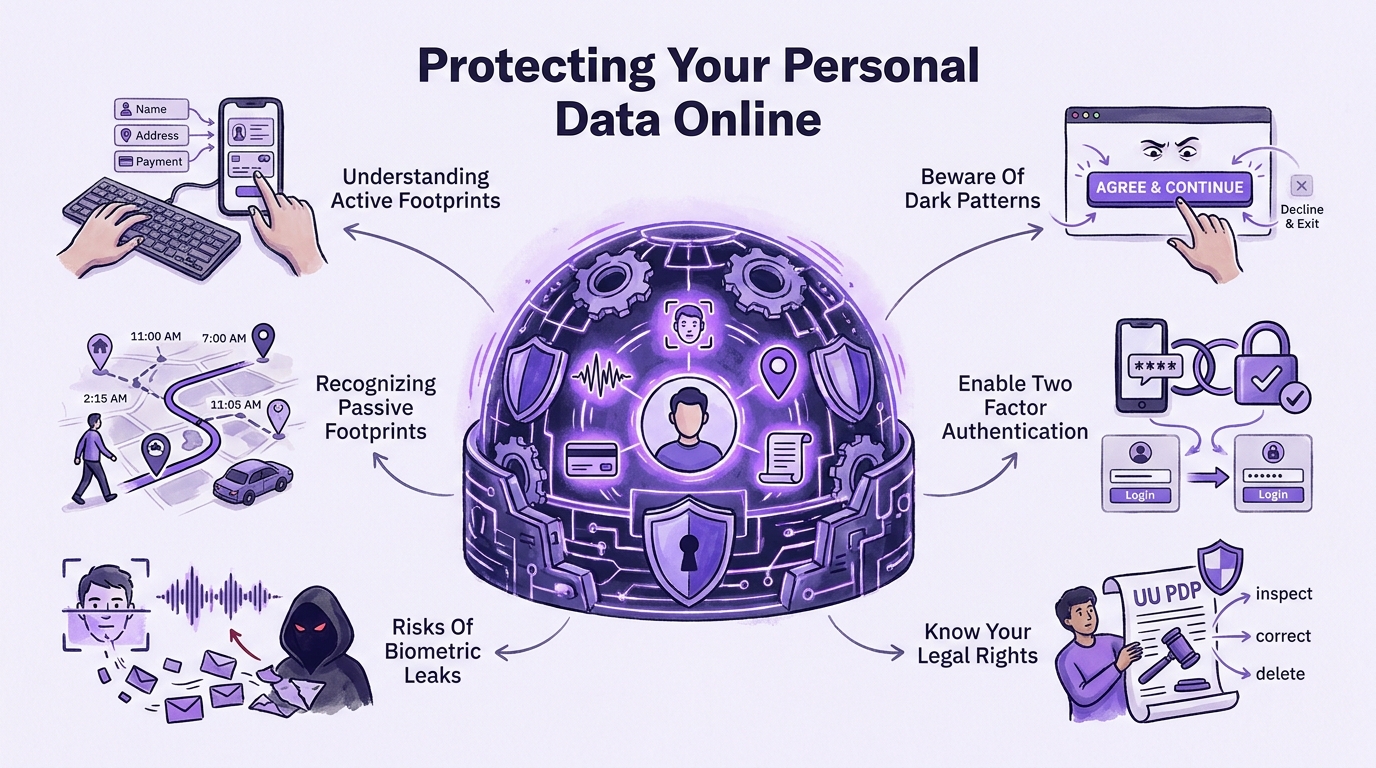
- 13:18Personal data extends beyond NIK numbers to include biometric data (face/voice) and passive behavioral tracking online
- 52:14Digital platforms use 'dark patterns' to manipulate users into consenting to data collection without reading terms
- 40:08Enabling two-factor authentication (2FA) is the most critical first step to securing personal accounts
- 44:21Users have explicit legal rights under UU PDP to question, inspect, and request the deletion of their collected personal data
Tap to enlarge
Most valuable section
For whom
Anyone concerned about online privacy, identity theft, or understanding how mobile apps monetize personal data
Dark Patterns and Manipulative App Design52:14
It explains the psychological tricks apps use to trick users into handing over privacy permissions.
Detailed summary
1. Introduction to Digital Literacy and Data Privacy
0:00Host MC Ammho opens the PORTAL podcast episode, welcoming expert speaker Donny B.U. to discuss personal data protection. The host emphasizes how everyday digital activities—from ordering ride-hailing services to scrolling social media—leave continuous digital trails that can reveal sensitive financial and behavioral details.
Donny B.U. is introduced as a digital literacy activist focusing on cybersecurity and internet governance in Indonesia. The conversation sets the stage for examining how personal data is collected, often with passive user consent, across various digital services.
2. Public Perceptions on Data Security
4:45A street interview segment gathers perspectives from regular citizens regarding personal data security. Interviewees share their experiences with app installations, targeted advertisements after discussing topics offline, and receiving unsolicited spam calls or illegal loan offers.
Most participants admit to skipping terms and conditions when installing new applications, opting to scroll directly to the 'agree' button. While some assume well-known brands keep data safe, others recognize that complete data privacy on the internet is nearly impossible.
3. Defining Personal Data Beyond NIK and Passwords
10:55The discussion breaks down common misconceptions about personal data, clarifying that it encompasses much more than national identity numbers (NIK) or account passwords. Donny highlights biometric data, such as facial recognition used at train gates or passport checkpoints, as highly sensitive personal data points.
If biometric databases are breached, the consequences are far more severe than traditional password leaks because facial and voice data cannot be changed. This data can be exploited using AI cloning techniques to orchestrate sophisticated fraud schemes.
4. Active vs. Passive Digital Footprints
18:05Donny categorizes digital footprints into active and passive types. Active footprints consist of conscious data entries, such as typing names, addresses, and credit card details during online transactions. Passive footprints occur without immediate user awareness, tracking location history, browsing preferences, and app usage patterns.
He illustrates passive tracking using navigation apps, showing how continuous background location recording can map an individual's minute-by-minute routines over several years unless location history is intentionally managed or disabled.
5. Where Does Collected Personal Data Go?
20:00The conversation addresses the physical and digital collection points of personal data, ranging from office visitor logs to social media platforms. Donny raises critical questions about whether third parties actually delete stored ID photos or visitor logs after their administrative need expires.
He points out that multiple minor data leaks across different services can be aggregated by malicious actors. When combined, these fragmented leaks build a comprehensive profile of an individual's private life and habits.
6. Monetization of Data and Targeted Advertising
27:12Exploring the popular adage 'If the product is free, you are the product,' Donny explains how digital platforms monetize user data through algorithmic micro-targeting. Platforms collect behavioral data to sell highly targeted ad space to advertisers, creating an efficient revenue model at the expense of user privacy.
Beyond commercial advertising, micro-targeting has been weaponized politically, as seen in cases like Cambridge Analytica. Algorithms analyze online sentiment and behavior to deliver persuasive content designed to sway political opinions and societal decisions.
7. Privacy Fatigue and Vulnerable Groups
31:55The discussion touches on 'privacy fatigue'—a state of exhaustion where users give up on protecting their data because the process feels overly complex or tedious. This mindset leaves individuals vulnerable to financial scams, identity theft, and unwanted solicitations.
Donny highlights that elderly individuals and children are the most vulnerable demographics. Elderly citizens are frequently targeted by romance scams and phishing, while children often lack the digital literacy required to navigate online risks safely.
8. First Steps to Secure Accounts: 2FA and Passwords
40:08Donny outlines practical steps for individuals to safeguard their digital identity after experiencing data leaks. He emphasizes creating strong passwords using a combination of uppercase letters, lowercase letters, numbers, and special symbols that are easy for the user to remember but difficult for others to guess.
He strongly recommends enabling Two-Factor Authentication (2FA) across all critical accounts, including messaging apps like WhatsApp. A brief tutorial video demonstrates how to activate 2FA on WhatsApp to prevent account hijacking.
9. Legal Rights Under Indonesia's PDP Law
44:21Donny explains key legal protections established by Indonesia's Personal Data Protection Law (UU PDP). Under this law, data controllers are legally obligated to inform users about how their data is collected, the purpose of collection, retention periods, and deletion procedures.
Users hold explicit rights to inspect, correct, and request the deletion of their personal data from both public and private entities. Organizations that collect personal information are legally accountable for maintaining appropriate cybersecurity standards.
10. Dark Patterns and Manipulative App Design
52:14The session covers 'dark patterns'—user interface designs intentionally built to trick users into making decisions that benefit the platform rather than the user. Examples include making cancellation buttons hidden or requiring multiple confirmation prompts when trying to opt out of data tracking.
These manipulative design choices exploit psychological tendencies, forcing users into default 'yes' options out of frustration or haste. Donny urges users to remain vigilant and recognize these design traps when using digital services.
11. Regulatory Frameworks: UU ITE, PP PSE, and PP TUNAS
55:17The guest outlines the broader legal framework governing digital spaces in Indonesia, including the ITE Law, PP PSE (Electronic System Providers regulation), and the upcoming PP TUNAS focused on child protection online. PP TUNAS requires digital platforms to adapt their interfaces and content delivery based on the user's age category.
Donny highlights the necessity of government oversight to ensure foreign and domestic digital platforms comply with national data security standards, protecting vulnerable groups from exposure to inappropriate content and data exploitation.
12. Conclusion and Practical Privacy Mindset
1:00:19In closing, Donny compares personal data to 'half of one's breath,' emphasizing that once data is published online, it is nearly impossible to completely retract. He cautions against treating personal information as disposable objects like building blocks that can easily be detached.
Host MC Ammho summarizes the key points, encouraging viewers to adopt a proactive digital security mindset, use privacy settings, and stay informed through digital literacy initiatives.
Questions this video answers
What is the difference between active and passive digital footprints?
Active digital footprints consist of data intentionally submitted by users, such as registration details, online purchases, and social media posts. Passive digital footprints are collected automatically without explicit user intervention, including location history via GPS, browsing habits, and music streaming activity.
How do digital platforms use dark patterns to collect user data?
Dark patterns are user interface designs structured to guide users toward giving consent without realizing it. Platforms achieve this by hiding 'decline' options behind multi-step processes or making terms and conditions excessively long so users scroll past and click 'agree'.
What rights do individuals have regarding their personal data under Indonesia's UU PDP?
Under UU PDP, data subjects have the right to know why their data is being collected, how long it will be stored, and who has access to it. Individuals can also request data correction or request that their data be completely deleted once its intended purpose is complete.
Ask a follow-up Premium
About this summary
SumTube AI wrote this recap from the video's words and chapters. Credit and the original belong to Literasi Digital Komdigi.