
Free AI summary of this YouTube video by SumTube
Crash Course Modern History | British East India Company from 1600 - 1857
TL;DR
This video provides a chronological overview of the East India Company's presence and expansion in India from 1600 to 1857. It traces how a trading enterprise transformed into a dominant political and military force through strategic alliances, military conflicts, and administrative reforms. The narrative concludes with the Indian Revolt of 1857, which led to the dissolution of the East India Company and the formal transfer of power to the British Crown.

Key takeaways
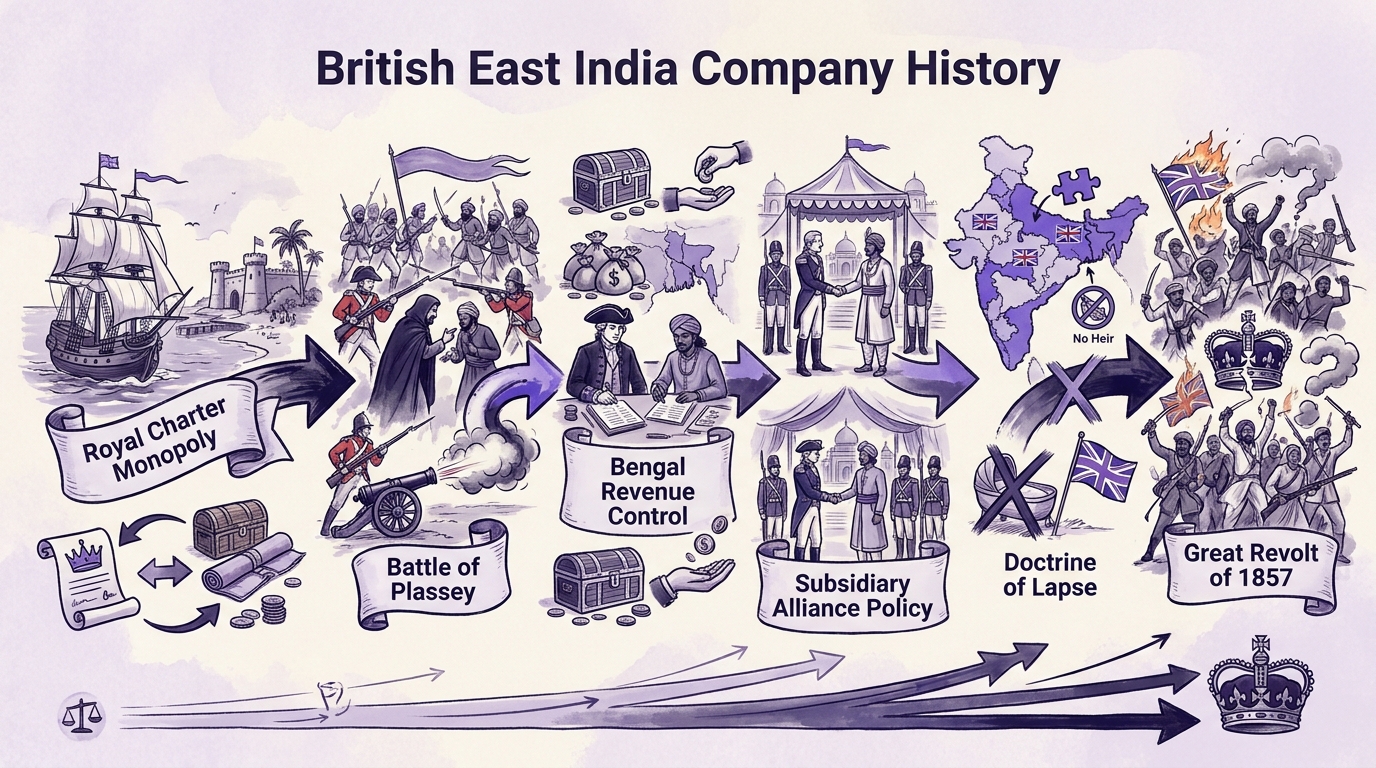
- 2:11The British East India Company shifted from pure commerce to political domination by exploiting regional rivalries after the decline of the Mughal Empire
- 14:50Key battles like Plassey (1757) and Buxar (1764) established the Company's military supremacy and revenue control over Bengal
- 37:18Policies like the Subsidiary Alliance and Doctrine of Lapse allowed the British to annex major princely states without full-scale invasion
- 43:23Widespread resentment against British administrative and economic exploitation culminated in the 1857 Revolt, ending Company rule
Tap to enlarge
Most valuable section
For whom
Students and history enthusiasts looking for a clear, chronological breakdown of British colonial expansion in India.
The Battle of Plassey & Company Monopoly14:50
This segment clearly illustrates the turning point where the East India Company shifted from commercial trading to actively manipulating Indian politics and establishing political dominance.
Detailed summary
1. Introduction & Historical Context
0:00The video opens with an introduction to the timeline of Indian history, categorizing it into Ancient, Medieval, and Modern periods. To understand modern Indian history, one must look at the decline of the Mughal Empire during the medieval period, specifically after the death of Emperor Aurangzeb in 1707.
Following Aurangzeb's death, local governors (Subahdars) and large landlords (Zamindars) sought autonomy, leading to the fragmentation of central authority. Meanwhile, European maritime explorers like Vasco da Gama had already opened sea routes to India long before the British arrived, setting the stage for international trade rivalry.
2. Arrival of European Traders
2:21Multiple European powers established trading posts in different coastal regions of India during the 16th and 17th centuries. The Portuguese arrived first in Calicut (1498), followed by the Dutch in Pulicat (1595), the English in Surat (1608), the Danish in Tranquebar (1616), and the French in Pondicherry (1664).
Because the Portuguese had a head start of nearly a century, they maintained a broader network of trade posts initially. However, competition quickly escalated as all these European powers sought the same high-demand goods, leading to commercial friction.
3. The English Monopoly & European Rivalry
3:28In 1600, Queen Elizabeth I granted a royal charter to the English East India Company, granting it a sole monopoly on English trade with the East. This meant no other English company could compete, but it did not prevent competition from other European nations already operating in India.
All European trading entities focused on purchasing Indian cotton, silk, and valuable spices like pepper, cloves, and cinnamon to sell in Europe at high margins. As demand grew, Indian merchants raised prices, reducing profit margins and prompting European traders to attack rival ships, block trade routes, and fortify their settlements.
4. Establishment in Bengal & Early Conflicts
6:21The English established their first factory on the banks of the Hugli River in 1651, expanding it into a fortified settlement by 1696. Through bribes and political pressure, they secured Zamindari rights over three villages, including Kalikata (modern Kolkata), and persuaded Emperor Aurangzeb to issue a royal decree (farman) granting duty-free trade rights.
However, Company officials abused this privilege by engaging in private, untaxed personal trade. This resulted in massive revenue losses for the Bengal government, creating deep animosity between the local Nawabs—starting with Murshid Quli Khan—and the East India Company.
5. Escalation under Nawabs of Bengal
9:22Following Aurangzeb's death, successive Nawabs of Bengal—Murshid Quli Khan, Alivardi Khan, and Siraj ud-Daulah—demanded that the Company pay taxes, stop unauthorized fortification, and respect local governance. The Company refused, arguing that local duties were destroying its commercial profitability.
This standoff worsened under Siraj ud-Daulah, who took decisive action in 1756 by capturing Fort William in Calcutta and detaining British officers. This military action prompted a swift counter-offensive from the British military command in Madras.
6. The Battle of Plassey (1757)
14:50In response to the capture of Fort William, Robert Clive led British forces from Madras to Bengal. Instead of relying solely on military power, Clive conspired with Mir Jafar, Siraj ud-Daulah's military commander, promising to make him Nawab in exchange for betrayal.
During the Battle of Plassey in 1757, Mir Jafar withdrew a large portion of the Nawab's army, securing an easy victory for the British. Siraj ud-Daulah fled but was captured and executed, marking the East India Company's first major political victory in India and making Clive the Governor of Bengal.
7. Battle of Buxar & Diwani Rights
17:02Mir Jafar proved to be an ineffective puppet, leading the British to replace him with his son-in-law, Mir Qasim, in 1760. When Mir Qasim also resisted British interference, the conflict culminated in the Battle of Buxar (1764), where British forces under Hector Munro defeated the joint armies of Mir Qasim, Shuja-ud-Daula of Awadh, and Mughal Emperor Shah Alam II.
In 1765, Shah Alam II formally granted the 'Diwani' (right to collect revenue) of Bengal, Bihar, and Orissa to the Company. This allowed the British to finance their trade and military operations directly using Indian tax revenues rather than importing silver from Britain.
8. Administrative Changes & The Regulating Act
19:58To centralize control and curbing rampant corruption among Company servants, the British Parliament passed the Regulating Act of 1773. This created the position of Governor-General of India, appointing Warren Hastings as the first official to hold the title.
Hastings introduced judicial reforms in 1772, dividing regions into districts managed by British Collectors and creating civil and criminal courts. Additionally, a Supreme Court was established at Fort William in Calcutta in 1773 to oversee judicial matters.
9. The Anglo-Mysore Wars
30:00Between 1767 and 1799, the Company fought four wars against the Kingdom of Mysore, which controlled the lucrative Malabar coast trade and maintained strong ties with the French. Hyder Ali and his son Tipu Sultan offered fierce resistance in the early conflicts.
During the Fourth Anglo-Mysore War in 1799, Lord Wellesley coordinated a joint attack with the Marathas and the Nizam of Hyderabad. Tipu Sultan was killed defending his capital, Seringapatam, allowing the Company to place Mysore under a submissive dynasty.
10. The Anglo-Maratha Wars
33:37The Maratha Empire was a powerful confederacy that posed a significant barrier to British hegemony. Over three Anglo-Maratha Wars (1775–1818), the Company systematically weakened and dismantled Maratha power using military force and internal diplomacy.
The Third Anglo-Maratha War (1817–1818) decisively crushed the Maratha Empire. The Peshwa was deposed and exiled, placing vast territories across central and western India under direct or indirect British control.
11. Expansionist Policies: Subsidiary Alliance & Doctrine of Lapse
37:18Lord Wellesley implemented the Subsidiary Alliance system, which required Indian rulers to accept British troops, pay for their maintenance, and surrender foreign policy control. Failure to pay resulted in immediate territorial annexation.
Later, Lord Dalhousie introduced the Doctrine of Lapse (1848–1856), stating that any princely state whose ruler died without a natural male heir would automatically be annexed. Under this policy, major states like Satara, Sambalpur, Udaipur, Nagpur, Jhansi, and eventually Awadh were brought under direct British rule.
12. The 1857 Revolt & Transfer of Power
42:42Accumulated anger over territorial annexations, economic exploitation, and cultural interference erupted in the Great Revolt of 1857 (the Sepoy Mutiny). Though the British managed to suppress the uprising, it exposed the unsustainable nature of Company rule.
In response, the British Parliament passed the Government of India Act 1858, formally dissolving the East India Company. Control over India was transferred directly to Queen Victoria and the British Crown, initiating the era of the British Raj.
Questions this video answers
How did the East India Company transition from trade to rule in India?
Initially arriving purely as a commercial entity, the Company capitalized on the political instability following Mughal Emperor Aurangzeb's death in 1707. By fortifying trading posts, interfering in succession disputes, and defeating local rulers in key military engagements, they secured territorial control and the right to collect tax revenue.
What was the significance of the Battle of Plassey in 1757?
The Battle of Plassey marked the Company's first major military victory in India, orchestrated by Robert Clive through a political pact with Mir Jafar. Defeating Siraj ud-Daulah allowed the Company to install puppet rulers in Bengal, vastly boosting its political influence and financial power.
What were the Subsidiary Alliance and the Doctrine of Lapse?
These were British expansionist policies used to annex Indian states. The Subsidiary Alliance forced local rulers to disband their armies and pay for British troop protection, while the Doctrine of Lapse allowed the British to annex any princely state where the ruler died without a direct male heir.
Why did the British Crown take over India in 1858?
The Great Revolt of 1857 revealed severe flaws and corruption in the East India Company's governance, which sparked widespread rebellion. Consequently, the British Parliament passed the Government of India Act 1858 to dissolve the Company and place India under direct British Crown administration.
Ask a follow-up Premium
About this summary
SumTube AI wrote this recap from the video's words and chapters. Credit and the original belong to Amit Sengupta.