
Free AI summary of this YouTube video by SumTube
Biologi Kelas 10: Bakteri, Pengertian Archaebacteria, Eubacteria, dan Bakteri
TL;DR
This educational video explains the characteristics, habitats, and differences between Archaebacteria and Eubacteria (bacteria), two primary branches of prokaryotic life. It covers their evolutionary history, structural features such as cell walls and membranes, and their roles in various environments and human life. Additionally, a detailed comparison table highlights key molecular and chemical distinctions between these two domains of life.

Key takeaways
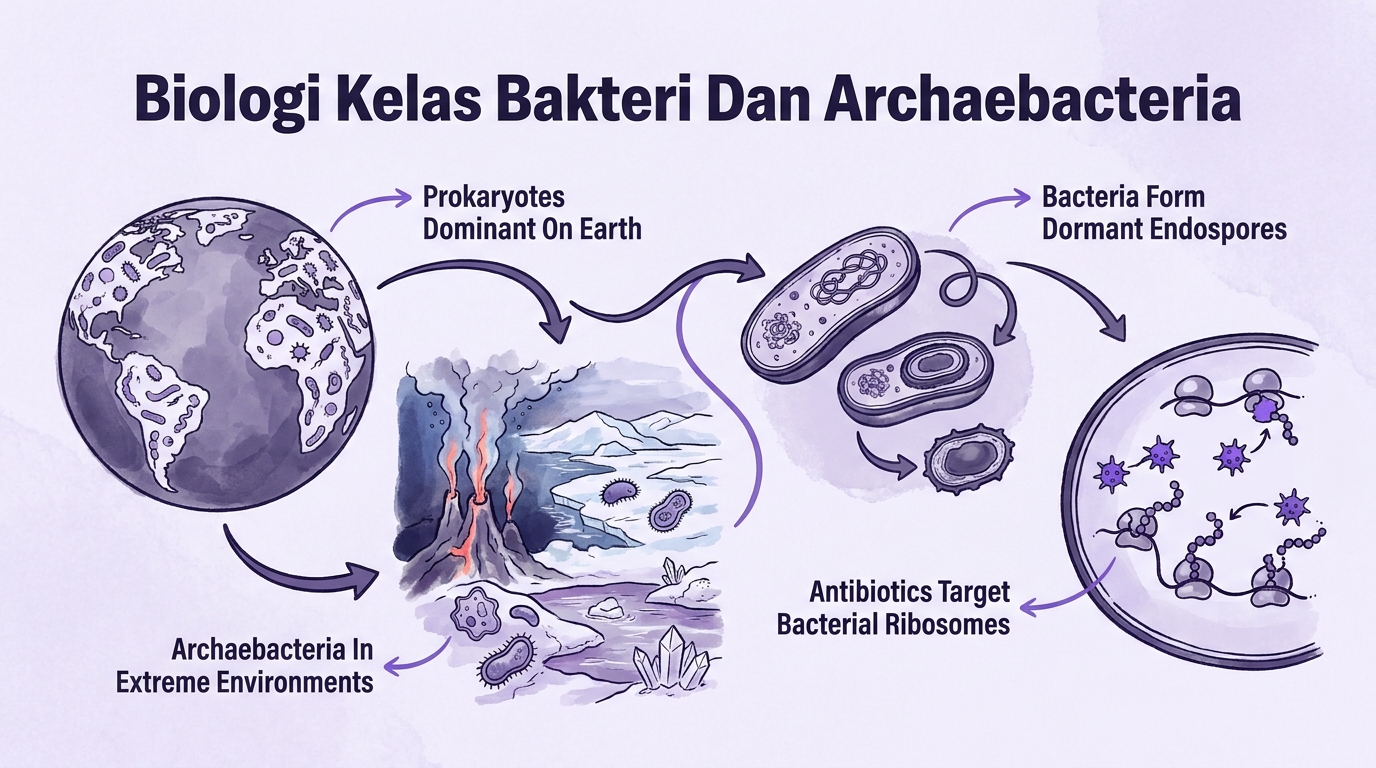
- 0:34Prokaryotes are unicellular organisms lacking a membrane-bound nucleus and represent the majority of life forms dominating Earth
- 4:06Archaebacteria thrive in extreme environments resembling early Earth, such as hydrothermal vents, hypersaline waters, and highly acidic pools
- 13:58Bacteria can form endospores to survive unfavorable environmental conditions through sporulation and germinate back into active vegetative cells when conditions improve
- 17:38Differences in ribosomal structure make true bacteria susceptible to antibiotics like streptomycin and chloramphenicol, while Archaebacteria remain resistant
Tap to enlarge
Most valuable section
For whom
Biology students, educators, and science enthusiasts seeking a clear visual overview of prokaryotic classification and microbiology basics
Differences between Archaebacteria and Eubacteria10:09
It breaks down the chemical, genetic, and physiological differences between the two domains into a clear visual table and explains why certain antibiotics affect bacteria but not archaea.
Detailed summary
1. Introduction to Prokaryotes
0:00Although humans inhabit all corners of the globe, prokaryotes are actually the most dominant living organisms on Earth. Prokaryotes are single-celled organisms that lack a membrane-bound nucleus. Because of their simple cellular organization and rapid reproduction, their total population far exceeds that of human beings.
Researchers believe prokaryotes were the first living organisms to exist on Earth. They are capable of surviving across an incredible diversity of habitats, including extreme heat, cold, salinity, and high acidity. Evolutionary trees show that prokaryotes diverged into two main evolutionary branches: Archaebacteria and Eubacteria.
2. Characteristics and Types of Archaebacteria
3:36The term Archaebacteria originates from the Greek word 'archaio', meaning ancient, reflecting the belief that these are among the oldest cell lineages on Earth. Evolutionary analysis indicates that Archaebacteria are genetically closer to eukaryotes than to true bacteria. Most species live in extreme conditions that mirror Earth's early environments, such as hot springs, volcanic craters, salt lakes, and peat bogs.
Key characteristics of Archaebacteria include being unicellular prokaryotes without a nuclear membrane, possessing cell walls made of pseudopeptidoglycan rather than true peptidoglycan, and having membrane lipids composed of monolayer structures. They are categorized into hyperthermophiles (thriving above 80°C), extreme halophiles (requiring high salt concentration up to 32%), and thermoacidophiles (flourishing in high heat and extreme acidity down to pH 0).
3. Introduction to Eubacteria and History of Discovery
8:32Eubacteria, commonly known simply as bacteria, derives from the Greek words 'eu' (true) and 'bakterion' (small rod). While both Archaebacteria and Eubacteria are structurally classified as prokaryotes due to their lack of a nuclear membrane, their molecular differences place them into distinct biological domains.
Bacteria were first discovered in 1676 by Dutch scientist Anton van Leeuwenhoek using a handcrafted high-power microscope. His observations were published by the Royal Society of London in 1684. Later in 1828, the term 'bacteria' was introduced by Christian Gottfried Ehrenberg, giving rise to the formal field of bacteriology.
4. Characteristics and Survival Mechanisms of Bacteria
11:54Bacteria are microscopic organisms measuring 0.5 to 5 micrometers in diameter and 0.5 to 20 micrometers in length. They feature cell walls made of peptidoglycan composed of N-acetylglucosamine and N-acetylmuramic acid cross-linked by peptide bonds. Many bacteria possess protective capsules that shield them from host immune systems, often making capsulated varieties more pathogenic, such as Escherichia coli.
Bacteria exhibit a cosmopolitan distribution, inhabiting water, soil, plants, animals, and humans. Under harsh conditions, some species form endospores through sporulation, entering a dormant state without active metabolism. When favorable conditions return, these endospores germinate back into active vegetative cells capable of normal growth and metabolism.
5. Key Differences: Archaebacteria vs. Eubacteria
16:49A detailed comparison highlights the fundamental structural and genetic differences between Archaebacteria and Eubacteria. Archaebacteria feature cell walls with pseudopeptidoglycan, branched lipid membranes, multiple RNA polymerases, and introns in several genes. In contrast, Eubacteria contain peptidoglycan cell walls, unbranched lipid membranes, a single type of RNA polymerase, and no introns.
Furthermore, Archaebacteria and Eubacteria respond differently to antibiotics like streptomycin and chloramphenicol. These antibiotics target bacterial ribosomes to inhibit protein synthesis, effectively halting bacterial growth. Because Archaebacteria possess distinct ribosomal structures, their protein synthesis remains unaffected by these antibiotics, allowing them to resist their inhibitory effects.
Questions this video answers
What are the main differences between Archaebacteria and Eubacteria?
Archaebacteria have cell walls containing pseudopeptidoglycan and branched membrane lipids, while Eubacteria contain peptidoglycan and unbranched lipids. Additionally, Archaebacteria possess multiple RNA polymerases and are resistant to antibiotics like streptomycin, whereas Eubacteria have a single RNA polymerase type and their growth is inhibited by these antibiotics.
How do bacterial endospores work?
When environmental conditions become harsh or unfavorable, certain bacteria undergo sporulation to release a dormant endospore that can survive without metabolism. Once conditions become favorable again, the endospore undergoes germination to re-emerge as a normal, metabolically active vegetative cell.
Who first discovered bacteria and how?
Dutch scientist Anton van Leeuwenhoek discovered bacteria in 1676 using a high-quality microscope he crafted himself. His findings were submitted to the Royal Society of London and published in 1684, establishing the foundation of microbiology.
Ask a follow-up Premium
About this summary
SumTube AI wrote this recap from the video's words and chapters. Credit and the original belong to Portal Sekolah.