
Free AI summary of this YouTube video by SumTube
Youthful Population Gambia
TL;DR
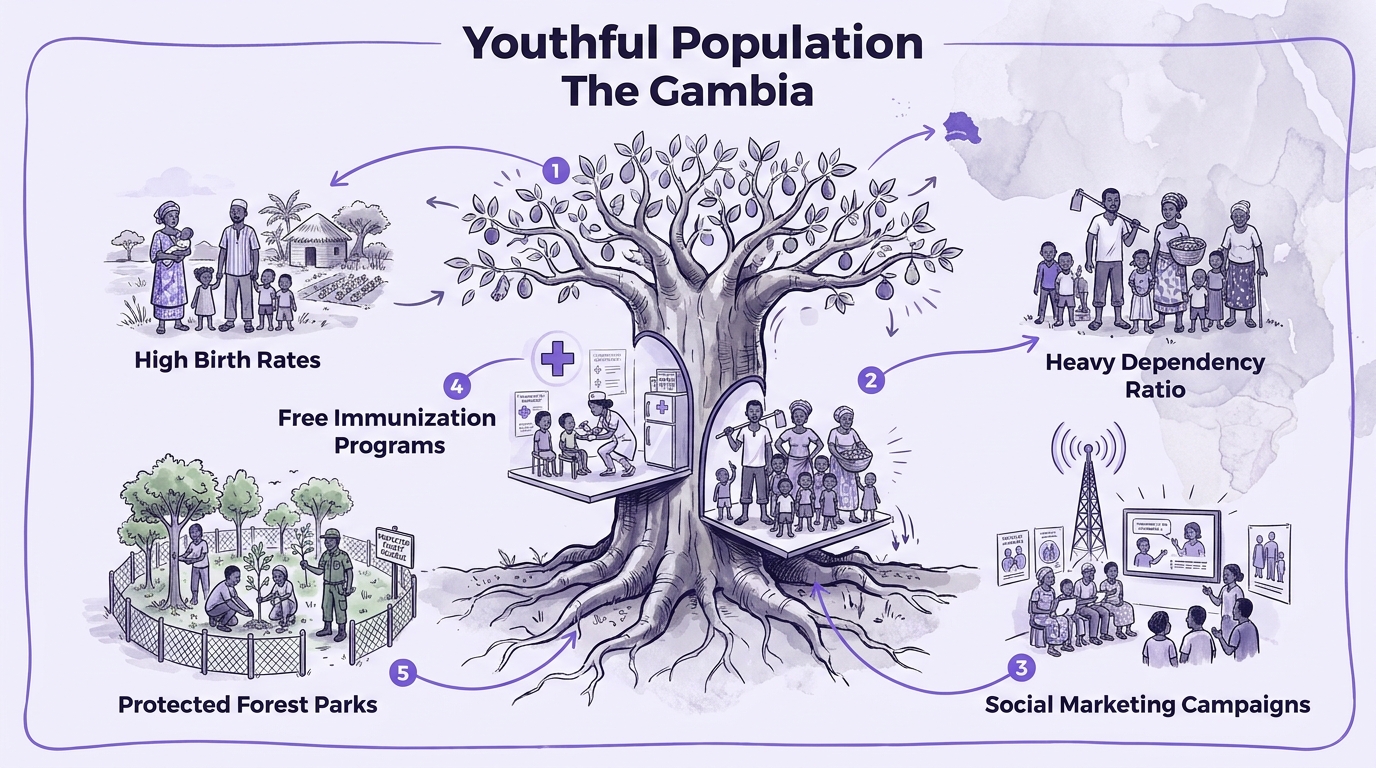
The Gambia has one of the youngest populations in the world due to high birth rates driven by religious beliefs, cultural traditions, and economic needs in rural farming communities. This rapid demographic growth puts tremendous pressure on the country's limited resources, leading to crowded housing, overburdened schools, and severe deforestation. To ensure a sustainable future, the Gambian government and non-governmental organizations are promoting family planning, subsidized contraception, healthcare access, and environmental conservation initiatives.

Key takeaways
- High birth rates in The Gambia stem from religious, cultural, and economic factors, such as relying on children for farm labor
- A dependency ratio of over 92% strains national resources, overcrowding schools, healthcare facilities, and local housing
- Targeted family planning, subsidized contraceptives, and public awareness campaigns have begun lowering population growth rates
- Community-managed forestry programs are helping combat severe deforestation caused by the growing demand for firewood
Tap to enlarge
Most valuable section
For whom
Students and educators interested in geography, demography, and West African development.
This section clearly breaks down the religious, cultural, and economic drivers behind high birth rates and details the country's demographic pyramid.
Detailed summary
1. Youthful Populations
0:00Children are visible everywhere across The Gambia, from rural villages to major urban centers. This introductory overview sets up the core questions of why the nation has such a young demographic and how rapid population growth impacts local resources and geography.
The documentary outlines how the government, local communities, and international organizations are trying to balance the needs of a young population with long-term economic and environmental sustainability.
2. Why so many young people?
0:54Religious traditions, social customs, and economic reliance on large families contribute to high birth rates. In rural farming areas, parents view having more children as essential for agricultural labor and household survival. Additionally, talking about reproductive health was historically considered a cultural taboo.
Demographic stats show a wide-based population pyramid with a birth rate over three times higher than economically developed nations. Low life expectancy and high infant mortality further drive families to have more children to ensure family continuity.
3. Implications
10:18Rapid population expansion creates a high dependency ratio, meaning a smaller proportion of working-age adults must support a large number of dependents. This creates severe strain on basic housing, sanitation, electricity, and local transportation infrastructure.
At home, large families often endure tight living conditions, minimal income, and food scarcity. On a community level, public services like schools face severe overcrowding, forcing institutions to adopt shift systems and share limited educational materials.
4. Family Planning: Contraception
19:09To address overpopulation, public health organizations have launched widespread social marketing campaigns to increase awareness and usage of contraceptives. Subsidized birth control options are distributed directly to pharmacies and health clinics across urban and rural zones.
Educational radio broadcasts and media advertisements are helping dismantle social taboos. These efforts have successfully contributed to a gradual decline in the national population growth rate over recent years.
5. Maternal & Child Health
15:41Improving maternal and infant healthcare is essential to reducing infant mortality and encouraging family spacing. Free immunization programs now protect children against common preventable diseases like measles, tuberculosis, and hepatitis B.
Maternity clinics provide prenatal care, birth spacing guidance, and health counseling to expectant mothers. As healthcare access improves, male family members are also becoming more supportive of family planning decisions.
6. Managing Resources
20:32Growing population numbers place extreme demand on natural resources, particularly forests harvested for cooking fuel and construction. Decades of unmanaged timber harvesting have significantly reduced forest cover across the country.
To reverse environmental degradation, the government and international partners are creating protected forest parks and shifting land ownership to local communities. Forest educators teach sustainable land management, bushfire prevention, and tree planting techniques to local villagers.
7. Education
24:00Access to education is critical for breaking the cycle of poverty and empowering the next generation. While primary school enrollment has increased significantly, schools still contend with shortages of classrooms, qualified teachers, and textbooks.
International aid programs assist by providing daily school meals to ensure students receive adequate nutrition. Educating young girls is recognized as one of the most effective strategies for lowering future birth rates and improving community health.
8. The Future
27:50Changing religious and cultural attitudes are slowly enabling more open discussions about reproductive health and family size. Community leaders and religious scholars increasingly endorse family planning as a means to ensure better care and education for children.
While significant economic and environmental challenges remain, a combination of government policy, NGO support, and youth education offers a promising path toward a sustainable future for The Gambia.
Questions this video answers
Why does The Gambia have such a high birth rate?
High fertility rates are driven by a combination of religious beliefs, cultural norms around large families, and economic necessity in rural areas. In farming communities, families rely on having many children to assist with agricultural labor and crop production.
What challenges does a youthful population present for The Gambia?
A high dependency ratio places immense strain on public resources and infrastructure. It results in severely overcrowded classrooms, inadequate medical facilities, housing shortages, and environmental degradation such as deforestation for firewood.
How is the government working to control population growth?
The government partners with international organizations and NGOs to promote family planning, offer subsidized contraceptives, and run public education campaigns via radio and TV. These efforts have helped reduce the population growth rate from 4.2% in 1993 to around 3% in 2005.
Ask a follow-up Premium
About this summary
SumTube AI wrote this recap from the video's words and chapters. Credit and the original belong to Ruskea Tukka.