
Free AI summary of this YouTube video by SumTube
Writing 1 lecture 3
TL;DR
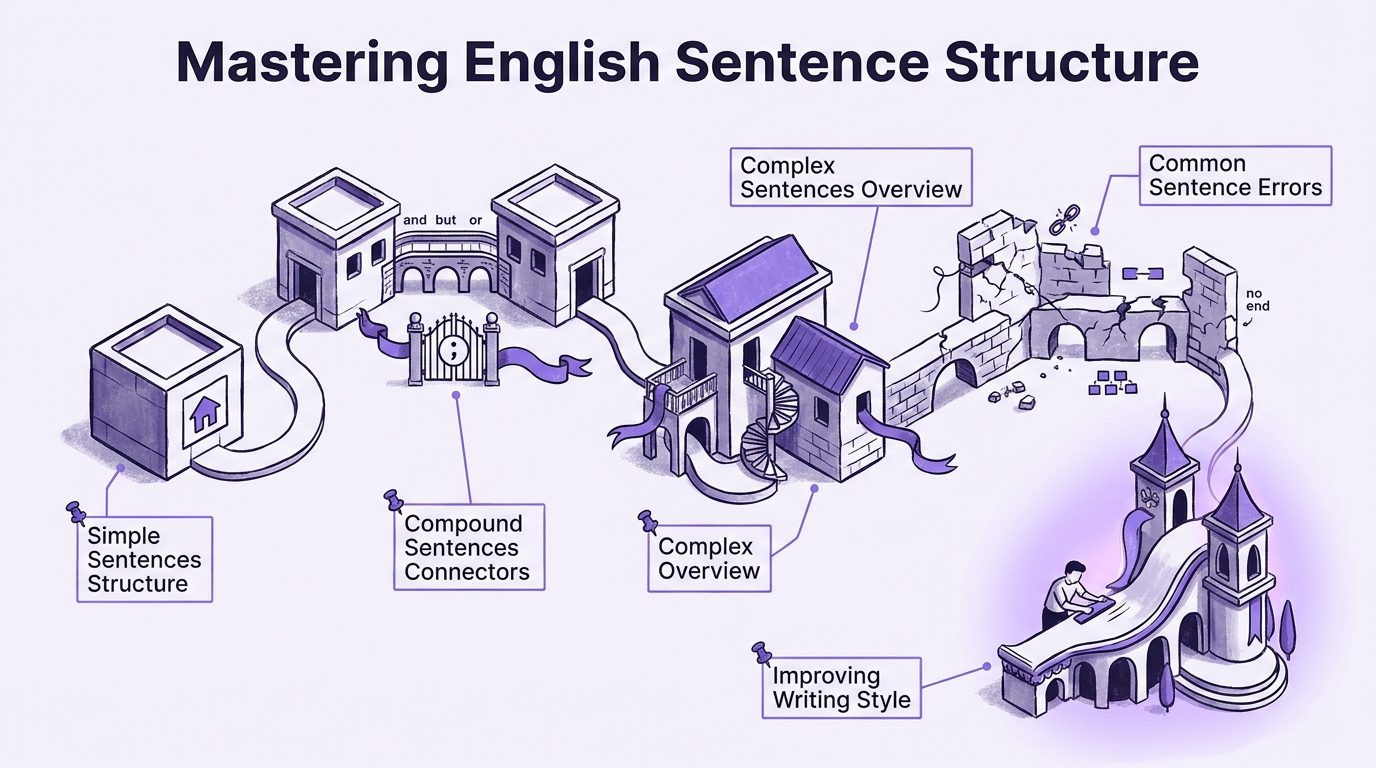
This lecture provides a comprehensive review of essential English writing principles, focusing on sentence structure and sentence-level errors. It covers the definitions and examples of simple, compound, and complex sentences, along with various methods for joining independent clauses. Furthermore, the instructor reviews common writing errors such as comma splices, run-on sentences, sentence fragments, choppy style, and stringy sentences.

Key takeaways
- 10:52Mastering compound and complex sentence structures is essential for elevating academic writing quality beyond basic simple sentences
- 6:08Compound sentences can be joined using coordinating conjunctions, conjunctive adverbs, or a semicolon alone
- 19:21Avoiding weak writing habits—such as overusing simple sentences (choppy style) or overusing coordinating conjunctions (stringy style)—creates a smoother and more professional narrative
Tap to enlarge
Most valuable section
For whom
English language learners and university students seeking to refine their academic writing style and avoid common grammatical errors
Compound Sentences & Connectors4:28
This section clearly demonstrates three distinct ways to form compound sentences using coordinators, conjunctive adverbs, and semicolons with practical examples.
Detailed summary
1. Introduction & Course Overview
0:00The instructor introduces the third lecture of the Writing 1 course, explaining that this session serves as a foundational revision of topics covered in previous lectures. The goal is to reinforce essential principles of English writing before moving forward to new material in future lectures.
Students are encouraged to review these fundamentals carefully, as a strong grasp of sentence structure and error identification directly impacts academic writing success at undergraduate and advanced graduate levels.
2. Simple Sentences Review
2:25This section covers the basic structure of a simple sentence in English. A simple sentence consists of a subject and a verb, containing a single independent clause that expresses a complete and standalone meaning without needing additional clauses.
Multiple illustrative examples are provided, such as 'Ali rode his bike to school' and 'Time flies.' The instructor emphasizes that understanding the core philosophy of a simple sentence is the first step toward building more sophisticated sentence structures.
3. Compound Sentences & Connectors
4:28The lecture explores compound sentences, which consist of two or more independent clauses joined together. The instructor outlines three methods for connecting these clauses: using coordinating conjunctions (FANBOYS: for, and, nor, but, or, yet, so), using conjunctive adverbs (e.g., however, as a result, in addition), or using a semicolon.
Detailed examples illustrate each method, demonstrating how punctuation changes depending on the transition word used. The concept of 'lexical reservoir' is also highlighted, showing how varied sentence construction enriches a writer's overall vocabulary and expression.
4. Complex Sentences Review
10:52This chapter defines complex sentences, which are formed by combining an independent clause with at least one dependent clause using subordinating conjunctions. Examples illustrate how dependent clauses add context such as reason, condition, or contrast.
Additional sentences demonstrate the importance of complex structures in academic writing. Utilizing complex sentences improves stylistic flow and sophistication, helping writers express nuanced arguments effectively.
5. Common Sentence Errors
16:42The instructor transitions to reviewing five major sentence-level errors commonly made by English writers: comma splices, run-on sentences, sentence fragments, choppy sentences, and stringy sentences. Each error type disrupts reading comprehension and weakens essay quality.
Definitions and correction techniques are provided for each problem. For instance, fragments lack an independent clause, while choppy and stringy styles result from failing to balance simple, compound, and complex sentence types.
6. Conclusion & Final Guidance
22:15The lecture wraps up with final advice regarding upcoming coursework and study materials. The instructor reassures students that key course topics will be posted on Moodle, outlining the upcoming chapters to be studied.
The session concludes with encouraging remarks, reminding students that writing is a creative and cumulative skill where core grammatical principles remain constant and beneficial throughout their academic journey.
Questions this video answers
What is the difference between a simple sentence and a compound sentence?
A simple sentence consists of a single independent clause with a subject and a verb that expresses a complete thought. In contrast, a compound sentence contains two or more independent clauses joined together using coordinators (like 'and' or 'but'), conjunctive adverbs, or semicolons.
How do conjunctive adverbs function in compound sentences?
Conjunctive adverbs, such as 'however,' 'as a result,' and 'in addition,' connect two independent clauses while showing a logical relationship like contrast or addition. Typically, they are preceded by a period or semicolon and followed by a comma.
What is a comma splice, and how can it be fixed?
A comma splice occurs when two independent clauses are joined with only a comma without a coordinating conjunction. It can be fixed by adding a coordinator after the comma, replacing the comma with a semicolon, or splitting the clauses into two separate sentences.
What are choppy sentences and stringy sentences?
Choppy sentences refer to a series of overly short, simple sentences that make writing feel disjointed. Stringy sentences, on the other hand, occur when too many independent clauses are strung together continuously using conjunctions like 'and,' 'but,' or 'so,' resulting in an unwieldy sentence.
Ask a follow-up Premium
About this summary
SumTube AI wrote this recap from the video's words and chapters. Credit and the original belong to Saed Saed.