
Free AI summary of this YouTube video by SumTube
Why This Giant Snake Is So Destructive
TL;DR
Burmese pythons have devastated the native wildlife population in the Florida Everglades, growing from a few escaped pets and hurricane-released specimens to hundreds of thousands. Their unique predatory adaptations, rapid reproduction, and lack of natural local predators make human management extremely difficult. Current removal efforts rely heavily on manual hunting and emerging scientific techniques like eDNA tracking, scout snakes, and potential future gene drives.

Key takeaways
- 3:38Burmese pythons are uniquely biological suited to thrive in the Everglades due to flexible jaw mechanics, high egg clutch sizes, and camouflaged hunting
- 9:54Native Florida species lack evolutionary instincts to fear pythons, leading to severe declines in mammal and bird populations
- 13:09Human hunting efforts face immense challenges because pythons spend 85% of their time motionless in inaccessible terrain
- 23:15Advanced tools like environmental DNA (eDNA) and 'Judas' scout snakes offer the best current strategy for tracking hidden python clusters
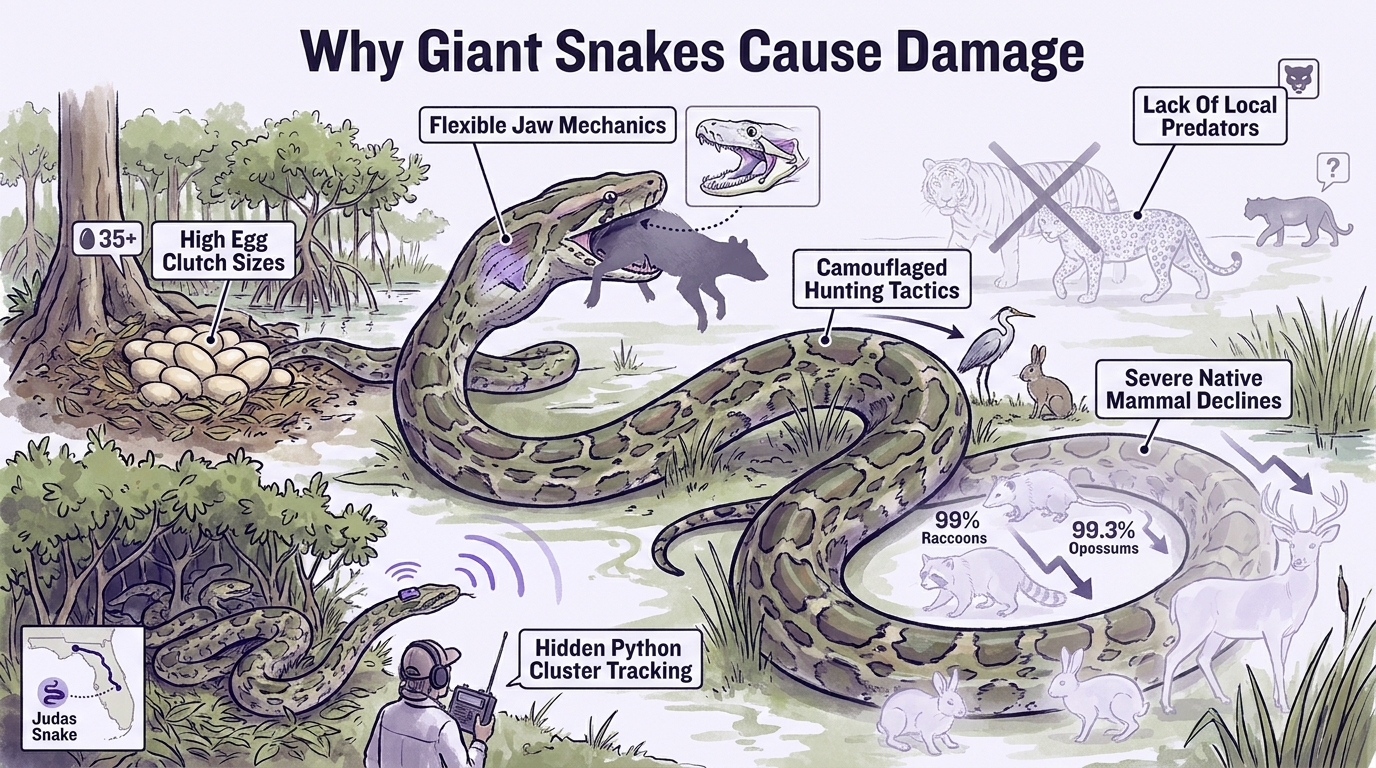
Tap to enlarge
Most valuable section
For whom
Wildlife enthusiasts, conservationists, and biology students interested in invasive species management.
This section breaks down the staggering reproductive math, jaw anatomy, and lack of apex predators that make the Burmese python an almost unstoppable invasive force in North America.
Detailed summary
1. Introduction to Florida's Python Crisis
0:00The Florida Everglades faces an ecological catastrophe caused by the rapid proliferation of invasive Burmese pythons. Released initially through the pet trade in the 1980s and 1990s, these giant constrictors have multiplied into hundreds of thousands across South Florida. They have caused near-total disappearances of small and medium-sized mammals across extensive areas of the wetland ecosystem.
Professional python hunters actively patrol the swamps to capture and dispatch as many snakes as possible. However, the sheer size of the python population and their secretive nature raise significant questions about whether manual removal will ever be sufficient to eradicate them completely.
2. Anatomy and Hunting Mechanics of the Burmese Python
1:54Native to Southeast Asia and Southern China, Burmese pythons are among the largest snake species globally, routinely reaching lengths of 12 to 16 feet and weighing up to 200 pounds. They are ambush predators that rely on muscular bodies for constrictive killing, which cuts off blood flow to a victim's brain rather than crushing bones or causing suffocation. Their mouths contain over 100 backward-curving teeth designed to firmly secure prey before constricting.
Contrary to common belief, pythons do not unhinge their jaws; instead, their lower jaw consists of four distinct moveable parts held together by flexible ligaments. This structure allows their gape to expand up to 10.2 inches (26 cm) in diameter, enabling them to swallow massive animals like full-grown white-tailed deer and adult alligators headfirst.
3. Origins of the Influx in Florida
5:05Burmese pythons became popular pets due to their relatively docile temperament compared to other constrictors. As pets grew too large for domestic handling, many owners intentionally released them into the wild Everglades. This issue was drastically compounded in August 1992 when Category 5 Hurricane Andrew struck South Florida.
During Hurricane Andrew, a major reptile breeding facility in Miami was destroyed, releasing roughly 900 hatchling pythons directly into the nearby wilderness. These escaped snakes established a self-sustaining population that multiplied exponentially over subsequent decades.
4. The Python Explosion
6:21The rapid growth of the Everglades python population is driven by exceptional reproductive traits. Female Burmese pythons lay an average clutch of 35 eggs per year, with larger females capable of laying over 100 eggs at a time. Unlike many reptiles, female pythons actively guard their nests, leading to high hatching success rates.
When python eggs hatch, the young are already over two feet long—the size of many adult native Florida snakes. With few natural predators capable of eating offspring of this size, young pythons rapidly mature into ten-foot adults within three years, consuming hundreds of native animals during their growth phase.
5. Ecological Destruction of Native Wildlife
8:01The presence of Burmese pythons has led to drastic declines in native Everglades wildlife populations. Research studies documented severe population reductions including a 99.3% drop in raccoons, a 98.9% decrease in opossums, an 87.5% drop in bobcats, and complete local disappearances of rabbits and foxes. Birds also comprise nearly 25% of the python's diet in the marshland.
Native prey species suffer disproportionately because they lack evolutionary adaptations or innate instincts to fear giant constrictors. Unlike prey in Southeast Asia that co-evolved alongside large pythons, Florida wildlife fails to recognize pythons as active threats until it is too late.
6. The Lack of Apex Predators in Florida
10:05In their native Asian habitats, python populations are kept in check by apex predators such as tigers, leopards, and large venomous snakes like King Cobras. In Florida, adult pythons face virtually no natural predators. While large alligators occasionally predate pythons, the confrontation goes both ways, and there are not enough giant alligators to impact python numbers significantly.
Florida panthers may occasionally prey on small pythons, but their critically low population of around 200 individuals prevents them from acting as an effective biological control. Consequently, humans remain the only significant threat to adult pythons in North America.
7. Challenges of Manual Python Hunting
12:06Professional hunter Amy Siewe explains the extreme difficulty of removing pythons from the wild. Pythons spend roughly 85% of their time remaining completely still, heavily hidden within inaccessible swamp vegetation. As a result, hunters are largely confined to patrolling access roads at night, waiting for snakes to move across open ground.
State-contracted hunting programs face strict resource limitations, with only around 100 official hunters hired due to road access constraints. Capturing pythons manually requires immense physical effort and carries risks of severe bites from their sharp teeth, though pythons generally try to flee rather than attack humans defensively.
8. Evaluating Public Hunting Competitions
18:09State-sponsored events like the Florida Python Challenge invite public participants to hunt pythons for cash prizes. However, experts note significant drawbacks to these events. The influx of over a thousand inexperienced participants creates heavy road traffic and noise, which alters python behavior and causes the snakes to remain concealed deep in the brush.
Another major issue with amateur participation is misidentification. Untrained hunters frequently kill beneficial native snake species—such as water snakes, corn snakes, and cottonmouths—mistaking them for juvenile pythons. Experts suggest that organizing structured hunting territories for qualified personnel would yield far better ecological data and removal rates.
9. Innovative Tracking Technologies: eDNA and Judas Snakes
23:15To overcome the limitations of visual hunting, researchers are implementing advanced tracking methodologies. Environmental DNA (eDNA) sampling allows scientists to test water samples for microscopic traces of python skin, feces, or mucus. This technology can detect python presence along the expansion frontier years before a physical snake is ever spotted.
Another highly effective method is the use of 'Judas snakes'—male pythons fitted with radio transmitters. During breeding season, these radio-tagged males lead researchers directly to hidden female pythons and large mating aggregations. This allows biologists to remove key breeding females before they can lay new egg clutches.
10. Future Solutions: Genetic Control and Gene Drives
24:52Scientists are exploring long-term bio-engineering solutions such as gene drives to suppress python populations. A gene drive alters inheritance rules to rapidly spread specific genetic traits through a population, such as inducing sterility or ensuring all offspring are born male. While effective in laboratory tests on fast-breeding insects like mosquitoes, applying gene drives to pythons presents complex ecological and biological challenges.
Pythons reproduce relatively slowly, meaning a gene drive would take decades to alter the population. Furthermore, releasing genetically modified organisms carries significant ecological risks, as modified genes could potentially cross-contaminate native python populations in Asia where the species is already threatened.
11. Holding the Line for Everglades Conservation
26:05Despite catching over 27,000 pythons since 2017, human removal efforts have not yet reduced the overall population estimate of 500,000 snakes. However, hunters and biologists emphasize that every individual python removed saves hundreds of native animals over that snake's lifetime.
Continued manual hunting serves as a critical stopgap to prevent total ecosystem collapse while scientists research more permanent technological and biological control measures. Persistence remains essential to preserving the remaining biodiversity of the Florida Everglades.
Questions this video answers
How did Burmese pythons end up in the Florida Everglades?
The invasion began through the exotic pet trade during the 1980s and 1990s, where owners released oversized pythons into the wild. The population exploded significantly after Hurricane Andrew destroyed a Miami reptile breeding facility in 1992, releasing hundreds of baby pythons near the Everglades.
Why are Burmese pythons so successful at hunting in Florida?
Pythons possess non-hinged, flexible four-part jaws connected by elastic ligaments, allowing them to swallow large prey like white-tailed deer and alligators whole. Additionally, native Florida animals did not co-evolve with large constrictors and lack natural defense instincts to avoid or flee from them.
Can python hunting competitions clear the Everglades of pythons?
Hunting alone cannot eliminate the population because pythons are exceptionally difficult to spot and inhabit vast, inaccessible swamp areas. Expert hunters note that high human traffic during open competitions can even disturb python behavior, causing them to stay hidden in the brush.
Ask a follow-up Premium
About this summary
SumTube AI wrote this recap from the video's words and chapters. Credit and the original belong to Real Science.