
Free AI summary of this YouTube video by SumTube
Why Runways Have to Be Repainted
TL;DR
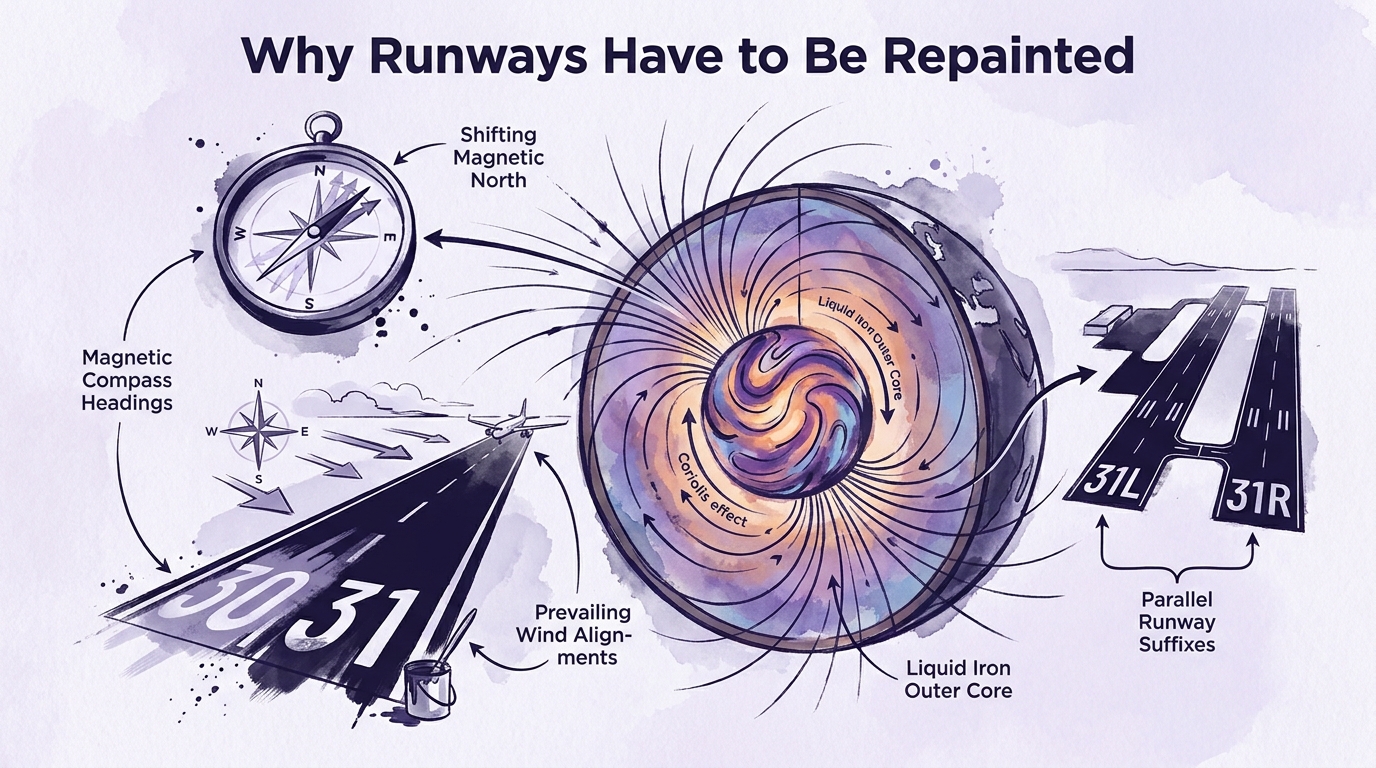
Runway numbers are derived from magnetic headings to assist pilots in landing into prevailing winds. Because Earth's magnetic north shifts over time, airports periodically renumber their runways to match updated compass readings. However, Canada uniquely uses True North (Geographic North) for its northern runways to avoid frequent renumbering, resulting in two distinct runway naming systems.

Key takeaways
- 5:08Runway numbers correspond to two-digit magnetic compass headings (rounded to the nearest 10 degrees) matching the direction planes land
- 13:54Earth's magnetic field is generated by liquid iron convection currents, causing Magnetic North to drift constantly
Tap to enlarge
Most valuable section
For whom
Aviation enthusiasts, geography buffs, and anyone curious about how airports and navigation systems function.
Why Runway Numbers Change13:54
It connects aviation conventions directly to planetary physics, explaining how Earth's shifting magnetic field forces airports to update their physical infrastructure.
Detailed summary
1. Introduction to Runway Numbers
0:00When looking out an airplane window, passengers often see large numbers painted at the end of runways. Even small airports with only a couple of runways might feature numbers like 8 or 24, raising questions about what these numbers mean.
Runway numbers are not simple sequential identifiers or evidence of missing infrastructure. They are part of a global navigational system designed to help pilots land safely regardless of weather conditions.
2. Why Wind Direction Matters for Airplanes
0:31Airport design begins with wind patterns. Aircraft take off and land facing into the wind because headwind increases lift, requiring less runway length and offering safer, more stable flight dynamics.
Early aviation solved changing wind directions by building triangular runway layouts. Modern large airports rely on historical wind data mapped onto a wind rose to align runways with the most common local wind directions.
3. How Runway Numbers Are Calculated
5:33Runways are numbered according to their compass orientation in degrees (0 to 360) from the perspective of an approaching aircraft. The full three-digit heading is rounded to the nearest 10, and the trailing zero is dropped to streamline air traffic control communications.
For example, a runway facing 360 degrees north becomes Runway 36 when approached from the south, while the opposite direction on the same strip is designated Runway 18.
4. Handling Parallel Runways
11:38Busy international airports often require multiple parallel runways aligned with the prevailing wind. Because parallel runways share the exact same compass heading, letter suffixes are appended to differentiate them.
Airports with two parallel runways add 'L' (Left) and 'R' (Right). When three parallel runways exist, 'C' (Center) is added. For four or more parallel runways, authorities offset the heading numbers slightly for half of them to avoid confusion.
5. Magnetic North vs. True North
13:54Navigation relies on two distinct definitions of north. Geographic or True North points directly to Earth's rotational axis, whereas Magnetic North is where compass needles align with Earth's magnetic field.
Traditionally, aviation relies on Magnetic North because traditional magnetic compasses serve as an essential, unpowered backup system in aircraft cockpits.
6. Why Earth Has a Shifting Magnetic Field
18:32Earth's magnetic field is created by thermal convection currents of liquid iron within the planet's outer core. Combined with the Coriolis effect from Earth's rotation, these swirling currents form a massive, dynamic geodynamo.
Because the liquid metal inside Earth moves unpredictably, Magnetic North constantly drifts across the planet's surface and even periodically reverses polarity over geological timescales.
7. Why Runway Numbers Have to Change
26:39As Magnetic North drifts, the magnetic heading of an airport runway gradually changes over time. When a runway's magnetic orientation shifts past a 10-degree threshold, the airport must officially renumber and repaint the runway.
The closer an airport is to a magnetic pole, the more dramatic the drift appears, causing northern airports to require renumbering every few decades.
8. Canada's True North Exception
27:03Due to its proximity to the magnetic pole, Canada faced frequent and expensive runway renumbering in its northern territories. To solve this, Canada adopted True North (Geographic North) for designating northern runways.
While this eliminates the need for repainting, it means Canadian northern runway designations do not match traditional magnetic compass headings, creating two distinct runway naming systems globally.
9. Creator Retraction and Re-upload Explanation
28:44In an extended post-video segment, the creator explains why this version of the video was re-uploaded. An earlier version contained a math error showing a runway number increasing instead of decreasing during a magnetic shift.
Rather than leaving the error online, the creator elected to delete the original video and publish a corrected version, along with behind-the-scenes insights for channel supporters.
Questions this video answers
How are runway numbers calculated?
Runway numbers are based on the compass direction a pilot faces when landing on that runway. The heading in degrees (0 to 360) is rounded to the nearest ten and the final zero is dropped, turning a 360-degree northbound approach into Runway 36.
Why do airports have to repaint runway numbers?
Most runway numbers are based on Magnetic North rather than Geographic (True) North. As Earth's liquid iron core moves, Magnetic North drifts, occasionally shifting a runway's magnetic heading enough to require renumbering.
What is the difference between Magnetic North and True North?
True North (Geographic North) is fixed at the rotational axis of Earth. Magnetic North is the point where Earth's magnetic field points straight down, and it constantly shifts over time due to fluid movements in Earth's outer core.
Why does Canada use a different runway numbering system?
Because Northern Canada is close to the magnetic pole, the shift of Magnetic North causes rapid changes in compass headings. To avoid repainting runway numbers constantly, Canada uses True North to designate northern runways instead of Magnetic North.
Ask a follow-up Premium
About this summary
SumTube AI wrote this recap from the video's words and chapters. Credit and the original belong to CGP Grey.