
Free AI summary of this YouTube video by SumTube
Why Kalimantan Burns: The Hidden Problem Beneath Indonesia’s Forests
TL;DR
This video examines why Kalimantan's tropical rainforests experience persistent, severe forest fires despite high rainfall and advanced monitoring infrastructure. It details how drainage canals built for commercial agriculture dry out carbon-rich peatlands, transforming natural water sponges into subterranean tinderboxes. The narrative explores the complex interplay of El Niño weather patterns, economic incentives, institutional fragmentation, and legal hurdles that perpetuate this recurring environmental crisis.

Key takeaways
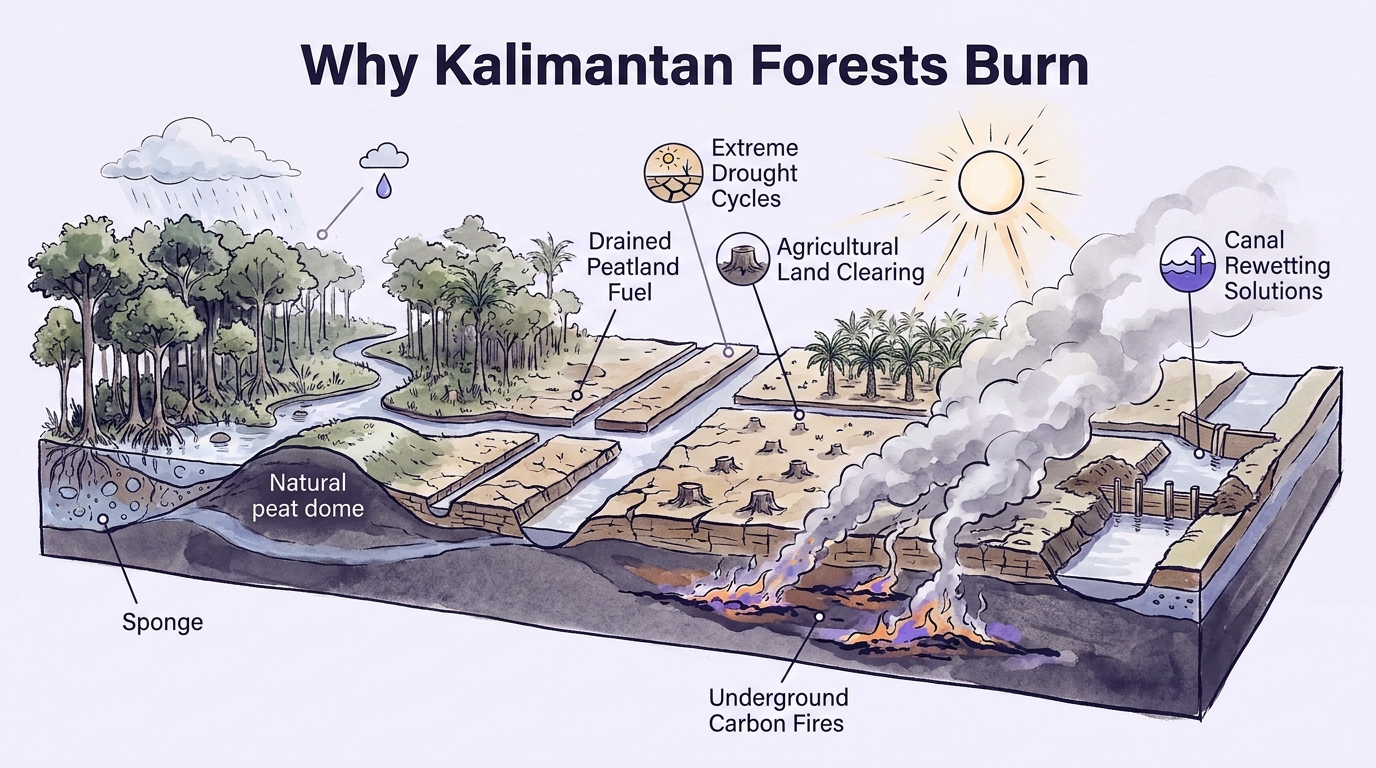
- Peatlands naturally act as fireproof sponges, but drainage canals for agriculture render subterranean carbon layers highly flammable
- Underground peat fires burn undetected beneath the surface and cannot be extinguished by surface water alone
- Climate phenomena like El Niño trigger severe droughts, but human land modification creates the flammable conditions
- Long-term fire prevention requires rewetting peatlands through canal blocking rather than relying solely on fire suppression
Tap to enlarge
Most valuable section
For whom
Environmental policy analysts, climate advocates, and geography enthusiasts
The Fire Beneath the Forest3:10
It clearly explains the unique science of peatland fires and why subterranean smoldering makes tropical forest fires nearly impossible to extinguish once started.
Detailed summary
1. Kalimantan Is Not Supposed to Burn
0:00Kalimantan, the Indonesian portion of Borneo, spans roughly 544,000 square kilometers and is defined by dense tropical rainforests, winding river systems, and immense biodiversity. Sitting directly on the equator, the region receives between 2,000 and 4,000 millimeters of rainfall annually. Under natural conditions, the forest's high canopy blocks direct sunlight, maintaining a humid, cool, and wet forest floor that prevents large-scale fires from taking root easily.
Despite these naturally damp conditions, Kalimantan experiences devastating seasonal fires that smoke out wide areas. Severe droughts caused by El Niño climate cycles drastically reduce rainfall, causing river levels to drop and canopy vegetation to dry out. However, even during dry spells, healthy pristine rainforests remain remarkably resilient, raising questions as to why vast tracts of this wet landscape ignite so intensely.
2. The Fire Beneath the Forest
3:10The primary cause of Kalimantan's severe fires lies beneath the surface in its extensive peatlands, locally known as gambut. Peat is formed over thousands of years when dead plant matter accumulates in waterlogged, oxygen-poor swamp environments without fully decomposing. In Kalimantan, these organic layers can reach up to 15 meters deep and store up to 20 times more carbon than standard mineral soil forests.
In its untouched state, peat acts as a massive wet sponge that is entirely fireproof. However, when peatlands dry out, they transform into dense, highly combustible fuel. Subterranean peat fires burn deep underground, smoldering silently for months along dry root networks. These hidden fires produce thick, toxic smoke, are nearly impossible to detect from the air, and often re-emerge on the surface miles away from where firefighters believe they were suppressed.
3. How Humans Changed the Landscape
5:10Rainforest fires rarely start spontaneously; they are the result of extensive landscape modifications driven by human economic activity. Decades of industrial deforestation, forest fragmentation, and agricultural expansion have systematically altered Kalimantan's natural hydrology. The most damaging practice is peatland drainage, which prepares swampy ground for commercial crops like oil palm and industrial pulpwood.
To make swampy land usable, networks of canals are excavated to drain water out of the peat and into nearby rivers. This process permanently lowers the regional water table, turning waterlogged soil into dry, flammable ground. By converting naturally fire-immune wetlands into drained agricultural zones, human land management creates ideal conditions for small sparks to become catastrophic wildfires.
4. Why People Use Fire
6:47While lightning strikes cause a tiny fraction of natural fires, the overwhelming majority of blazes in Kalimantan are ignited by humans for land clearing. Preparing dense tropical land for farming using heavy mechanical equipment like bulldozers and excavators can cost hundreds of dollars per hectare. In contrast, fire provides a cheap, rapid, and efficient alternative for clearing thick underbrush and agricultural debris.
Fire also provides short-term agronomic benefits by destroying crop pests and leaving behind an ash layer that temporarily neutralizes acidic peat soils. While traditional indigenous communities historically practiced controlled, small-scale slash-and-burn farming that allowed forests to recover, modern large-scale commercial land conversion and illegal land clearing use fire aggressively, allowing small land-clearing flames to escape control during dry periods.
5. The Economic Value of Kalimantan's Land
8:37Understanding Kalimantan's fire crisis requires examining the economic drivers shaping the region's land use. Indonesia is the world's leading producer of crude palm oil, an essential raw material used in consumer packaging, food products, and cosmetics. Additionally, Kalimantan serves as a major global hub for timber, paper pulp production, and coal mining.
These resource-extractive industries support millions of local jobs and generate vital tax revenues for national and local governments. Consequently, authorities face a persistent political and economic tension between promoting infrastructure and economic growth on one side, and enforcing strict environmental protection standards and climate commitments on the other.
6. Who Is Responsible for Protecting the Forest?
10:04Responsibility for managing and protecting Kalimantan's forests is split across multiple government institutions and private entities. At the national level, the Ministry of Environment and Forestry (KLHK) oversees national forest estates and environmental regulation, while the Peat and Mangrove Restoration Agency (BRGM) works specifically to rewet and restore degraded peatlands. During active emergency disasters, the National Disaster Management Agency (BNPB) coordinates firefighting responses and aerial water-bombing operations.
However, Indonesia's decentralized administrative structure grants significant authority over land-use permits to provincial governors and district regents. Private concession holders are legally obligated to prevent and extinguish fires within their boundaries. This fragmented division of authority across state agencies, regional governments, and private corporations creates immense coordination challenges when responding to fires across millions of hectares.
7. Prevention Is More Important Than Firefighting
11:49Once a subterranean peat fire establishes itself over a wide area, conventional suppression tactics and water drops are almost entirely ineffective until heavy seasonal rains arrive. As a result, fire management experts emphasize that proactive prevention is far more critical than emergency firefighting. Effective prevention requires real-time satellite thermal monitoring, continuous ground patrols by specialized brigades like Manggala Agni, and community engagement.
The most decisive preventive measure is rewetting dried peatlands by constructing canal blocks and dams. By damming drainage networks, water is trapped within the swamp, raising the water table back to the surface and restoring the peat's natural fire resistance. Rewetting ensures that the organic soil remains too wet to ignite, permanently removing the primary fuel source for large-scale fires.
8. The Government Budget Question
12:57Maintaining proactive fire prevention programs across millions of remote hectares requires sustained financial investments. During the 2020 global pandemic, the Indonesian government redirected funds to health care and economic recovery, cutting the Ministry of Environment and Forestry's budget by over $140 million USD. Specialized bodies like the Peat and Mangrove Restoration Agency operate on limited annual budgets that must cover multiple expansive provinces.
Budgetary constraints restrict the frequency of ground patrols, early warning maintenance, and canal-blocking operations. However, data indicates that budget cuts alone do not automatically trigger bad fire seasons. For example, wet La Niña weather patterns in 2020 and 2021 suppressed fire activity despite reduced agency budgets, demonstrating that atmospheric conditions interact closely with institutional resources.
9. Money Is Not the Only Problem
15:24Even with substantial funding, physical geography poses severe obstacles to firefighting in Kalimantan. Large portions of the peatlands are isolated, lacking paved roads or ground transport infrastructure. When satellite sensors detect a hotspot deep in a remote swamp, response teams must travel for hours by small riverboats and hike through thick mud while carrying heavy water pumps and equipment.
Furthermore, unclear and overlapping land tenure complicates rapid response efforts. A single fire can burn across national park borders, corporate concessions, and untitled village lands simultaneously. Uncertainties over legal jurisdiction and land ownership frequently delay initial emergency interventions, allowing localized ignitions to grow into massive blazes before response teams take ownership.
10. Why Is Enforcement So Difficult?
16:56Enforcing environmental laws against illegal fire use presents steep evidentiary and legal challenges. While NASA and national satellite systems detect thermal hotspots in real time, satellite data only identifies coordinates emitting heat; it cannot identify who started the fire. Law enforcement officers must travel to remote, burned areas to conduct forensic investigations and determine if a fire was started intentionally or spread accidentally.
Proving corporate liability inside large agricultural concessions is equally difficult, as companies often blame encroaching smallholders or external fires. Although the Indonesian government intensified prosecutions following the 2015 fires—issuing sanctions, revoking operating licenses, and suing major companies—appeals processes take years, and collecting financial penalties remains historically difficult.
11. The Role of El Niño and Climate
18:23Atmospheric conditions act as the ultimate climate trigger for Kalimantan's fire crisis. Data from Indonesia's meteorological agency (BMKG) shows that catastrophic fire years, such as 1997, 2015, and 2019, coincided with severe El Niño events and positive Indian Ocean Dipole anomalies. These global climate events suppress regional rainfall, leaving peatlands devoid of moisture for extended months.
Crucially, severe El Niño droughts act as climate triggers, but human land modification provides the dry fuel. Pristine, undrained rainforests generally survive severe droughts without burning because their dense canopies and intact hydrology retain internal moisture. Drained peatlands and logged terrain, however, lack natural defenses, turning climate-induced droughts into environmental disasters.
12. Why the Fire Keeps Coming Back
20:17Kalimantan's recurring fire crisis stems from a self-reinforcing environmental degradation cycle. Forest conversion and peat drainage expose the landscape to fire during dry seasons. When fires burn, they destroy surface vegetation and burn away top peat layers, removing the protective canopy and exposing the ground to direct sunlight, which dries out the remaining peat even further.
This ongoing degradation makes the landscape progressively more vulnerable to future ignitions, ensuring that subsequent dry seasons produce faster-spreading, harder-to-extinguish blazes. Suppressing surface flames without rewetting drained peatlands leaves the underlying vulnerability intact, baking fire risks into the geography of the region as economic demands continue to shape the land.
Questions this video answers
Why do tropical rainforests in Kalimantan burn if they receive so much rain?
While Kalimantan receives thousands of millimeters of rainfall annually, extensive drainage canals dug for palm oil and pulpwood plantations drain water from peatlands. When dry seasons or El Niño events arrive, the exposed organic peat soil dries out and becomes highly flammable, allowing fires to spread deep underground.
Why are peat fires in Indonesia so difficult to extinguish?
Peat fires burn beneath the surface inside thick layers of compressed organic matter, smoldering through dry root systems without visible flames. Pouring water on the ground surface often fails to reach the burning subterranean layers, allowing fires to re-emerge miles away months later.
How does Indonesia prevent forest fires before they start?
Prevention relies on water management, specifically rewetting peatlands by building dams across drainage canals to raise the water table back to the surface. Additionally, specialized forest fire brigades patrol vulnerable areas and satellite systems monitor thermal hotspots for early intervention.
Ask a follow-up Premium
About this summary
SumTube AI wrote this recap from the video's words and chapters. Credit and the original belong to Geography of Nusantara.