
Free AI summary of this YouTube video by SumTube
Why Animal Eyes Look So Weird
TL;DR
Animal eyes display a remarkable variety of structures, from camera-type eyes to unique pupil shapes, all adapted to suit their specific ecological niches. Specialized adaptations in cornea, lens, and pupil shape allow animals like seals, eagles, owls, and cats to navigate different light levels, environments, and hunting strategies. Exploring these evolutionary traits highlights how vision has evolved independently and efficiently to meet distinct survival needs.

Key takeaways
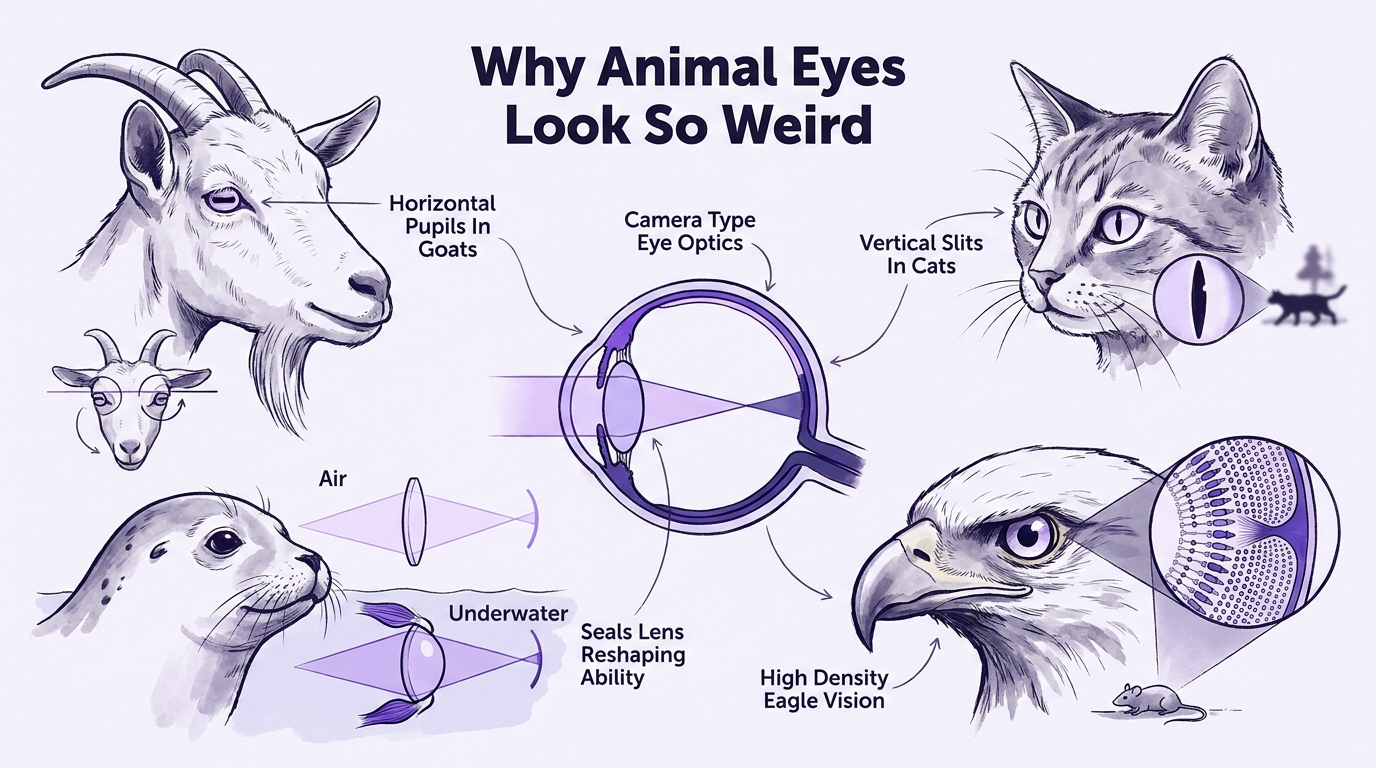
- 5:54Seals use ciliary muscles to dramatically reshape their eye lenses, allowing sharp vision both in air and underwater
- 13:54Goats maintain horizontal pupils aligned with the horizon by rotating their eyes up to 40 degrees as they lower or raise their heads
- 18:09Vertical slit pupils in small ambush predators like cats combine stereo depth perception with defocus blur to accurately judge distance to prey
- 24:17Complex camera-type eyes can evolve rapidly in fewer than 400,000 years through small incremental improvements
Tap to enlarge
Most valuable section
For whom
Science enthusiasts, biologists, and anyone curious about animal evolution and vision mechanics.
It visually demonstrates the astonishing mechanical ability of goats to rotate their eyes within their sockets to keep their pupils parallel to the ground while grazing.
Detailed summary
1. The Diversity of Animal Eyes
0:00The video opens by exploring the astonishing variety of eye shapes, pupil configurations, and optical structures found across the animal kingdom. Animals such as turtles, frogs, cats, owls, goats, and cuttlefish possess distinct eye designs tailored to their unique ways of life. These visual masterworks reveal how each species interacts with its environment, what it needs to spot, and how it avoids danger.
Central questions guide the discussion: Why do herbivores like goats have horizontal pupils while predators like domestic cats feature sharp vertical slits? How do complex camera-type eyes operate across wildly different conditions, such as under water, high in the canopy, or in pitch-black night?
2. How Camera-Type Eyes Work
1:16Camera-type eyes are present in all vertebrates and even some invertebrates, favored for their ability to generate clear, high-resolution imagery. Light enters through the protective dome of the cornea and passes through the lens, which focuses incoming light rays onto the retina packed with light-sensitive photoreceptor cells. This unified structure empowers animals to navigate terrain, identify potential mates, and hunt prey with high accuracy.
In terrestrial organisms, the cornea actually performs the majority of light focusing—roughly two-thirds in humans—because light bends significantly as it moves from air into the fluid-filled eye. The internal lens then fine-tunes this focus to ensure a crisp image lands directly on the retina.
3. Underwater Vision & Graded-Index Lenses
3:03Underwater optics present a distinct challenge because water and the cornea share almost the same refractive index, meaning the cornea cannot bend incoming light rays. Fully aquatic species like fish depend entirely on their internal lenses to do all the focusing work. To prevent spherical aberration—an optical blur caused by uniform spherical lenses—aquatic eyes evolved a graded-index lens where optical density is highest at the center and gradually decreases toward the edges.
Amphibious creatures like seals face the dilemma of seeing both above and below the surface. Seals address this by having flat corneas that minimize distortion in air, alongside powerful ciliary muscles that alter the shape of their internal lenses across a vast range, maintaining clear vision in both environments.
4. Retinal Anatomy & Pupil Apertures
7:00Once light passes through the lens, it reaches the retina, which functions like a digital camera sensor filled with rod and cone cells. Rods specialize in vision during low-light conditions, while cones capture vivid color and intricate detail. When light strikes these photoreceptors, chemical reactions produce electrical signals sent to the brain to construct visual perception.
Before light hits the retina, it must enter through the pupil, which regulates the overall light volume. Simple eyes like those of the nautilus lack lenses altogether, operating like pinhole cameras where narrow pupils create sharper but dim images. Animals must constantly adjust pupil size to strike the perfect balance between light input and image sharpness across daytime and nighttime environments.
5. Extreme Daytime & Nighttime Vision
8:00The harpy eagle possesses eyes as large as human eyes despite having a much smaller head, featuring double foveas and high photoreceptor density. Its pupils expand and contract far more dramatically than human pupils, allowing rapid adjustment when diving through shadowy rainforest canopies into bright clearings to spot prey over 200 meters away.
Conversely, nocturnal hunters like owls sacrifice peripheral vision to maximize light sensitivity in the dark. Owls have large, tubular eyes that lack broad retinas, focusing all visual acuity straight ahead. Because these fixed tube eyes cannot move in their sockets, owls evolved the ability to rotate their heads up to 270 degrees to scan their surroundings.
6. Horizontal Pupils in Prey Animals
11:26Animals with eyes positioned on the sides of their heads, such as goats, deer, and horses, predominantly feature horizontal slit pupils. This configuration expands their panoramic field of view along the ground, enabling them to scan for crouching predators across wide distances while grazing.
Strikingly, when a goat tilts its head down to eat grass, its eyeballs rotate within their sockets by up to 40 degrees. This automatic rotation keeps the horizontal slit aligned parallel with the ground, preserving wide-angle predator detection at all times. Additionally, structures like the corpora nigra act as built-in sun visors to shade the pupil from harsh overhead sunlight.
7. Vertical Slit Pupils in Ambush Predators
14:59Small ambush predators like domestic cats, foxes, and reptiles frequently possess vertical slit pupils. Unlike large pursuit predators that rely on motion parallax during high-speed chases, stationary ambush hunters use a combination of stereopsis (binocular depth perception) and defocus blur to judge precise pouncing distances.
A vertical slit pupil narrows horizontally to sharpen vertical contours for binocular depth estimation, while remaining open vertically to create a shallow depth of field. Furthermore, vertical slits allow an extreme range of area adjustment—a cat's pupil can expand up to 135 times its constricted area, compared to just 15 times in humans—granting exceptional vision in both bright daylight and near-total darkness.
8. Unique Pupil Shapes: Geckos & Cuttlefish
18:59Some species feature highly specialized pupil geometries that solve specific environmental hurdles. Geckos possess vertical slits with multiple pinhole-like indents that form several distinct pupil openings when constricted; this multi-pinhole array generates displaced overlapping images that help the gecko accurately measure distance to targets.
Cuttlefish display a distinctive W-shaped pupil that helps balance uneven light distribution coming from above the oceanic horizon. Cuttlefish can also detect polarized light signals reflected off their skin to communicate with one another, and their wavy pupil outlines break up the recognizable round shape of the eye to enhance camouflage.
9. Evolutionary Speed of Complex Eyes
23:11The evolution of camera-type eyes has occurred independently across multiple animal lineages, serving as a key example of convergent evolution. A landmark 1994 paper by Dan-Eric Nilsson and Susanne Pelger calculated that a complex camera eye could evolve from a simple flat patch of light-sensitive cells in less than 364,000 years through small, 1% incremental improvements per generation.
This rapid timeframe demonstrates that complex optical structures do not require grand design blueprints. Instead, natural selection continually refines visual organs through steady trial and error, favoring any functional variation that enhances an organism's ability to survive and reproduce in its specific habitat.
Questions this video answers
Why do goats and other grazing animals have horizontal slit pupils?
Horizontal pupils maximize light capture along the ground and horizon, providing a wide field of view to detect incoming predators. Additionally, goats can rotate their eyeballs within their sockets by up to 40 degrees so their pupils stay aligned with the horizon even when grazing.
How do cats' vertical slit pupils help them hunt?
Vertical slit pupils create a small horizontal aperture for sharp stereo depth perception while simultaneously opening up vertically to allow significant defocus blur. Small ambush predators use this combination of stereo vision and depth blur to precisely gauge pouncing distance without revealing themselves through motion.
Why do aquatic animals like fish have perfectly spherical lenses?
Because water and the cornea have nearly identical refractive indices, the cornea provides virtually no light-bending power underwater. As a result, aquatic eyes rely entirely on a spherical, graded-index lens that gradually bends light toward its center to form sharp, distortion-free images on the retina.
Ask a follow-up Premium
About this summary
SumTube AI wrote this recap from the video's words and chapters. Credit and the original belong to Real Science.