
Free AI summary of this YouTube video by SumTube
What’s Hidden Under Antarctica?
TL;DR
This video explores what would happen if someone drilled through four kilometers of Antarctic ice sheet down to Lake Vostok. The lake has been isolated for at least 15 million years beneath the ice, warmed by Earth's core, and harbors unique subglacial liquid ecosystems. Russian scientists successfully retrieved frozen water samples in 2012, revealing potential isolated lifeforms among over 400 subglacial lakes.

Key takeaways
- 0:11Deep Antarctic ice contains air bubbles preserved from historical eras ranging from the Renaissance to the last Ice Age
- 0:47Scientists confirmed the existence of subglacial lakes using ice-penetrating radio waves
- 1:53Sampling subglacial environments poses a high risk of biological contamination, making further exploration controversial
Tap to enlarge
Most valuable section
For whom
Curious learners interested in extreme environments, Antarctic geology, and subglacial microbiology.
Reaching Lake Vostok and Sampling Ice0:55
It shows how Russian researchers managed to collect water samples from Lake Vostok without contaminating the pristine 15-million-year-old environment.
Detailed summary
1. Drilling Through Antarctic Ice
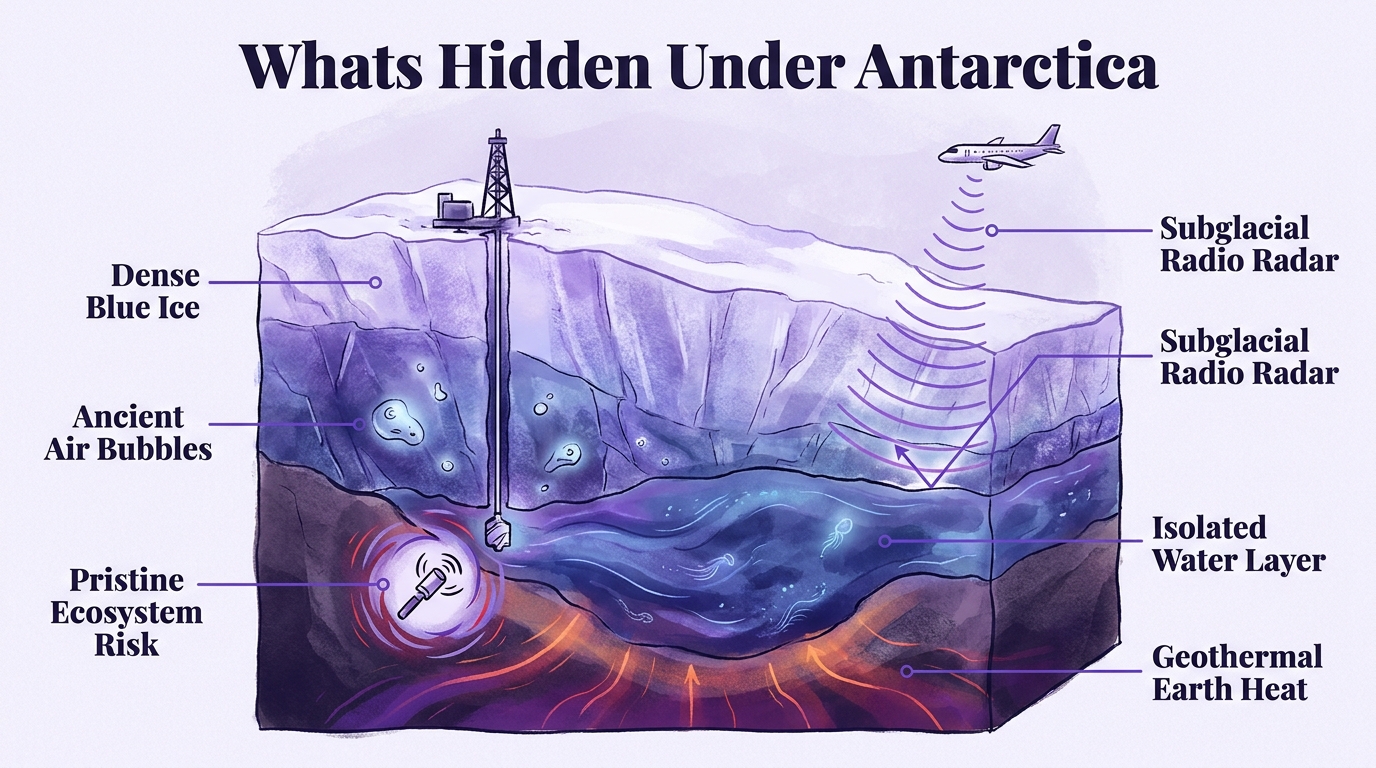
0:00Drilling into the Antarctic ice sheet reveals layers of history frozen in time. As depth increases, soft surface snow compresses into dense blue ice, trapping ancient atmospheric air bubbles. These trapped bubbles provide a timeline of Earth's atmosphere, preserving samples from the Renaissance, ancient Rome, and the last Ice Age.
Going deeper into the ice sheet increases environmental pressure while temperatures rise due to geothermal heat from Earth's core. At a depth of four kilometers, the extreme pressure and geothermal energy turn the solid ice into liquid water, exposing a hidden underground aquatic environment.
2. Discovering Lake Vostok
0:28Descending through the ice brings you into Lake Vostok, a subglacial lake comparable in surface area to Jamaica. Sealed beneath four kilometers of ice for at least 15 million years, the lake has remained completely isolated from Earth's surface atmosphere and light. This extreme environment may harbor organisms that have evolved independently for millions of years.
Scientists initially detected Lake Vostok by sending radar radio waves through the Antarctic ice sheet from aircraft. The radar signals bounced off a distinct, flat horizontal layer beneath the ice, confirming the presence of a vast body of liquid water.
3. Sampling and Environmental Concerns
0:55In 2012, a Russian research team successfully drilled down to Lake Vostok using specialized equipment. To prevent surface contamination, they allowed a small amount of lake water to enter the bottom of the borehole and freeze, then retrieved that ice sample for scientific analysis. Initial tests uncovered unusual bacterial DNA, though conclusions about complex life remain tentative.
Further exploration of Lake Vostok remains controversial due to the risk of contaminating pristine ecosystems. However, satellite and radar surveys have revealed over 400 subglacial lakes beneath Antarctica, opening up new possibilities for studying life in extreme environments.
Questions this video answers
How deep is Lake Vostok beneath the ice?
Lake Vostok lies approximately four kilometers (around 13,000 feet) beneath the Antarctic ice sheet. It stays in liquid form due to the pressure of the ice above and geothermal heat radiating from Earth's core.
How do scientists know subglacial lakes exist without drilling?
Researchers used ice-penetrating radar equipment mounted on aircraft to map the subsurface of Antarctica. Smooth, flat reflection lines in the radar data indicated the presence of liquid water bodies beneath the ice.
Has life been found in Lake Vostok?
In 2012, Russian scientists drilled to the surface of Lake Vostok and extracted samples of ice formed from lake water. Analysis revealed unusual bacterial DNA, though evidence of complex organisms remains unconfirmed.
Why is exploring subglacial lakes controversial?
Because these lakes have been isolated from the outside world for millions of years, introducing modern drills, chemicals, or surface microbes risks contaminating untouched ecosystems and distorting scientific findings.
Ask a follow-up Premium
About this summary
SumTube AI wrote this recap from the video's words and chapters. Credit and the original belong to Cleo Abram.