
Free AI summary of this YouTube video by SumTube
What causes economic bubbles? - Prateek Singh
TL;DR
This video explores the economic phenomenon of market bubbles by examining the historical example of Tulip Mania in 17th-century Holland. It breaks down how speculative manias develop through feedback loops driven by supply and demand, and how they inevitably collapse when market prices stray too far from intrinsic value.

Key takeaways
- 0:47During the Dutch Golden Age in the 17th century, Amsterdam emerged as a major global commercial hub
- 3:20A market mania occurs when buyers are willing to pay astronomical prices for items with relatively low intrinsic value
- 5:03A speculative bubble collapses as soon as market participants collectively realize that prices have vastly outpaced intrinsic value
Tap to enlarge
Most valuable section
How Speculative Bubbles Work3:20
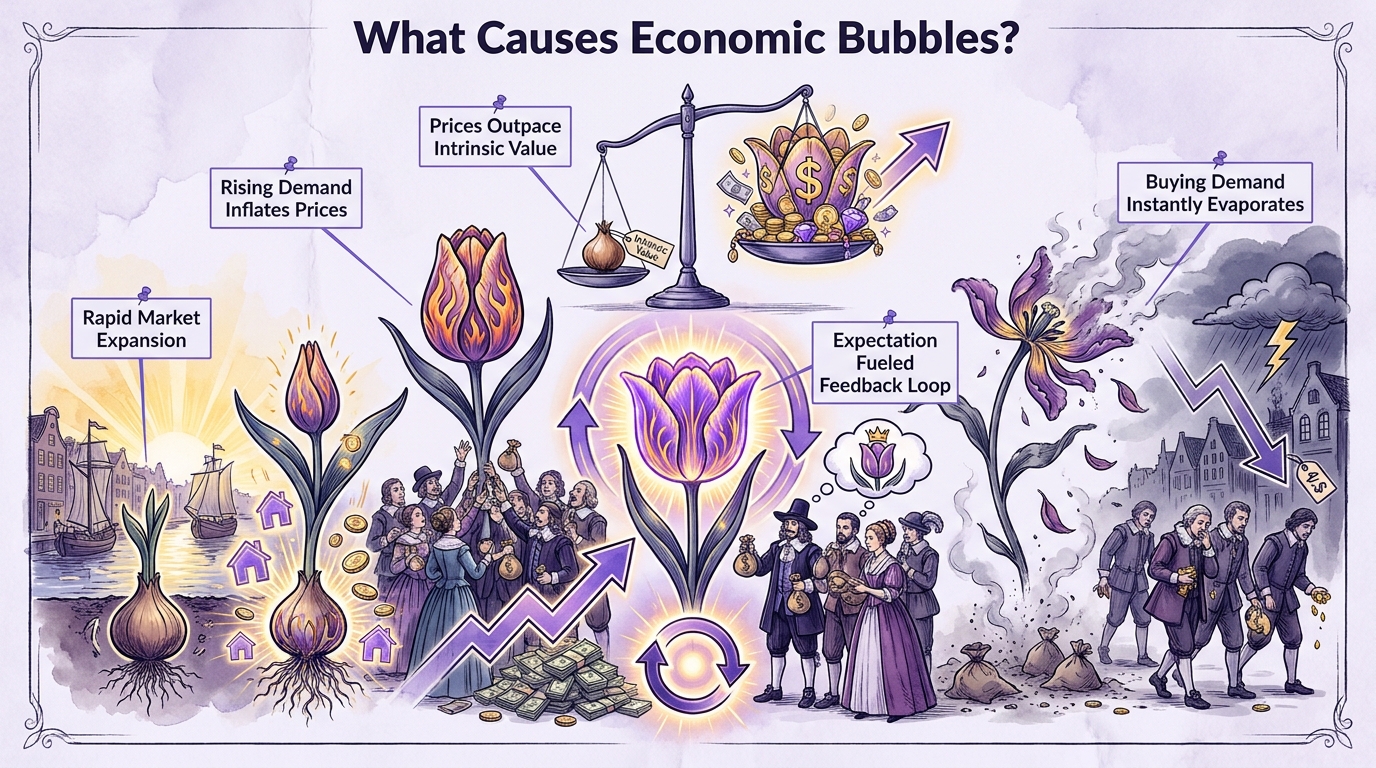
As investors anticipate future value, rising demand inflates prices further, driving the asset's market value far above any realistic measure of its true worth.
Detailed summary
1. Introduction to Economic Bubbles
0:00An economic bubble is a cycle defined by rapid market expansion followed by a sharp contraction. Throughout history, various assets—ranging from real estate and internet stocks to simple flowers—have seen their prices skyrocket far beyond their true value before suddenly crashing.
Understanding the mechanics of a bubble helps explain why speculative behavior repeatedly occurs across different eras. To illustrate this pattern, the video examines one of the earliest and most famous market crashes in history: Tulip Mania.
2. The Rise of Tulip Mania
0:47During the Dutch Golden Age in the 17th century, Amsterdam emerged as a major global commercial hub. Wealthy merchants showcased their prosperity by surrounding their mansions with exotic gardens, making rare tulips a highly prized status symbol.
The demand escalated further when a plant virus created unique, flame-like patterns on select tulip petals. Because these rare varieties took years to cultivate, extreme scarcity paired with immense popularity sparked a speculative frenzy known as Tulip Mania.
3. How Speculative Bubbles Work
3:20A market mania occurs when buyers are willing to pay astronomical prices for items with relatively low intrinsic value. At the height of Tulip Mania, a single bulb could cost more than ten times the annual salary of a skilled craftsman, mirroring modern speculative events like the late 1990s dot-com bubble.
This process is driven by an expectation-fueled feedback loop. As investors anticipate future value, rising demand inflates prices further, driving the asset's market value far above any realistic measure of its true worth.
4. The Bursting of the Bubble
5:03A speculative bubble collapses as soon as market participants collectively realize that prices have vastly outpaced intrinsic value. Once confidence falters, buying demand instantly evaporates, triggering a panic sell-off that plummets prices back down.
In both 17th-century Tulip Mania and the 2008 real estate crash, this sudden shift in market sentiment brought an abrupt end to the mania. Studying historical market cycles helps economists better identify modern booms and busts as they unfold.
Questions this video answers
What does this video say about Introduction to Economic Bubbles?
An economic bubble is a cycle defined by rapid market expansion followed by a sharp contraction. Throughout history, various assets—ranging from real estate and internet stocks to simple flowers—have seen their prices skyrocket far beyond their true value before suddenly crashing. Understanding the mechanics of a bubble helps explain why speculative behavior repeatedly occurs across different eras
What does this video say about The Rise of Tulip Mania?
During the Dutch Golden Age in the 17th century, Amsterdam emerged as a major global commercial hub. Wealthy merchants showcased their prosperity by surrounding their mansions with exotic gardens, making rare tulips a highly prized status symbol. The demand escalated further when a plant virus created unique, flame-like patterns on select tulip petals. Because these rare varieties took years to cu
What does this video say about How Speculative Bubbles Work?
A market mania occurs when buyers are willing to pay astronomical prices for items with relatively low intrinsic value. At the height of Tulip Mania, a single bulb could cost more than ten times the annual salary of a skilled craftsman, mirroring modern speculative events like the late 1990s dot-com bubble. This process is driven by an expectation-fueled feedback loop. As investors anticipate futu
What does this video say about The Bursting of the Bubble?
A speculative bubble collapses as soon as market participants collectively realize that prices have vastly outpaced intrinsic value. Once confidence falters, buying demand instantly evaporates, triggering a panic sell-off that plummets prices back down. In both 17th-century Tulip Mania and the 2008 real estate crash, this sudden shift in market sentiment brought an abrupt end to the mania. Studyin
Ask a follow-up Premium
About this summary
SumTube AI wrote this recap from the video's words and chapters. Credit and the original belong to TED-Ed.