
Free AI summary of this YouTube video by SumTube
We Don't All Have a "Mind's Eye" | Aphantasia
TL;DR
This video explores aphantasia, a neurological condition characterized by the inability to voluntarily create visual imagery in one's mind's eye. The host discusses how aphantasia was discovered, how researchers test for it, and how it impacts memory, emotion, and perception.
Key takeaways
- 0:48Aphantasia was first recognized after a man lost his visual imagery abilities following a minor stroke, prompting other individuals to share similar lifelong experiences
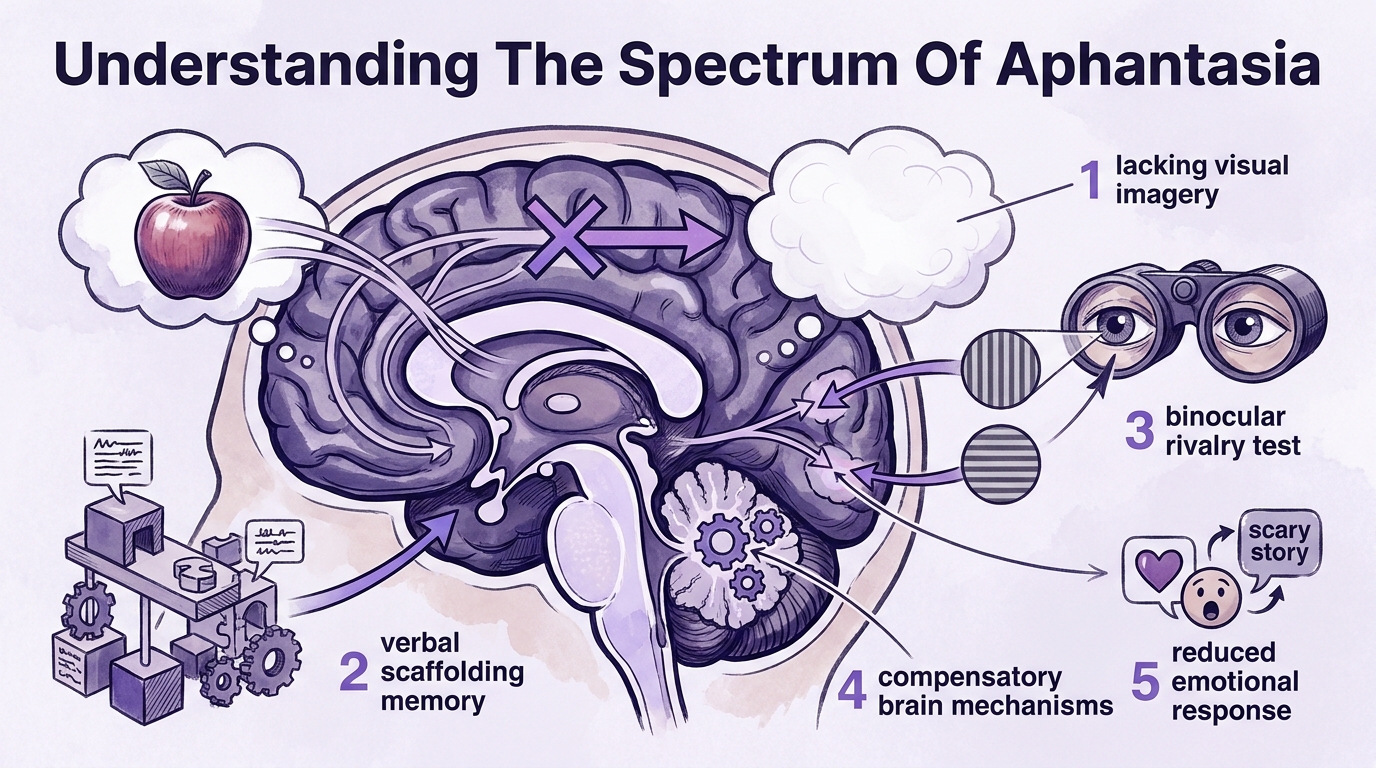
- 5:46Studies demonstrate that people with aphantasia reconstruct memories using "verbal scaffolding"—describing details with text and factual knowledge rather than mental pictures
- 0:48Researchers confirm the physiological reality of aphantasia through tests like binocular rivalry, where visual imagery normally biases perception
- 0:48In individuals with aphantasia, imagery priming has no effect, proving their mind's eye operates differently
- 5:46While they recall fewer details overall, their spatial placement is accurate and they make fewer false additions than non-aphantasic control groups
Tap to enlarge
Most valuable section
Scientific Testing and Neural Basis0:48
However, for those born with it, MRI scans reveal compensatory mechanisms: individuals use regions like the anterior cingulate to rely on spatial awareness, verbal descriptions, and logical memory rather than visual reca
Detailed summary
1. What is Aphantasia?
0:00when asked to visualize a red apple, most people can picture a clear image in their mind, but some people cannot see anything at all. This lack of a visual imagination or "mind's eye" is known as aphantasia, a condition first formally identified by the scientific community in 2010.
Aphantasia is not just a metaphor or a miscommunication of experience; it represents a fundamental difference in how the brain processes imagination, memory, and emotion. The condition exists on a spectrum, with some individuals experiencing faint visual imagery and others unable to construct mental images whatsoever.
2. Scientific Testing and Neural Basis
0:48Aphantasia was first recognized after a man lost his visual imagery abilities following a minor stroke, prompting other individuals to share similar lifelong experiences. Researchers confirm the physiological reality of aphantasia through tests like binocular rivalry, where visual imagery normally biases perception. In individuals with aphantasia, imagery priming has no effect, proving their mind's eye operates differently.
Brain injury studies show that damage to the occipital or parietal lobes can cause acquired aphantasia. However, for those born with it, MRI scans reveal compensatory mechanisms: individuals use regions like the anterior cingulate to rely on spatial awareness, verbal descriptions, and logical memory rather than visual recall.
3. Impact on Emotion and Memory
5:46Studies demonstrate that people with aphantasia reconstruct memories using "verbal scaffolding"—describing details with text and factual knowledge rather than mental pictures. While they recall fewer details overall, their spatial placement is accurate and they make fewer false additions than non-aphantasic control groups.
Additionally, research shows that emotional responses can be directly linked to visual imagery. While reading scary stories induces stress-related physiological responses (like increased skin conductance) in typical visualizers, individuals with aphantasia do not experience this physical fear response, highlighting the deep connection between visualization and emotion.
Questions this video answers
What does this video say about What is Aphantasia?
when asked to visualize a red apple, most people can picture a clear image in their mind, but some people cannot see anything at all. This lack of a visual imagination or "mind's eye" is known as aphantasia, a condition first formally identified by the scientific community in 2010. Aphantasia is not just a metaphor or a miscommunication of experience; it represents a fundamental difference in how
What does this video say about Scientific Testing and Neural Basis?
Aphantasia was first recognized after a man lost his visual imagery abilities following a minor stroke, prompting other individuals to share similar lifelong experiences. Researchers confirm the physiological reality of aphantasia through tests like binocular rivalry, where visual imagery normally biases perception. In individuals with aphantasia, imagery priming has no effect, proving their mind'
What does this video say about Impact on Emotion and Memory?
Studies demonstrate that people with aphantasia reconstruct memories using "verbal scaffolding"—describing details with text and factual knowledge rather than mental pictures. While they recall fewer details overall, their spatial placement is accurate and they make fewer false additions than non-aphantasic control groups. Additionally, research shows that emotional responses can be directly linke
Ask a follow-up Premium
About this summary
SumTube AI wrote this recap from the video's words and chapters. Credit and the original belong to SciShow Psych.