
Free AI summary of this YouTube video by SumTube
Voynich Manuscript Decoded | The Mysterious Book Finally Solved?
TL;DR
The Voynich Manuscript is a mysterious 15th-century codex filled with unrecognizable text and bizarre illustrations of plants, astrological charts, and women in baths. Despite centuries of effort by top cryptographers, linguists, and computer scientists, no translation attempt has held up to academic scrutiny. Ultimately, the manuscript remains an unsolved enigma, with theories ranging from medieval hoax to lost ancient dialect.
Key takeaways
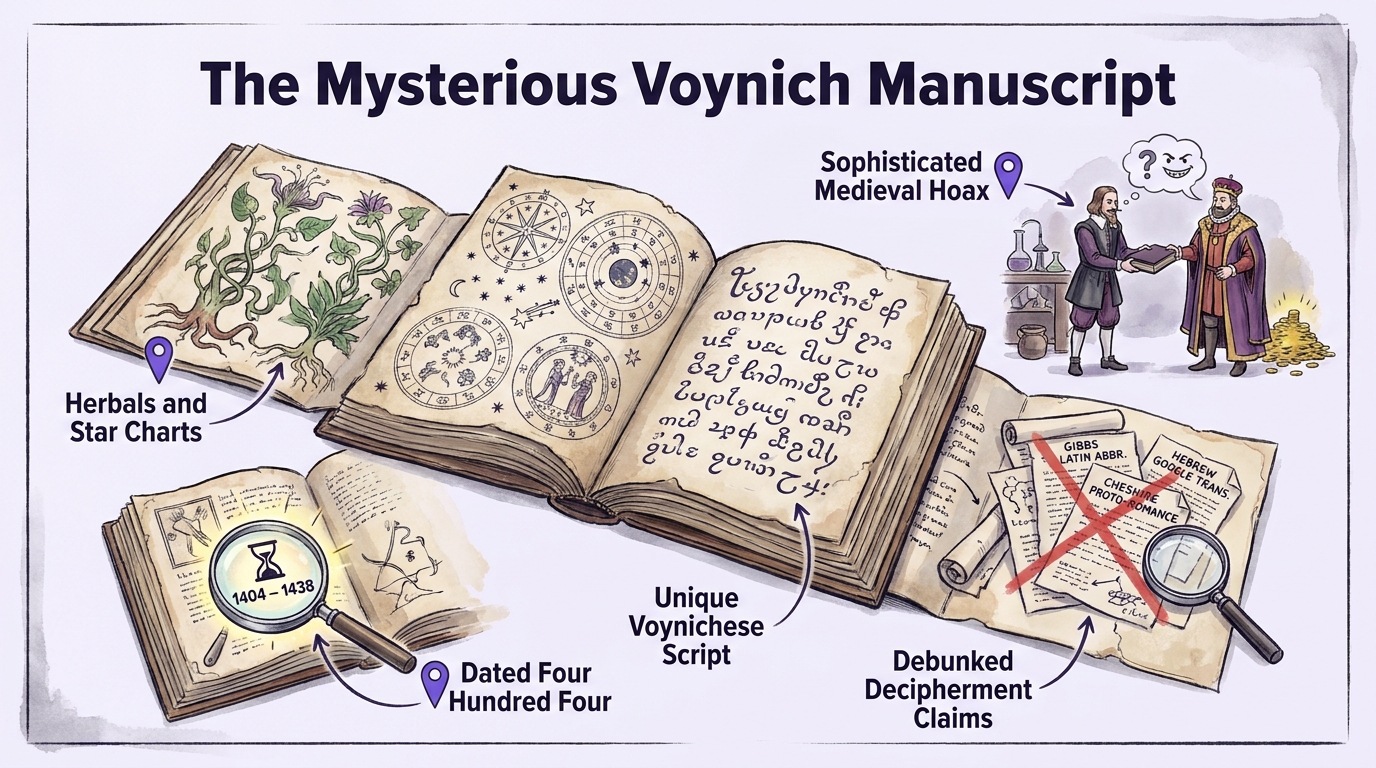
- 9:02Every claimed breakthrough to decode the manuscript, including Hebrew, Latin, and unknown proto-languages, has been debunked by experts
- 12:21Scientific analysis carbon-dates the calfskin pages to between 1404 and 1438, likely originating in Northern Italy
- 5:33The manuscript's text, termed 'Voynichese,' exhibits structured linguistic properties with 20 to 25 unique letters, yet lacks any recognized cipher pattern
- A plausible theory suggests the text could be a medieval scam or 'angelic' gibberish created to fool early collectors like Emperor Rudolf II
Tap to enlarge
Most valuable section
For whom
Enthusiasts of historical mysteries, cryptography, and strange historical artifacts.
Failed Decipherment Attempts and Debunked Theories7:38
It showcases how modern researchers, computer scientists, and TV writers repeatedly fell into the trap of confirmation bias trying to solve the text.
Detailed summary
1. Introduction to the Voynich Manuscript
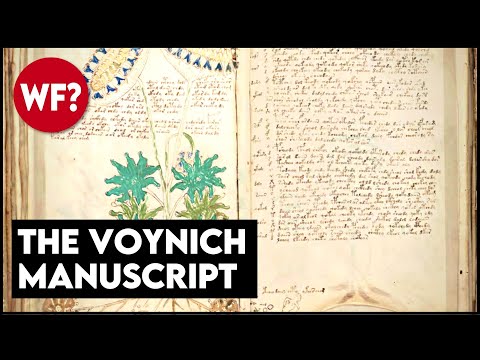
0:01The Voynich Manuscript is an undeciphered 240-page medieval codex that has confounded cryptographers, computer scientists, and historians for 600 years. Containing strange drawings of unknown plants, celestial diagrams, and mysterious nude figures, it defies traditional categorization.
Despite attempts by legendary figures such as Alan Turing and top FBI cryptanalysts, the book remains unread. Its mysterious origins and peculiar visual style have made it one of the most famous unsolved puzzles in literary history.
2. The Four Sections of the Codex
2:19Historians categorize the manuscript into four distinct sections: herbal, astrological, balneological, and pharmacological. The herbal section features bizarre, twisted plants being consumed by strange reptilian creatures, while the astrological section displays sky charts intertwined with women emerging from tubes.
The balneological section is the most famous, detailing naked women swimming and lounging in complex networks of pipes and tubs. Finally, the pharmacological section contains dense blocks of undecoded text alongside illustrations of medicinal containers.
3. The Structure of Voynichese and Alien Theories
5:33The script, dubbed 'Voynichese,' is written from left to right and consists of 20 to 25 distinct characters. While cryptographers agree that the text exhibits structural patterns similar to real human languages, no one has been able to establish a working alphabet or cipher.
Due to the unidentifiable star charts and unique script, popular internet theories suggest the text was written by an extraterrestrial who crash-landed in the 1400s. With standard cryptanalysis failing for centuries, unconventional explanations continue to flourish.
4. Failed Decipherment Attempts and Debunked Theories
7:38Numerous researchers have claimed to solve the manuscript, only to be quickly debunked. German Egyptologist Rainer Hannig posited a Semitic/Hebrew origin, while researcher Gerard Cheshire claimed it was a lost Romance language, though both theories faced heavy academic criticism for forcing translation meaning onto random patterns.
Other failed attempts include a 2017 proposal by Nicholas Gibbs claiming it was a Latin-abbreviated women's health manual, and a 2016 effort using Google Translate on Hebrew characters. To date, over 60 published decipherment claims have all proven invalid under expert review.
5. Proven History and Origins of the Book
12:13While the text remains mysterious, physical testing has provided concrete facts about its creation. Carbon-dating conducted by the University of Arizona dates the calfskin parchment to between 1404 and 1438, with visual styles and pigments pointing toward a Northern Italian origin.
The manuscript first entered historical records in the late 16th century when Holy Roman Emperor Rudolf II purchased it. After passing through several alchemists and disappearing for centuries, it was acquired by Wilfrid Voynich in 1912 and now resides at Yale University.
6. The Hoax Theory and Final Conclusions
15:01One of the most convincing explanations is that the book was a sophisticated medieval hoax created by fraudster Edward Kelley to trick Emperor Rudolf II into buying an expensive mystery. Kelley famously claimed to transcribe the spoken language of angels during mystical trances.
If the text is indeed a transcription of fabricated 'angelic' glossolalia, traditional cryptanalysis will never succeed. Until further evidence emerges, the Voynich Manuscript remains an enticing, unsolved window into medieval imagination.
Questions this video answers
What is the Voynich Manuscript and what is inside it?
The Voynich Manuscript is a 240-page medieval codex written in an indecipherable script known as 'Voynichese'. It is divided into four main sections—herbal, astrological, balneological (baths), and pharmacological—featuring drawings of unidentified plants, star charts, and naked women in intricate bath networks.
Has anyone successfully decoded the Voynich Manuscript?
No, over 60 proposed solutions have been published and subsequently debunked by scholars. Translators claiming it was based on Hebrew, Latin abbreviations, or a lost Romance language failed under peer review.
Where did the Voynich Manuscript come from?
Carbon-dating places the creation of its parchment between 1404 and 1438 in Northern Italy. Its recorded history begins in the late 16th century when Holy Roman Emperor Rudolf II purchased it, before it eventually surfaced in 1912 through book dealer Wilfrid Voynich.
Ask a follow-up Premium
About this summary
SumTube AI wrote this recap from the video's words and chapters. Credit and the original belong to The Why Files.