
Free AI summary of this YouTube video by SumTube
Verheyen Academy | Avarie commune
TL;DR
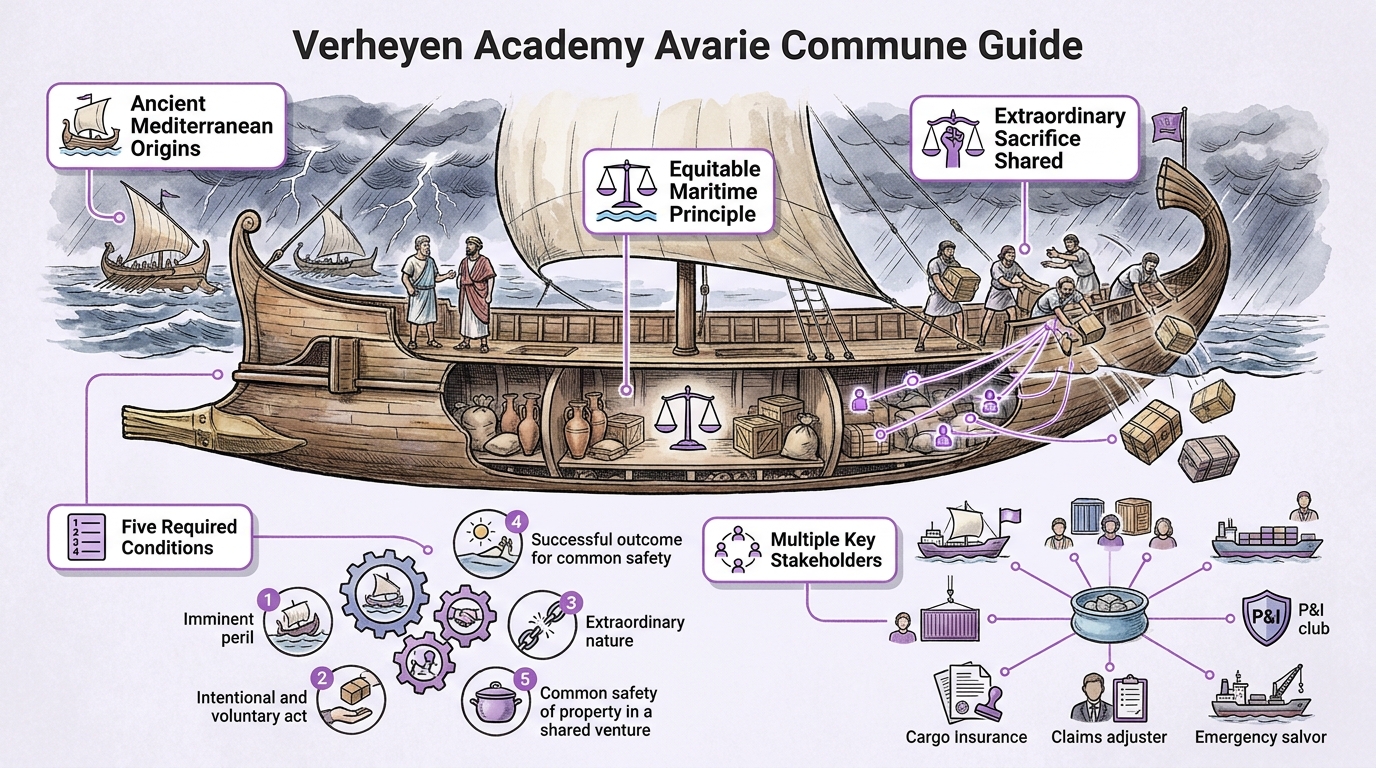
This educational session from Verheyen Academy introduces the fundamentals of maritime General Average from a cargo interest perspective. It covers the historical origins of General Average dating back to ancient Mediterranean traders, outlines the formal legal definition and its five core conditions, and details the key stakeholders involved in maritime casualties.

Key takeaways
- 5:44General Average is an equitable maritime principle ensuring financial losses from extraordinary sacrifices are shared proportionally among all parties involved
- 7:05For an event to qualify as General Average, it must involve an intentional, extraordinary, and successful sacrifice or expenditure during an imminent peril
- 12:12Managing a General Average casualty on modern megaships involves coordinating thousands of individual cargo owners, insurers, adjusters, and legal representatives
Tap to enlarge
Most valuable section
For whom
Maritime logistics professionals, cargo owners, and marine insurance claims handlers looking to understand the core mechanics of maritime General Average.
The Five Conditions of General Average7:05
This section breaks down the precise legal and practical criteria required before a casualty can be formally classified as a General Average act.
Detailed summary
1. Introduction to the General Average Course
0:00This course presents a practical guide to understanding and handling General Average situations from a daily operational perspective rather than a strictly legal one. It introduces a four-module framework covering the history, practical guidelines, York-Antwerp Rules, and real-life case studies of maritime casualties.
2. Historical Origins of General Average
3:24The origins of General Average date back to ancient Mediterranean trading routes used by the Phoenicians and Carthaginians. Merchants traveled alongside their cargo, and when faced with severe storms, agreed to jettison goods to prevent capsizing under the agreement that all surviving parties would share the financial losses proportionally upon reaching port.
3. Definition and Five Conditions of General Average
5:51General Average is formally defined as an extraordinary sacrifice or expenditure intentionally and reasonably incurred for the common safety of property in a shared maritime venture. To qualify, five conditions must be met: an extraordinary event, intentional action by the captain, benefit for common safety, presence of imminent peril, and ultimate success in saving the property.
4. Stakeholders and Typical Incidents
9:05Multiple stakeholders are involved in General Average casualties, including vessel owners, cargo owners, container owners, P&I clubs, cargo insurers, adjusters, and emergency salvors. Common incidents triggering General Average declarations include vessel groundings requiring towage, cargo fires requiring chemical extinguishment, and piracy ransom payments.
Questions this video answers
What is the historical origin of General Average?
General Average originated with ancient Mediterranean sea traders, such as the Phoenicians, traveling with their cargo on small wooden vessels. When severe storms threatened to capsize the ship, merchants would agree to jettison cargo to save the voyage on the condition that all participating merchants and ship owners would proportionally share the financial loss upon safe arrival.
What conditions must be met to declare General Average?
Five specific criteria must be met: the sacrifice or expenditure must be extraordinary (unexpected), intentionally made by voluntary decision of the captain, carried out for the common safety of all interests, executed during real and imminent peril, and successful in saving both the ship and cargo.
Who are the primary stakeholders in a General Average situation?
The main physical stakeholders include the vessel owner, bunker suppliers, cargo owners, freight owners, and container owners. They are backed by various insurers, including Hull & Machinery insurers, P&I Clubs, cargo insurers, as well as appointed General Average adjusters, surveyors, salvors, and maritime lawyers.
Ask a follow-up Premium
About this summary
SumTube AI wrote this recap from the video's words and chapters. Credit and the original belong to Jean Verheyen.