
Free AI summary of this YouTube video by SumTube
Urbanização do Brasil - Resumo Ilustrado (Geografia)
TL;DR
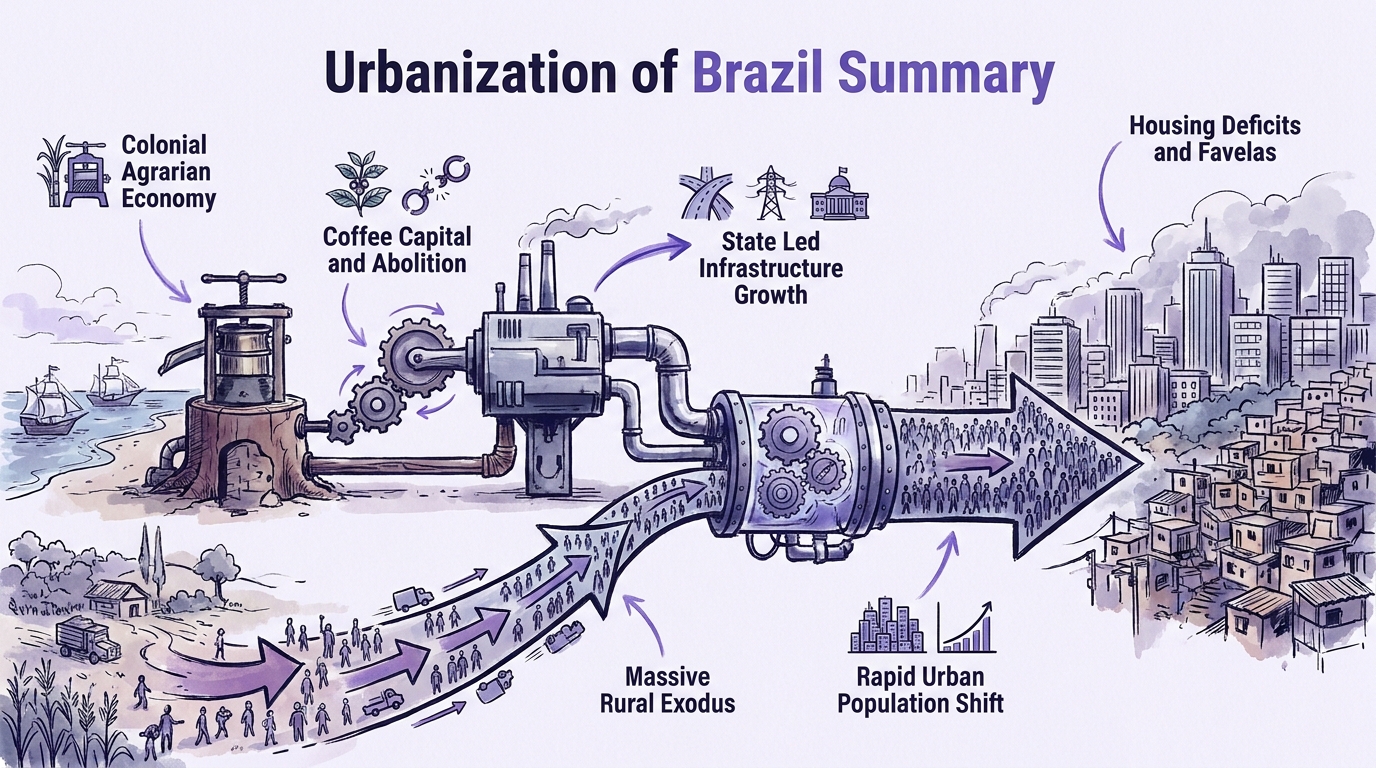
This educational video explores the history and key drivers of Brazilian urbanization, explaining how early colonial exploitation laid a delayed foundation for city growth. It details how the abolition of slavery, coffee production, and 1930s industrialization fueled rural-to-urban migration (êxodo rural), making Brazil a predominantly urban nation by the 1970s. Finally, it highlights the urban challenges resulting from rapid, unplanned growth, such as housing deficits, socio-spatial segregation, and favelization.

Key takeaways
- 0:28Brazil's colonial model of exploitation and slave labor severely delayed early urban development compared to settlement-focused colonies
- 3:43The abolition of slavery and coffee profits were crucial precursors that established a consumer market and funded early industrialization
- 8:40Brazil shifted to a majority urban population in the 1970s due to the interconnected triad of industrialization, rural modernization, and rural exodus
- 10:22Unplanned, highly concentrated urban expansion in major cities like São Paulo and Rio de Janeiro caused lasting social segregation and favelization
Tap to enlarge
Most valuable section
For whom
Students of geography, history, and urban planning seeking a clear, visual overview of Brazil's urban development
Synthesis: Urbanization, Industrialization, and Rural Exodus8:40
It neatly synthesizes the core core concept—the interconnected triad driving Brazil's demographic shift—and illustrates the exact moment in the 1970s when the urban population surpassed the rural population.
Detailed summary
1. Historical Context & Colonial Agrarian Economy
0:00The lesson opens by comparing the colonization of North America (settlement) with South America and Brazil (exploitation). Early Brazilian urban centers were largely restricted to coastal port cities like São Vicente and Salvador to facilitate exporting raw materials and agricultural goods back to Europe.
For centuries, Brazil's economy remained strictly agrarian, reliant on large land holdings (latifúndios) and slave labor. The lack of a wage-earning free class hindered the growth of a domestic market, keeping urban infrastructure low until the arrival of the Portuguese royal family in 1808 initiated basic civic improvements.
2. Precursors to Industrialization: Abolition & Coffee
3:43Two major factors laid the foundation for 20th-century urban growth: the abolition of slavery in 1888 and the rise of the coffee economy. Abolition created a wage-earning class that spurred internal consumer demand, while coffee production in the late 19th and early 20th centuries generated capital accumulation.
This accumulated capital and economic dynamism provided the necessary financial resources to fund industrial development, paving the way for sweeping structural changes in Brazilian society.
3. The 1930s and State-Led Urban Infrastructure
5:30During the Era Vargas in the 1930s, the Brazilian state began investing heavily in urban infrastructure to support emerging domestic industries. Roadways, utilities, and public services were developed to facilitate the flow and consumption of manufactured goods.
These state investments transformed urban centers into economic hubs, making cities far more attractive to rural workers and triggering a massive internal migration wave from the countryside to urban areas.
4. Rural Exodus and Demographic Shift
7:16Between the 1950s and 1980s, Brazil experienced an intense rural exodus. This mass migration was driven by dual pressures: the pull of industrial jobs in growing cities and the push of rural modernization and land concentration that displaced agricultural laborers.
This created a direct triad between industrialization, rural exodus, and rapid urbanization. Census data reveals that by the 1970s, Brazil's urban population officially surpassed its rural population for the first time.
5. Urban Challenges: Deficits, Segregation, and Favelization
10:22Because Brazil's urban growth was fast and largely unplanned, cities were unable to adequately accommodate incoming populations. Migration concentrated overwhelmingly in major metropolises such as São Paulo and Rio de Janeiro.
This rapid influx without matching infrastructure resulted in severe housing deficits, widespread socio-spatial segregation, and the proliferation of informal settlements and favelas, forming defining challenges of contemporary Brazilian cities.
Questions this video answers
Why did urban development take so long to start in Brazil?
Unlike North American settlement colonies, Brazil was colonized under an exploitation model based on large agrarian estates (latifúndios) and slave labor. This structure prevented the growth of a domestic consumer market and internal purchasing power, leaving cities with minimal infrastructure until the arrival of the Portuguese royal family and the 20th century.
When did Brazil officially become a predominantly urban country?
Brazil became a majority-urban nation during the 1970s. This shift occurred after decades of accelerated rural exodus driven by city industrialization and the mechanization and land concentration in rural areas.
What major socio-economic problems were created by rapid urbanization in Brazil?
Because urban growth was rapid and unplanned, major cities like São Paulo and Rio de Janeiro lacked the infrastructure to absorb incoming populations. This led to a severe housing deficit, socio-spatial segregation, and widespread favelization.
Ask a follow-up Premium
About this summary
SumTube AI wrote this recap from the video's words and chapters. Credit and the original belong to geo ilustrada.