
Free AI summary of this YouTube video by SumTube
⚠️Trying very hard but not getting the forehand topspin you want?‼️
TL;DR
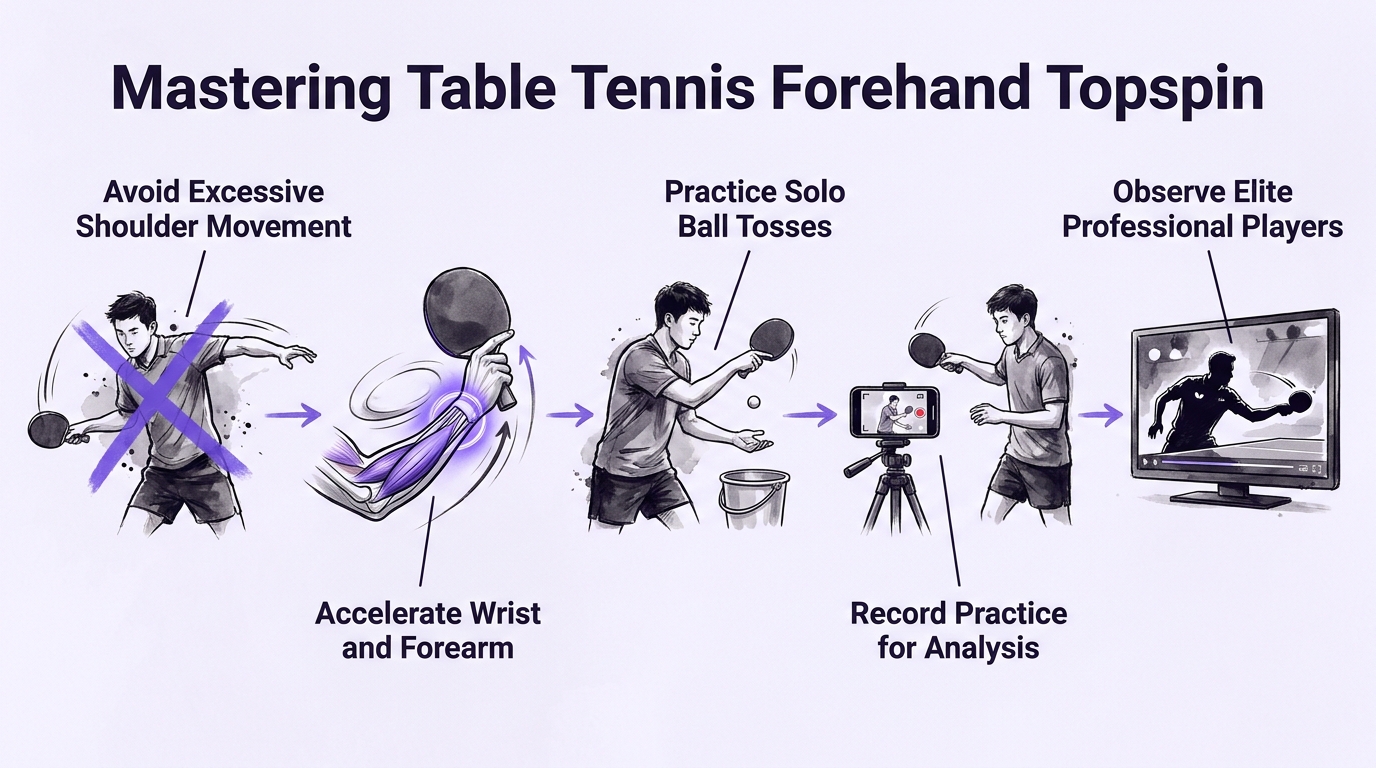
This video breaks down the proper biomechanics of the table tennis forehand topspin, focusing on generating speed and spin through wrist and forearm motion rather than large shoulder movements. It details how over-involving the shoulder slows down bat speed and degrades shot quality. Finally, it outlines solo practice routines and self-filming strategies to re-train muscle memory effectively.

Key takeaways
- 2:04Using your shoulder to drive a forehand topspin slows down the bat and reduces spin
- 3:48Maximum power and spin come from flexing the wrist back and closing the forearm through impact
- 5:29Solo ball-tossing drills allow players to fix stroke mechanics without the pressure of keeping rallies alive
- Correct technical adjustments often feel unnatural at first, making video analysis crucial for feedback
Tap to enlarge
Most valuable section
For whom
Table tennis players struggling to generate power and spin on their forehand strokes.
Wrist Isolation and Stroke Mechanics2:04
It clearly demonstrates how engaging the shoulder slows down bat speed and proves why isolating the wrist creates maximum stroke quality.
Detailed summary
1. Grip and Common Forehand Errors
0:00The tutorial begins with an overview of the basic grip for a forehand topspin, holding three fingers around the bottom of the handle while keeping the thumb and index finger comfortable on opposite sides of the rubber. Proper hand placement provides the stability needed before initiating the backswing and stroke motion.
Many beginner and intermediate players make the mistake of using excessive shoulder and body movement, which cuts out essential spin and speed. Over-exerting the shoulder leads to diminishing returns, causing players to exert more effort while producing weaker, less controlled shots.
2. Wrist Isolation and Stroke Mechanics
2:04Because a table tennis racket is lightweight, maximum speed and spin come almost entirely from wrist acceleration and subtle finger control. Engaging the shoulder or swinging widely from the elbow actually causes the wrist to slow down, dramatically reducing contact quality.
To execute a proper forehand topspin, players should stabilize the shoulder and elbow while cocking the wrist back. Sweeping the wrist back and snapping the forearm closed through the ball provides a reliable, high-efficiency formula for generating power.
3. Solo Practice Drill at Home
5:17For players looking to rebuild their mechanics, practicing during live multi-ball or rally drills can be overwhelming because the primary focus shifts to keeping the ball on the table. A dedicated solo drill isolates technical movement so players can hone their form without needing a training partner or a full table setup.
To perform the drill, hold a bucket of balls and gently toss each ball directly toward your racket rather than high in the air. Focus on drawing the wrist back and following through quickly upon contact, repeating the motion continuously to build sound muscle memory.
4. Fixing Habits and Video Analysis
9:02Correcting long-standing technical habits takes considerable time and patience, as muscle memory often makes improper swings feel natural. Because correct movements initially feel strange, relying purely on body awareness can be misleading when trying to overhaul a stroke.
Filming practice sessions is critical for tracking true progress and verifying stroke mechanics. Video feedback helps bridge the gap between perception and reality, confirming whether the wrist and forearm are moving correctly regardless of how awkward the new technique feels.
5. Pro Player Examples
12:04The video concludes by analyzing footage of elite professional players like Liam Pitchford executing forehand topspins in match scenarios. Observing world-class players highlights how the wrist initiates the backswing and drives through the ball to overpower incoming blocks.
By watching these high-level examples, viewers can see the practical application of wrist snapping and full follow-through under real playing conditions.
Questions this video answers
Why shouldn't I use my shoulder when hitting a forehand topspin?
Unlike tennis or badminton, table tennis uses a much smaller, lighter racket that relies on fast wrist and finger acceleration. Engaging your shoulder or elbow slows down your wrist speed, which ultimately reduces the velocity and spin you can impart on the ball.
How can I practice forehand topspin mechanics without a partner?
You can practice by tossing balls lightly toward your racket with one hand while standing next to a table or open space. Focus entirely on cocking your wrist back and closing your forearm on contact without worrying about sustaining a rally.
Why is video recording recommended when practicing table tennis strokes?
Proper stroke changes often feel uncomfortable or strange initially because they break old muscle memory habits. Filming yourself provides objective visual feedback so you can verify whether your technique is actually correct regardless of how it feels.
Ask a follow-up Premium
About this summary
SumTube AI wrote this recap from the video's words and chapters. Credit and the original belong to Heming Hu.