
Free AI summary of this YouTube video by SumTube
Titanic: Respuestas Desde el Abismo (Capítulo 1) | Documental
TL;DR
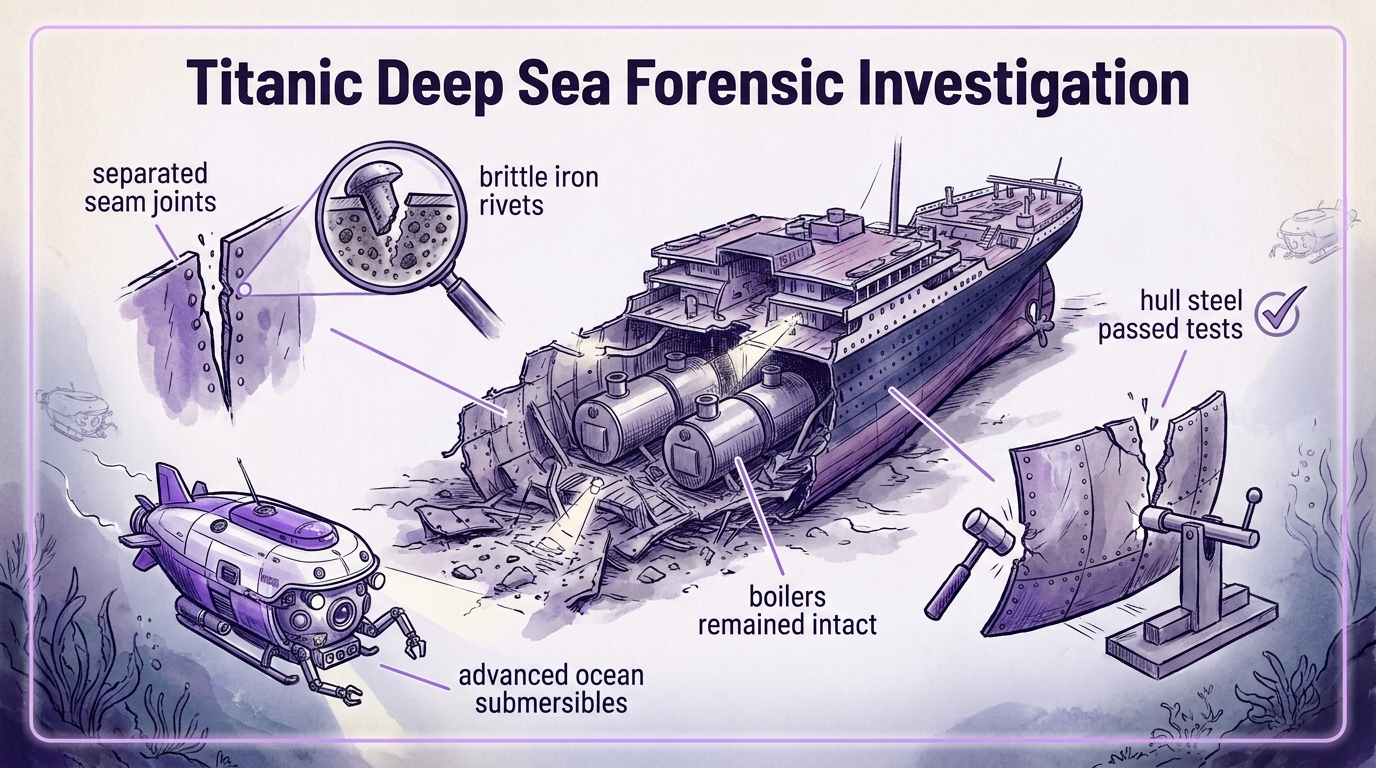
In 1998, an international team of marine engineers and scientists conducted the first comprehensive forensic investigation of the RMS Titanic wreck site. Utilizing advanced deep-sea ROVs, submersibles, and metallographic testing, the researchers investigated key mysteries surrounding the ship's sinking, including the true nature of the iceberg damage, whether the boilers exploded, and the quality of the ship's steel and rivets.
Key takeaways
- 19:48Sonar and underwater inspection revealed that iceberg damage was not a massive 90-meter gash, but rather a series of thin openings caused by separated seam joints
- 25:46Metallurgical testing on recovered rivets showed an excessive concentration of slag, making iron rivets brittle and prone to snapping under stress
- 38:40Close-up analysis of the Titanic's boilers proved they did not explode or implode during the sinking, disproving long-held survivor myths
- 45:42Fracture toughness tests on recovered hull steel confirmed the steel itself was strong and not inherently defective
Tap to enlarge
Most valuable section
For whom
Naval history enthusiasts, marine engineers, and Titanic historians looking for a scientific, forensic analysis of the ship's sinking.
Iceberg Damage & Rivet Failure Analysis19:48
It shows real-time subsea exploration pinpointing the exact seam separations along the hull, followed by laboratory micro-analysis explaining how brittle rivets led to the catastrophe.
Detailed summary
1. A Scientific Forensic Investigation
0:00Nearly a century after the RMS Titanic sank to the bottom of the North Atlantic, taking over 1,500 lives, an international team of scientists, naval architects, and forensic engineers assembled to investigate the wreck. Operating from research vessels equipped with high-tech equipment, their goal was to apply modern forensic engineering to determine the precise sequence of events during the tragedy.
While historical narrative relied heavily on survivor testimony and initial post-sinking inquiries, many technical details remained unverified. By combining subsea footage, computer modelling, and physical sampling, the expedition set out to resolve key debate points regarding hull damage, structural integrity, and the ship's breakup.
2. Submersibles and Advanced Deep-Sea Tech
7:14The research expedition deployed specialized deep-submergence assets to explore the wreck at a depth of over 3,800 meters. These included the remotely operated vehicle Magellan 725, equipped with high-definition cameras and robotic arms, and the manned French submersible Nautile. Operating under immense pressure and freezing conditions, these vehicles allowed scientists to examine structural details up close.
Simultaneously, teams aboard research ships like the Ocean Voyager and Nadir analyzed incoming telemetry, mapping debris and coordinating dives. The dual approach allowed continuous monitoring and sampling across both the bow section and the heavily damaged stern section.
3. Locating Iceberg Damage Along the Bow
19:48Historically, it was believed the iceberg created a massive 90-meter tear along the starboard side of the hull. However, earlier sonar surveys suggested the damage consisted of narrow, scattered openings. To verify this, the Magellan ROV navigated along the mud line where the bow struck the ocean floor, searching for exposed hull plates.
Guided by historical accounts from stoker Frederick Barrett—who witnessed water entering boiler room 6 near the floor—the team located an open seam right along the mud line. Closer inspection confirmed that the hull plates were not torn open in a massive gash, but had separated along riveted joints.
4. Testing the Titanic's Rivets
22:22To understand why the hull seams separated, scientists collected sample rivets and steel plates from the debris field for laboratory testing. Back on the surface, materials scientists prepared cross-sections of the wrought iron rivets to examine their microstructure under optical microscopes.
The analysis revealed that some rivets contained an excessive percentage of slag—a byproduct of iron manufacturing. High slag concentrations made the iron brittle, particularly in icy temperatures, causing the rivet heads to snap off under the bending strain caused by the iceberg collision.
5. Creating the Photo Mosaic of the Wreckage
27:45To gain a clear perspective of the wreck's condition, the Nautile performed systematic photo passes across the bow and stern sections. Hundreds of overlapping high-resolution photographs were compiled into digital photo mosaics, providing an unprecedented view of key areas such as the Grand Staircase, Marconi radio room, and lifeboat davits.
These mosaics allowed naval architects to evaluate structural collapses and deformities across the entire ship. The visual evidence matched historical accounts of emergency operations while revealing new details about how upper decks collapsed during the descent.
6. Investigating the Boiler Explosion Theory
38:40Many survivors reported hearing loud explosions as the Titanic sank, leading to a long-standing theory that cold seawater caused the massive boilers to explode. The expedition investigated the boiler field in the debris zone as well as the intact boiler rooms inside the bow section.
Inspection of the single-ended and double-ended boilers revealed no signs of explosive rupture or structural collapse. The boilers remained intact, proving that the explosions heard by survivors were likely internal deck collapses, heavy machinery breaking loose, or air escaping as the ship submerged.
7. Retrieving 'The Big Piece' Hull Section
41:02To evaluate the quality of the Titanic's hull steel, salvage teams focused on recovering a 20-ton section of the hull known as 'The Big Piece.' Using heavy lift bags and towing lines, the team successfully brought the massive steel section to the surface and transported it to Boston Harbor for detailed analysis.
Naval architects and metallurgists inspected the recovered plate, noting its rivet hole alignments, plate thickness, and fracture edges near the area where the ship broke in two.
8. Metallurgical Tests on Titanic's Steel
44:22At the National Institute of Standards and Technology (NIST), scientists subjected samples of the recovered hull steel to mechanical bending and Charpy impact tests. The tests aimed to determine if the steel suffered from extreme low-temperature brittleness, a common hypothesis for the catastrophic failure.
The results demonstrated that while early 20th-century steel was more sensitive to cold than modern naval steel, the Titanic's steel possessed adequate strength and ductility. The steel itself was not defective, confirming that the sinking was driven by seam separation and overwhelming structural load during the breakup rather than weak hull plating.
Questions this video answers
Did the Titanic sink because of cheap or defective steel?
No, forensic tests performed by materials scientists on recovered hull steel proved it possessed high fracture toughness comparable to modern steel standards. The steel itself did not fail due to brittleness; rather, the structural failure was linked to extreme mechanical stress during the breakup and flawed seam rivets.
Did the iceberg cut a huge hole in the side of the Titanic?
Sonar imaging and deep-sea visual inspection showed there was no continuous 90-meter hole in the hull. Instead, the collision popped rivet heads along overlapping steel plates, causing thin seam separations that allowed water to flood multiple watertight compartments.
Did the Titanic's boilers explode as the ship sank?
No. When submersibles inspected the intact boilers resting both inside the bow section and scattered in the debris field, they were found structurally intact without signs of violent rupture or steam implosion.
Ask a follow-up Premium
About this summary
SumTube AI wrote this recap from the video's words and chapters. Credit and the original belong to Titanic - Canal Oficial.