
Free AI summary of this YouTube video by SumTube
Tips for Effective Technical Writing in Engineering
TL;DR
In this episode of The Engineering Career Coach Podcast, host Jeff Perry interviews Dr. Pam Hurley, founder of Hurley Write, Inc., about how engineers can dramatically improve their technical writing skills. Dr. Hurley shares practical strategies for overcoming common writing hurdles by viewing communication as a structured, objective problem-solving process rather than an arbitrary creative exercise.

Key takeaways
- 6:20Technical writing is an objective science based on readability principles, not a subjective opinion exercise
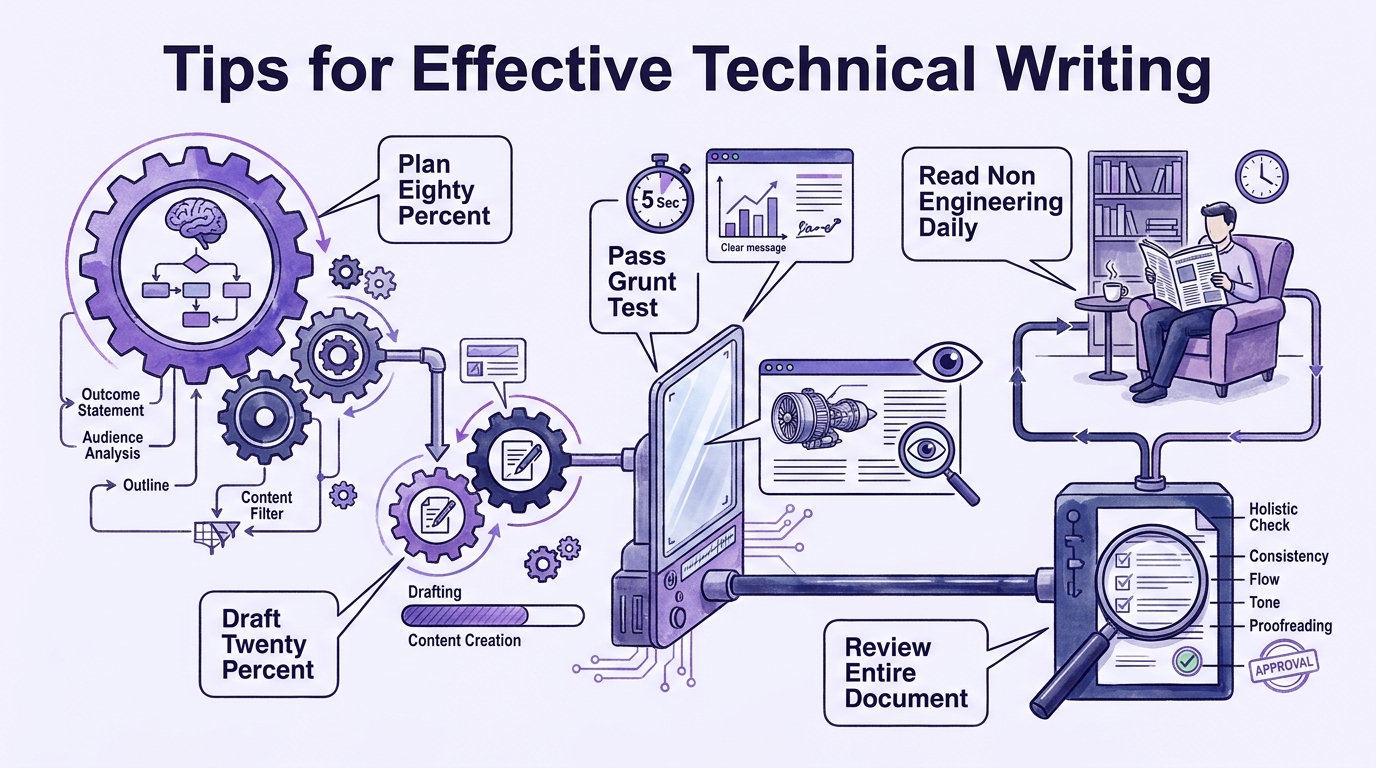
- 14:00Engineers should apply the 80/20 rule to writing, spending 80% of their time planning and only 20% drafting
- 9:30Visuals should augment the text and pass the 'grunt test,' conveying their primary message in under five seconds
- 17:50Daily reading of non-engineering content (novels, news) for 15 minutes helps engineers passively acquire natural sentence structures and vocabulary
Tap to enlarge
Most valuable section
For whom
Engineers and technical professionals who want to improve their report writing, proposals, and team communication.
Dr. Hurley breaks down the essential three-step action plan for writing any technical document effectively.
Detailed summary
1. Introduction & Overview
0:00Host Jeff Perry introduces Dr. Pam Hurley, PhD, founder and president of Hurley Write, Inc., a certified women-owned business specializing in writing training for technical professionals. They discuss the scope of the episode, which focuses on helping engineers overcome writing challenges, improve clarity, and adopt effective communication strategies.
2. Pam's Professional Career Overview
0:52Dr. Hurley shares her background in academia and explains why she transitioned into corporate technical writing training. She observed that traditional university education often fails to prepare students for real-world professional writing, prompting her to start a company that delivers practical, outcome-driven writing solutions.
3. Engineers' Common Writing Challenges
2:13The discussion turns to why so many engineers dislike and avoid writing. Dr. Hurley notes that when people dislike an activity, they tend to procrastinate, which prevents skill development. She encourages engineers to reframe writing by applying their natural analytical problem-solving skills to the written word.
4. Crafting Engaging and Concise Content for Engineers
4:50Dr. Hurley explains that writing is not subjective—it is a science based on established readability principles. She discusses how academic writing instruction often causes confusion in workplace document reviews. By understanding sentence structure, audience intent, and reverse-engineering the desired outcome, engineers can write concise and targeted documents.
5. How Can Engineers Use Visuals to Enhance Their Writing?
9:14Jeff and Pam talk about integrating visuals like diagrams, charts, and PowerPoint slides into technical communications. Dr. Hurley emphasizes that graphics must augment text rather than substitute for it. She introduces the 'grunt test,' which states that a visual's primary takeaway should be clear to the reader within five seconds.
6. How Engineers Can Edit and Proofread Effectively
11:20The conversation covers the crucial distinction between proofreading and editing (or reviewing). While automated AI tools like Grammarly can handle basic mechanics, holistic editing requires checking whether the document flows logically and addresses the reader's needs. Dr. Hurley advises against 'wordsmithing' during initial drafting and recommends allowing documents to incubate before revising.
7. Keys to Effective Communication
15:58Pam stresses the importance of using an outcome statement as a filter for document content. Engineers often fall into 'overwriting' by including irrelevant details simply because they find them interesting. By focusing on the target reader's perspective and ultimate objective, writers can easily filter out superfluous information.
8. Enhancing Writing Skills: Resources for Engineers
17:24Dr. Hurley outlines two daily habits for engineers seeking to sharpen their communication skills: writing for 15 minutes every day and reading non-engineering literature (such as news or fiction) for 15 minutes daily. Exposure to well-crafted sentences helps professionals absorb nuances in style and syntax.
9. Audiobooks vs. Reading: Impact on Writing Skills
18:26Jeff asks whether listening to audiobooks provides the same benefits as reading physical text when trying to improve writing abilities. Dr. Hurley notes that while preference plays a role, the core benefit comes from engaging with diverse language structures and concepts outside one's primary technical field.
10. Take Action Today
20:00Dr. Hurley provides actionable advice for engineers working on an upcoming document. She emphasizes allocating 80% of project time to planning and understanding the target audience, leaving only 20% for actual writing. Treating writing as an iterative, flexible process rather than a linear task leads to superior workplace documents.
11. Closing Remarks & Resources
22:00Pam shares where listeners can learn more about Hurley Write's courses, blogs, and white papers via their website, email, or LinkedIn. Jeff wraps up the episode by highlighting resources from the Engineering Management Institute, including career checklists and training programs.
Questions this video answers
Why do many engineers struggle with technical writing?
Many engineers dislike writing because traditional academic settings teach writing as a subjective, opinion-based process. This leads to procrastination and diminished practice. Viewing writing instead as an objective problem-solving task tailored to a specific audience and outcome makes the process much more manageable.
How should engineers use visuals like charts and slides effectively?
Visuals should augment written text rather than replace it entirely. They must pass the 'grunt test,' meaning a reader can understand the main point of the graphic within five seconds without being overwhelmed by crowded data.
What is the most actionable habit to improve engineering writing skills?
Dr. Pam Hurley recommends spending 15 minutes every single day writing and another 15 minutes reading non-engineering material such as novels or newspapers. This consistent exposure to varied writing styles builds language fluency and improves sentence structure over time.
Ask a follow-up Premium
About this summary
SumTube AI wrote this recap from the video's words and chapters. Credit and the original belong to Engineering Management Institute.