
Free AI summary of this YouTube video by SumTube
چطور با فن بیان و اعتماد به نفس صحبت کنیم؟ ( خلاصه کتاب Think faster talk smarter)
TL;DR
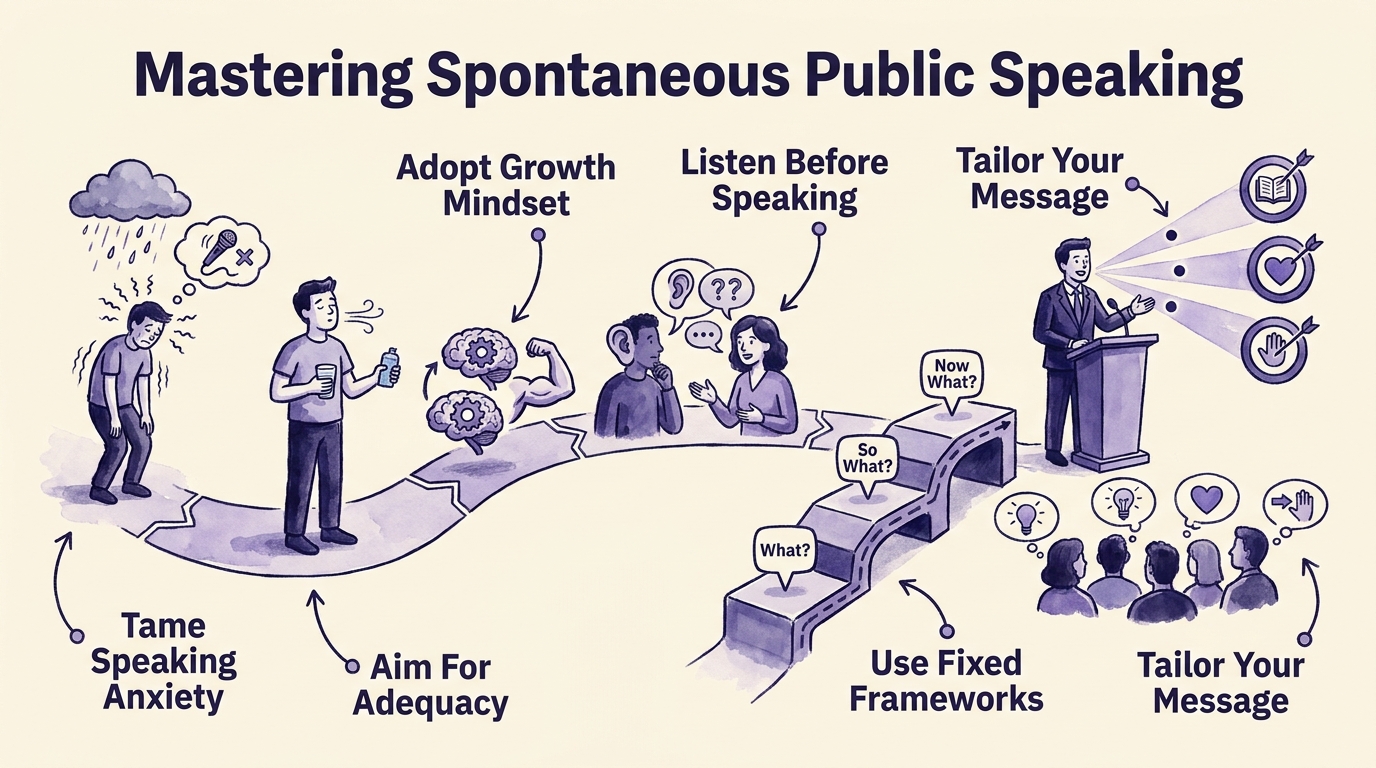
This video breaks down key communication principles from Matt Abrahams' book and Stanford course, "Think Faster, Talk Smarter." It explores how spontaneous speaking and public communication can be mastered like a muscle through six structured steps divided into mindset shift and message transmission. By addressing anxiety, embracing adequacy over perfectionism, active listening, and using structured responses, anyone can convey their ideas clearly and confidently.

Key takeaways
- 5:38Managing communication anxiety requires managing physical symptoms first and shifting from perfectionism to an adequacy mindset
- 13:59Effective spontaneous speaking relies as much on active, empathetic listening as it does on talking
- 17:59Adopting fixed communication frameworks like 'What? So What? Now What?' frees mental bandwidth for clear messaging
- 20:24Tailor your message precisely by asking what you want the audience to know, feel, and do
Tap to enlarge
Most valuable section
For whom
Professionals, students, and introverts who struggle with anxiety or freeze up during impromptu speaking and Q&A sessions.
Stage 5: Structured Improvisation16:37
It introduces actionable mental structures like 'What? So What? Now What?' that immediately reduce cognitive overload when answering unexpected questions.
Detailed summary
1. Introduction & Matt Abrahams' Background
0:00The presenter opens by addressing common communication fears, such as freezing up during presentations, struggling to answer unexpected questions, or failing to convey complex thoughts clearly. He introduces Matt Abrahams, a renowned communication professor at Stanford University who has researched spontaneous speaking, anxiety management, and professional communication for over two decades.
Abrahams developed a highly popular course at Stanford titled 'Think Faster, Talk Smarter,' which also inspired a bestselling book and a YouTube lecture with over 50 million views. This video synthesizes the core principles of Abrahams' teaching into six structured steps designed to help anyone speak with confidence and clarity.
2. The Science Behind Spontaneous Speaking
1:56The video details the origins of Abrahams' course and his belief that effective communication is a learnable skill rather than an inborn talent. Abrahams shares his personal story of growing up as an anxious speaker who was forced into early speaking roles due to alphabetical seating arrangements, eventually learning how to overcome his own panic through practice.
After a fellow Stanford faculty member noted that even the brightest students often struggled when put on the spot during 'cold calls,' Abrahams was inspired to build a curriculum. He combined cognitive research, behavioral psychology, and practical techniques into a comprehensive guide divided into two main categories: mastering mindset and delivering the message.
3. Stage 1: Taming Communication Anxiety
8:58The first step focuses on handling the overwhelming anxiety that causes speakers to retreat into the shadows and suppress great ideas. Anxiety manifests both as long-term anticipation and acute real-time panic, both of which can paralyze a speaker if left unmanaged.
To manage anxiety symptoms, the video highlights physiological solutions such as deep diaphragmatic breathing with extended exhales, drinking water, holding something cool, and getting present-oriented. Exercises like counting backward from 100 in odd increments help re-engage cognitive processing and distract the mind from panic.
4. Stage 2: Maximize Adequacy over Perfection
15:37The second step addresses perfectionism, which is identified as one of the largest sources of performance anxiety. While amateur speakers get trapped in a cycle of restarting or panicking over small mistakes, seasoned communicators realize that 'good enough' is great during spontaneous speaking.
Instead of aiming for flawless execution, speakers should focus on conveying the core message effectively. Accepting minor errors and maintaining conversational momentum allows the speaker to stay calm and continuously improve over time.
5. Stage 3: Mind Your Mindset
18:42Drawing from Carol Dweck's research on Growth Mindset, this step encourages speakers to view communication as a dynamic muscle that strengthens through practice rather than a fixed ability. A fixed mindset treats every failure as proof of incompetence, whereas a growth mindset treats mistakes as valuable data for future growth.
By viewing difficult speaking situations as opportunities to practice rather than high-stakes evaluations, individuals reduce their fear of judgment. Over time, repeated exposure transforms daunting public speaking scenarios into manageable routines.
6. Stage 4: Don't Judge, Listen
22:03Transitioning into message delivery, the fourth step emphasizes that great speakers must first be exceptional listeners. Effective communication requires understanding the audience's underlying needs and intentions rather than simply formulating an immediate response.
To become a better listener, Abrahams recommends controlling pace, respecting spatial dynamics, and using paraphrasing (rephrasing the listener's question or point). Paraphrasing ensures mutual understanding while buying the speaker valuable seconds to structure a thoughtful response.
7. Stage 5: Structured Improvisation
16:37The fifth step introduces pre-packaged mental structures to streamline spontaneous speech and relieve the cognitive load on the brain. When speaking on the spot, the brain struggles to figure out both *what* to say and *how* to say it simultaneously.
A proven framework highlighted is the 'What? So What? Now What?' model. 'What' introduces the issue, 'So What' explains its significance or relevance, and 'Now What' outlines the next steps, creating a coherent and easy-to-follow narrative for any audience.
8. Stage 6: Focus & Precision
19:36The final step centers on maintaining presence and clarity during the presentation. Anxiety often causes speakers' minds to wander or ramble, making it essential to keep the focus tight on the immediate audience and key points.
To achieve precision, speakers should ask themselves three crucial questions prior to speaking: What do I want the audience to *know* (information)? What do I want them to *feel* (emotion)? What do I want them to *do* (action)? Coupling this with conciseness (BLUF: Bottom Line Up Front) ensures the message is accessible and impactful without wasting time.
Questions this video answers
Who is Matt Abrahams and why are his communication methods popular?
Matt Abrahams is a communication professor at Stanford University with over two decades of research in spontaneous speaking and stress management. His lectures and book, 'Think Faster, Talk Smarter,' have garnered tens of millions of views worldwide by turning public speaking into a trainability-based skill rather than an innate talent.
How can I calm my nerves before put on the spot to speak?
Abrahams recommends deep diaphragmatic breathing with long exhales to physically lower your heart rate. Additionally, holding a cold object or chewing gum can help relieve physical symptoms, while mental warm-ups like counting backward can reorient your brain to the present moment.
What is the 'What? So What? Now What?' structure in communication?
It is a practical framework for spontaneous speaking. 'What?' defines the main topic, 'So What?' explains why it matters to the audience, and 'Now What?' provides the actionable next steps or resolution.
Ask a follow-up Premium
About this summary
SumTube AI wrote this recap from the video's words and chapters. Credit and the original belong to KhashayarTalks.