
Free AI summary of this YouTube video by SumTube
Thin underwater cables hold the internet. See a map of them all.
TL;DR
Despite the popular notion that the internet lives in 'the cloud,' roughly 99 percent of international data traffic actually relies on about 300 subsea fiber-optic cables. First pioneered for telegraphs in the 1500s and 1800s, these undersea cables remain the fastest, most reliable method for connecting global data infrastructure across oceans.

Key takeaways
- 0:05Over 99% of international internet traffic travels through physical underwater cables, not satellites or wireless clouds
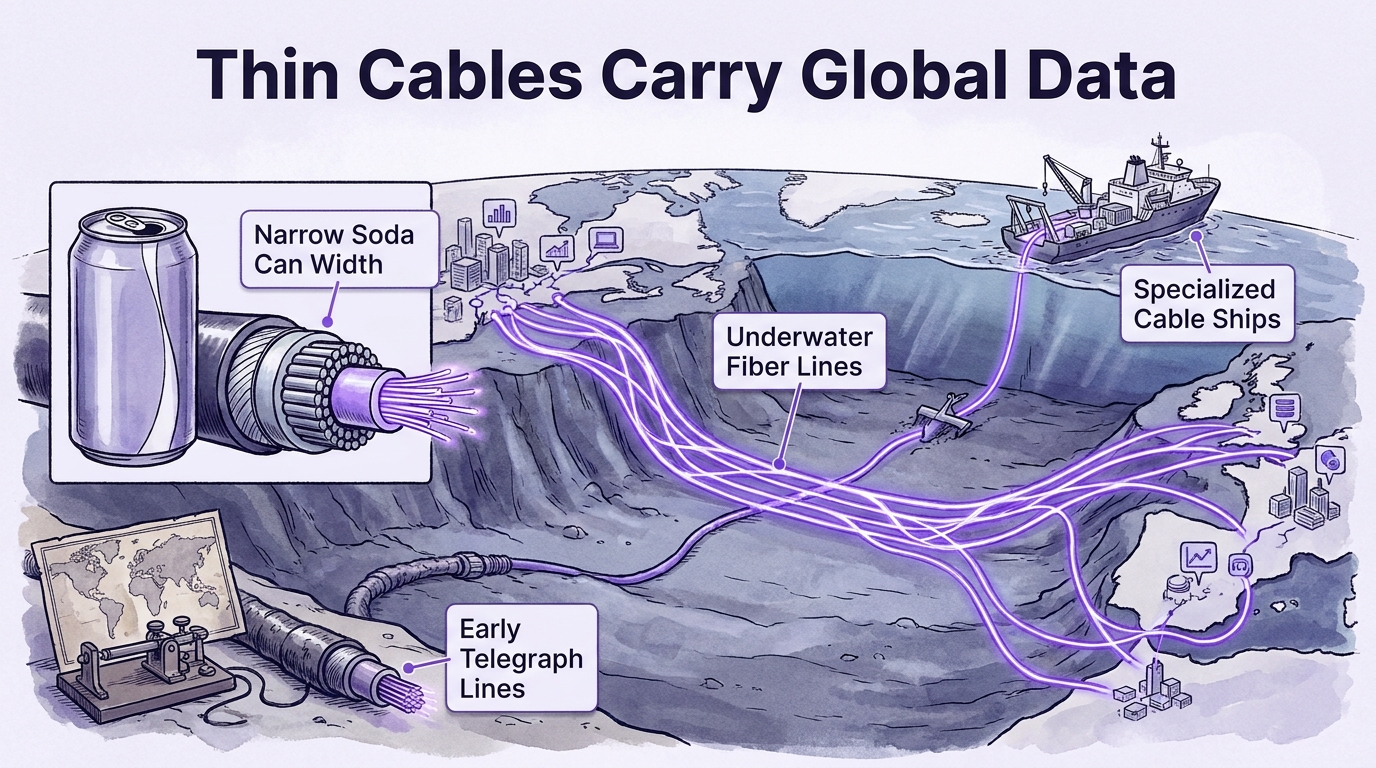
- 0:32Subsea cables are surprisingly narrow—roughly the width of a soda can—and are protected by layers including petroleum jelly
- 2:05Undersea telecommunication cables have a 150+ year history, starting with transcontinental telegraph lines in the 1800s
Tap to enlarge
Most valuable section
For whom
Tech enthusiasts curious about how global internet infrastructure physically connects continents
How Submarine Cables Work and Are Laid0:32
It breaks down the physical construction of underwater fiber-optic cables and shows the fascinating process of how ships plow and bury them into the ocean floor.
Detailed summary
1. The Ocean Internet Backbone
0:00While standard cultural shorthand assumes the internet operates out of 'the cloud,' almost all international web traffic is transmitted underwater. Around 300 submarine fiber-optic cables carry 99 percent of global data communication across oceans.
These private company-owned subsea cables connect financial hubs, carry streaming video, and provide the essential backbone for global network traffic by physically stringing fiber lines between continents.
2. How Submarine Cables Work and Are Laid
0:32A typical subsea internet cable is surprisingly compact—about the width of a standard soda can. It consists of central optical fibers surrounded by protective insulation layers, steel wires, and petroleum jelly (Vaseline) to keep out sea water.
To protect cables from natural hazards like earthquakes, marine life, and anchors, specialized ships deploy subsea plows that dig shallow trenches on the ocean floor. Over time, natural ocean currents naturally cover and bury the cable in seabed sand.
3. A 150-Year History of Undersea Cables
2:00Laying data cables across the ocean floor is far from a new invention; the practice dates back over 150 years to early electric telegraph technology. After connecting localized regions and cities along railway lines, early engineers began insulating cables with natural tree sap to run across sea floors.
By 1858, trans-Atlantic telegraph cables successfully linked North America and Europe. Modern tech giants like Google and Facebook continue to invest heavily in underwater cables today, as deep-sea fiber optics remain far faster and more reliable than satellite networks.
Questions this video answers
Is the internet really stored and transmitted in the cloud?
No, while local wireless and satellite technologies exist, over 99% of international data relies on physical fiber-optic cables buried deep underwater across the world's oceans.
How thick are underwater internet cables?
Despite carrying massive amounts of global data, subsea fiber-optic cables are surprisingly thin—no larger in diameter than a standard soda can. They are composed of protective outer layers, steel wires, petroleum jelly, and central optical fibers.
How long have underwater communications cables existed?
Subsea communication cables have been used for over 150 years. The earliest undersea telegraph lines were laid in the mid-19th century, with trans-Atlantic cables successfully operating by 1858.
Ask a follow-up Premium
About this summary
SumTube AI wrote this recap from the video's words and chapters. Credit and the original belong to Vox.