
Free AI summary of this YouTube video by SumTube
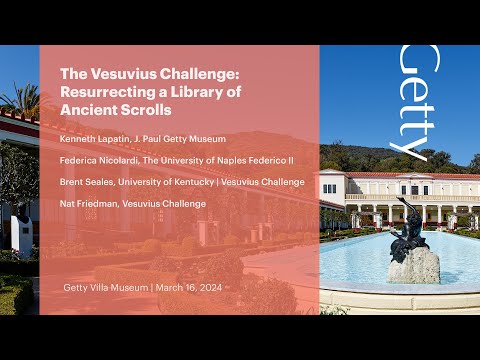
The Vesuvius Challenge: Resurrecting a Library of Ancient Scrolls
TL;DR
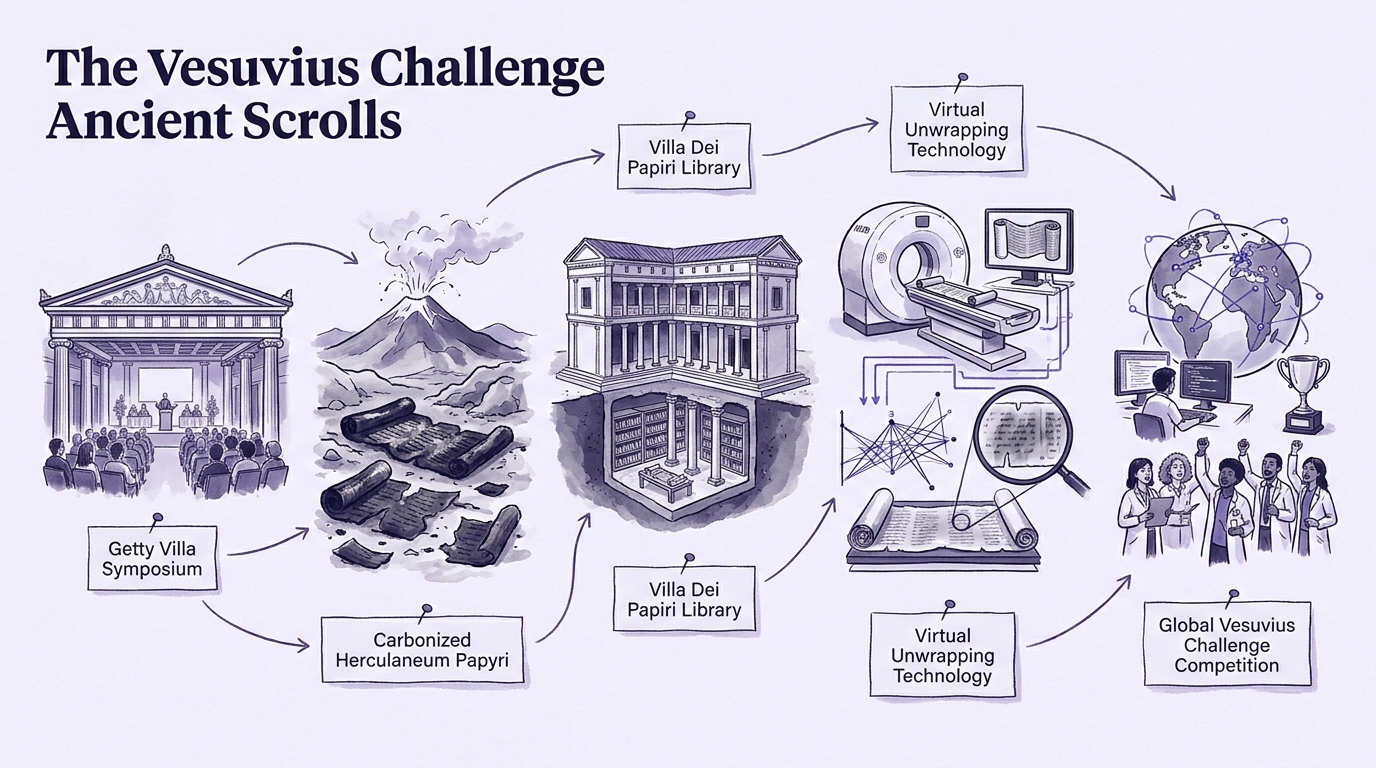
In this symposium held at the Getty Villa, scholars and technology innovators discuss the history, significance, and groundbreaking recovery of the carbonized Herculaneum papyri. The event details the architectural link between the ancient Villa dei Papiri and the Getty Villa, the philosophical contents of the ancient library, and the high-tech AI and X-ray methods used by the Vesuvius Challenge to virtually unroll and read the scrolls. The session culminates with the presentation of awards to the prize-winning team and contributors who successfully deciphered the ancient texts.
Key takeaways
- 6:05Dr. Philippe Hoffmann delivers greetings on behalf of the Académie des Inscriptions et Belles-Lettres and its permanent secretary, Professor Nicolas Grimal.
- 9:31Kenneth Lapatin returns to the stage to detail the historical and archaeological background of the Villa dei Papiri and its relationship to the Getty Villa
- 30:10Dr. Federica Nicolardi of the University of Naples Federico II presents an overview of the literary and philosophical contents found within the Villa dei Papiri's library.
- 52:39Dr. W. Brent Seales, professor of computer science at the University of Kentucky, presents the technological evolution of virtual unwrapping that made reading the Herculaneum scrolls possible.
- 1:23:26Nat Friedman, tech entrepreneur and sponsor of the Vesuvius Challenge, takes the podium to share the story of how the global competition came to fruition
Tap to enlarge
Most valuable section
The Library of the Villa dei Papiri30:10
Furthermore, she discusses the presence of Latin texts, such as historical works by Seneca the Elder and poems on the Battle of Actium, and emphasizes that virtual unrolling will unlock vast amounts of previously inacces
Detailed summary
1. Welcome and Opening Remarks
0:00Kenneth Lapatin, curator of antiquities at the Getty Villa Museum, welcomes attendees to a special symposium celebrating the Herculaneum papyri and the Vesuvius Challenge. He highlights key historical milestones for the Getty Villa, noting the 70th anniversary of J. Paul Getty establishing his original museum in 1954 and the 50th anniversary of the opening of the replica villa in 1974. Lapatin explains that the Getty Villa was modeled directly after the ancient Villa dei Papiri at Herculaneum, making it an extraordinarily fitting host for celebrating the breakthrough in reading these ancient, carbonized scrolls.
Lapatin expresses gratitude to the museum staff, public programming teams, technical support, and collaborators who made the symposium possible. He outlines the event's itinerary, introducing upcoming talks by papyrologist Dr. Federica Nicolardi, computer science professor Dr. Brent Seales, and tech entrepreneur Nat Friedman, who co-founded the Vesuvius Challenge. He also welcomes special guest Dr. Philippe Hoffmann from the Institut de France, whose institution holds several key scrolls that were used in the global competition.
2. Greetings from the Institut de France
6:05Dr. Philippe Hoffmann delivers greetings on behalf of the Académie des Inscriptions et Belles-Lettres and its permanent secretary, Professor Nicolas Grimal. He celebrates the remarkable scientific progress being honored at the event and congratulates the researchers and prize winners who successfully unrolled and read the scrolls using modern non-invasive technologies. Hoffmann pays tribute to past leaders in papyrology, including Professor Jean Leclant, and notes the long-standing commitment of the French academic community to the study of Epicurean philosophy and ancient texts.
Hoffmann highlights the unique history of the six Herculaneum papyri held in Paris, which were gifted to Napoleon Bonaparte by King Ferdinand IV of Naples in 1802. He notes that the scientific breakthroughs being celebrated fulfill Napoleon's original vision for international scholarly collaboration. He concludes by extending warm congratulations to the competition winners and expressing gratitude to the Getty for hosting the milestone celebration.
3. History and Archaeology of the Villa dei Papiri
9:31Kenneth Lapatin returns to the stage to detail the historical and archaeological background of the Villa dei Papiri and its relationship to the Getty Villa. He explains that although J. Paul Getty never visited the buried site himself, he modeled his museum on the ancient villa's floor plans after seeing the magnificent bronzes, marbles, and frescoes excavated from the site and displayed in Naples. Lapatin describes the 79 AD eruption of Mount Vesuvius, contrasting how Pompeii was buried in ash while Herculaneum was enveloped in deep, hot pyroclastic flows that carbonized and preserved delicate organic materials, including the famous library of papyrus scrolls.
Lapatin discusses the 18th-century subterranean excavations directed by Swiss military engineer Karl Weber, who mapped the villa through a network of dangerous underground tunnels. Weber's detailed, annotated plans proved remarkably accurate when modern excavations re-exposed parts of the villa in the late 20th century. Lapatin illustrates how the papyri, bronzes, and frescoes were discovered in specific rooms of the villa, emphasizing how the ancient site continues to yield unprecedented treasures through modern archaeological and digital restoration efforts.
4. The Library of the Villa dei Papiri
30:10Dr. Federica Nicolardi of the University of Naples Federico II presents an overview of the literary and philosophical contents found within the Villa dei Papiri's library. She discusses the prominent role of the Epicurean philosopher Philodemus of Gadara, who lived during the 1st century BC and whose writings dominate the surviving Greek collection. Nicolardi explains how Philodemus adapted traditional Greek Epicureanism to fit the elite political and cultural context of the late Roman Republic, addressing notable figures like Julius Caesar's father-in-law, Lucius Calpurnius Piso, and maintaining friendships with prominent intellectuals like Virgil and Cicero.
Nicolardi reviews the wide range of subjects preserved in the library, including treatise series on the history of philosophy, rhetoric, music, poetry, theology, and ethics. She notes the discovery of draft versions, corrected proofs, and duplicate copies, which suggest that the library served as an active working scriptorium during Philodemus's lifetime, while later copies from the 1st century AD prove its continued use until the eruption. Furthermore, she discusses the presence of Latin texts, such as historical works by Seneca the Elder and poems on the Battle of Actium, and emphasizes that virtual unrolling will unlock vast amounts of previously inaccessible text and provide new insights into ancient library organization.
5. Unburied by Technology: Virtual Unwrapping
52:39Dr. W. Brent Seales, professor of computer science at the University of Kentucky, presents the technological evolution of virtual unwrapping that made reading the Herculaneum scrolls possible. Reflecting on two decades of research, Seales describes the core technical challenge: carbon-based ink on carbonized papyrus shares a near-identical density, making it invisible to standard X-ray computed tomography. To overcome this, his team at EduceLab developed micro-CT scanning techniques and machine learning models capable of detecting subtle, micro-structural surface morphology changes caused by the ink layer.
Seales highlights the major breakthroughs achieved between 2019 and 2023, particularly through high-resolution scanning at the Diamond Light Source synchrotron in Oxford, England, which captured 3D volumes at an unprecedented 8-micron resolution. He acknowledges key team members, including Seth Parker, who created the Volume Cartographer software and surface volume regularization techniques, and Dr. Stephen Parsons, whose PhD research demonstrated that AI models could accurately detect hidden ink layers in volumetric data. This rigorous combination of high spatial resolution, structural regularization, and machine learning laid the technical groundwork required to launch the Vesuvius Challenge.
6. Launching the Vesuvius Challenge
1:23:26Nat Friedman, tech entrepreneur and sponsor of the Vesuvius Challenge, takes the podium to share the story of how the global competition came to fruition. Inspired by a book on ancient Roman history during the 2020 COVID-19 lockdowns, Friedman discovered Dr. Brent Seales's work on the Herculaneum scrolls and became fascinated by the possibility of reading an unopened ancient library. After meeting Seales in late 2022, Friedman realized that while the fundamental science was sound, significant technical hurdles remained to make the software scale and read full scrolls. Along with Daniel Gross, Friedman pledged initial prize money and launched a public competition to crowdsource solutions from developers worldwide.
Friedman explains the strategic design of the competition, which combined a $1 million Grand Prize with smaller, open-source "Progress Prizes." This structure encouraged fierce competition for the final goal while mandating that intermediate tools, code, and discoveries be released publicly to benefit all participants. To build momentum after an initial quiet launch, Friedman hosted an online fundraiser that raised over $1.5 million in six hours. The competition established a vibrant Discord community of thousands of engineers, data scientists, and classical scholars who collaborated to build custom viewers, segmentation tools, and ink detection algorithms.
7. Overcoming Obstacles and Deciphering First Words
1:40:00Nat Friedman describes the major technical and logistical hurdles faced during the Vesuvius Challenge, particularly the manual bottleneck of 3D surface segmentation—tracing distorted papyrus layers inside the CT scans. To overcome this, the Vesuvius Challenge hired a dedicated team of full-time segmenters who manually traced over 1,000 square centimeters of papyrus. Later, competitor Julian Schilliger developed an automated 3D segmentation algorithm using 10,000 lines of code, revolutionizing the speed at which volumetric data could be flattened and prepared for AI analysis.
Friedman recounts key breakthrough moments, beginning with Casey Handmer's discovery of subtle "ink crackle" patterns visible in raw CT data, which earned him the First Ink Prize. Building on Handmer's findings, 21-year-old computer science student Luke Farritor and graduate student Youssef Nader independently trained machine learning models that successfully revealed the first complete ancient Greek word inside an unopened scroll: "πορφύραc" (porphyras), meaning "purple." These incremental open-source milestones created enormous momentum, leading directly to the Grand Prize attempts at the end of 2023.
8. Awarding the Grand Prize and Closing Celebration
1:53:20The symposium concludes with the presentation of awards to the winners and runners-up of the 2023 Vesuvius Challenge. Nat Friedman and Dr. Brent Seales invite the recognized contestants onto the stage to receive novelty oversized checks and gift bags from the Getty. Grand Prize runners-up including Shao-Qian Mah, the team of Lou Schlessinger and Arefeh Sherafati, and an 8-person team led by Elian Rafael Dal Prá are celebrated for their significant contributions to unrolling and reading extensive passages of text.
The $700,000 Grand Prize is awarded to the team of Youssef Nader, Luke Farritor, and Julian Schilliger, who successfully revealed over 2,000 characters of Greek text across multiple columns within the scroll Herc.Paris 4. A video message is played from Youssef Nader, who was unable to attend in person due to visa restrictions, expressing his gratitude to the organizers, scholars, and fellow competitors. Friedman closes the ceremony by outlining the future master plan: automating full 3D scroll segmentation, scanning the remaining hundreds of unopened scrolls in Naples, and advocating for new physical excavations at the Villa dei Papiri.
Questions this video answers
What does this video say about Welcome and Opening Remarks?
Kenneth Lapatin, curator of antiquities at the Getty Villa Museum, welcomes attendees to a special symposium celebrating the Herculaneum papyri and the Vesuvius Challenge. He highlights key historical milestones for the Getty Villa, noting the 70th anniversary of J. Paul Getty establishing his original museum in 1954 and the 50th anniversary of the opening of the replica villa in 1974. Lapatin exp
What does this video say about Greetings from the Institut de France?
Dr. Philippe Hoffmann delivers greetings on behalf of the Académie des Inscriptions et Belles-Lettres and its permanent secretary, Professor Nicolas Grimal. He celebrates the remarkable scientific progress being honored at the event and congratulates the researchers and prize winners who successfully unrolled and read the scrolls using modern non-invasive technologies. Hoffmann pays tribute to pas
What does this video say about History and Archaeology of the Villa dei Papiri?
Kenneth Lapatin returns to the stage to detail the historical and archaeological background of the Villa dei Papiri and its relationship to the Getty Villa. He explains that although J. Paul Getty never visited the buried site himself, he modeled his museum on the ancient villa's floor plans after seeing the magnificent bronzes, marbles, and frescoes excavated from the site and displayed in Naples
What does this video say about The Library of the Villa dei Papiri?
Dr. Federica Nicolardi of the University of Naples Federico II presents an overview of the literary and philosophical contents found within the Villa dei Papiri's library. She discusses the prominent role of the Epicurean philosopher Philodemus of Gadara, who lived during the 1st century BC and whose writings dominate the surviving Greek collection. Nicolardi explains how Philodemus adapted tradit
What does this video say about Unburied by Technology: Virtual Unwrapping?
Dr. W. Brent Seales, professor of computer science at the University of Kentucky, presents the technological evolution of virtual unwrapping that made reading the Herculaneum scrolls possible. Reflecting on two decades of research, Seales describes the core technical challenge: carbon-based ink on carbonized papyrus shares a near-identical density, making it invisible to standard X-ray computed to
Ask a follow-up Premium
About this summary
SumTube AI wrote this recap from the video's words and chapters. Credit and the original belong to Getty Museum.