
Free AI summary of this YouTube video by SumTube
The Simplest Math Problem No One Can Solve - Collatz Conjecture
TL;DR
The Collatz Conjecture, or 3x+1 problem, is one of mathematics' most famous unsolved problems due to its simple rules yet seemingly unpredictable behavior. This video explores the mechanics of the conjecture, statistical approaches like Benford's Law and heuristic models, historical attempts to solve it, and recent progress by mathematicians like Terence Tao.

Key takeaways
- 2:13The paths taken by different starting numbers—referred to as seed numbers—vary drastically even between adjacent integers
- 6:52When analyzing large numbers in Collatz sequences, taking the logarithm of the sequence reveals a downward logarithmic trend, resembling geometric Brownian motion seen in stock markets
- 11:46A heuristic argument suggests why Collatz sequences generally shrink
- 15:02By reversing the rules, one can construct a directed graph showing how all numbers branch out from 1 into a vast, tree-like structure
- 16:38There are two primary ways the Collatz Conjecture could fail: either there exists a starting number that shoots off to infinity without ever descending, or there exists a separate, closed loop of positive integers that n
Tap to enlarge
Most valuable section
Statistical Patterns & Benford's Law6:52
While Benford's Law demonstrates structural regularity across orders of magnitude, it does not prove that all numbers must eventually descend to 1.
Detailed summary
1. The Rules of 3x+1
0:00The Collatz Conjecture is a famous open problem in mathematics known for its simple premise. Starting with any positive integer, if the number is odd, you multiply it by 3 and add 1; if it is even, you divide it by 2. Repeating this process creates a sequence of numbers, often called "hailstone numbers," because they fluctuate up and down before eventually dropping.
The conjecture asserts that no matter what positive integer you start with, the sequence will always eventually reach the number 1, entering an infinite loop of 4, 2, 1. Despite its elementary formulation, the problem has resisted all attempts at a rigorous mathematical proof, leading prominent mathematicians to advise younger colleagues against wasting their time trying to solve it.
2. Hailstone Numbers & Stopping Times
2:13The paths taken by different starting numbers—referred to as seed numbers—vary drastically even between adjacent integers. For instance, the number 26 reaches 1 in just 10 steps, whereas the number 27 undergoes a massive surge, climbing to a peak of 9,232 (higher than Mount Everest) before taking 111 steps to finally reach 1.
Because the sequences fluctuate so wildly, mathematicians have attempted to analyze the behavior of these sequences statistically and visually rather than relying solely on brute-force computation for individual numbers.
3. Statistical Patterns & Benford's Law
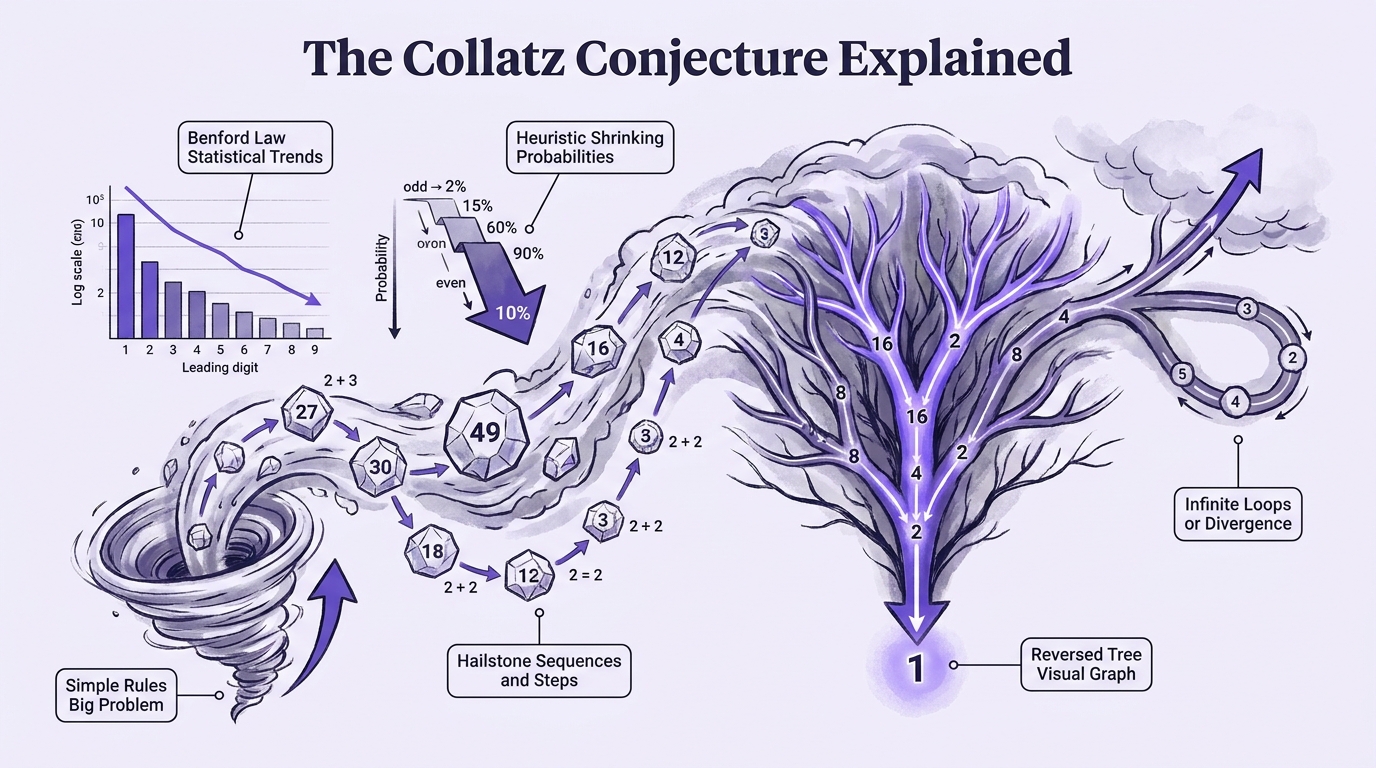
6:52When analyzing large numbers in Collatz sequences, taking the logarithm of the sequence reveals a downward logarithmic trend, resembling geometric Brownian motion seen in stock markets. While the short-term movements appear random, the overall long-term trajectory tends downward toward 1.
Additionally, Collatz sequences obey Benford's Law, which states that in naturally occurring sets of numerical data, the leading digit is far more likely to be a 1 (around 30% of the time) than a 9 (less than 5%). While Benford's Law demonstrates structural regularity across orders of magnitude, it does not prove that all numbers must eventually descend to 1.
4. Heuristic Probabilities: Why It Should be True
11:46A heuristic argument suggests why Collatz sequences generally shrink. Although odd numbers are multiplied by 3 and increased, the result is always an even number, which must immediately be divided by 2. This means an odd number actually increases by a factor of roughly 3/2 on the first step.
On subsequent steps, there is a 50% chance of dividing by 2 again, a 25% chance of dividing by 4, a 12.5% chance of dividing by 8, and so on. Taking the geometric mean across all possible division outcomes yields an average multiplier of 3/4 between consecutive odd numbers. Since 3/4 is less than 1, sequences are statistically driven toward smaller numbers over time.
5. Visualizing the Collatz Tree
15:02By reversing the rules, one can construct a directed graph showing how all numbers branch out from 1 into a vast, tree-like structure. If the conjecture holds true, every single positive integer lies somewhere on this infinite graph, flowing down into the main river of the 4-2-1 loop.
Mathematicians have also created organic visual representations by rotating line segments clockwise for even numbers and counterclockwise for odd numbers. By tweaking the angles of rotation, these graphs generate intricate structures resembling coral, seaweed, or biological structures, highlighting the surprisingly complex aesthetic patterns embedded in simple arithmetic rules.
6. Ways the Conjecture Could Be False
16:38There are two primary ways the Collatz Conjecture could fail: either there exists a starting number that shoots off to infinity without ever descending, or there exists a separate, closed loop of positive integers that never connects to the 4-2-1 loop.
Computers have verified the conjecture for all starting numbers up to 2^68 (nearly 300 quintillion), finding no counterexamples. Furthermore, calculations indicate that any alternative loop would have to be at least 186 billion numbers long. However, computational verification up to a finite limit is not a mathematical proof.
7. Recent Breakthroughs & Terence Tao's Result
18:37Mathematical progress on the problem has focused on proving that "almost all" numbers eventually reach values much smaller than their starting seeds. In 1976, Riho Terras proved that almost all numbers reach a value below their initial input, a limit that was progressively tightened in subsequent decades.
In 2019, Fields Medalist Terence Tao achieved a major breakthrough by proving that almost all Collatz sequences reach a value smaller than any arbitrarily slow-growing function f(x) that goes to infinity. While Tao described this as about as close as anyone can get to solving the conjecture without actually proving it, the distinction between "almost all" and "all" leaves open the possibility that a counterexample exists.
8. The False Sense of High Limits & Undecidability
25:27Testing up to 2^68 may seem comprehensive, but history shows that mathematical counterexamples can occur at extraordinarily high numbers. For instance, the Pólya Conjecture, proposed in 1919, stood for decades until a counterexample was discovered in 1958 at roughly 1.845 × 10^361—a number infinitely larger than 2^68.
Another possibility is that the Collatz Conjecture is undecidable—meaning it can neither be proven true nor false within standard axiomatic mathematics. John Conway showed in 1987 that a generalization of the 3x+1 problem (FRACTRAN) is Turing complete and subject to the Halting Problem, suggesting that 3x+1 might also represent an inherently unprovable mathematical system.
Questions this video answers
What does this video say about The Rules of 3x+1?
The Collatz Conjecture is a famous open problem in mathematics known for its simple premise. Starting with any positive integer, if the number is odd, you multiply it by 3 and add 1; if it is even, you divide it by 2. Repeating this process creates a sequence of numbers, often called "hailstone numbers," because they fluctuate up and down before eventually dropping. The conjecture asserts that no
What does this video say about Hailstone Numbers & Stopping Times?
The paths taken by different starting numbers—referred to as seed numbers—vary drastically even between adjacent integers. For instance, the number 26 reaches 1 in just 10 steps, whereas the number 27 undergoes a massive surge, climbing to a peak of 9,232 (higher than Mount Everest) before taking 111 steps to finally reach 1. Because the sequences fluctuate so wildly, mathematicians have attempted
What does this video say about Statistical Patterns & Benford's Law?
When analyzing large numbers in Collatz sequences, taking the logarithm of the sequence reveals a downward logarithmic trend, resembling geometric Brownian motion seen in stock markets. While the short-term movements appear random, the overall long-term trajectory tends downward toward 1. Additionally, Collatz sequences obey Benford's Law, which states that in naturally occurring sets of numerical
What does this video say about Heuristic Probabilities: Why It Should be True?
A heuristic argument suggests why Collatz sequences generally shrink. Although odd numbers are multiplied by 3 and increased, the result is always an even number, which must immediately be divided by 2. This means an odd number actually increases by a factor of roughly 3/2 on the first step. On subsequent steps, there is a 50% chance of dividing by 2 again, a 25% chance of dividing by 4, a 12.5% c
What does this video say about Visualizing the Collatz Tree?
By reversing the rules, one can construct a directed graph showing how all numbers branch out from 1 into a vast, tree-like structure. If the conjecture holds true, every single positive integer lies somewhere on this infinite graph, flowing down into the main river of the 4-2-1 loop. Mathematicians have also created organic visual representations by rotating line segments clockwise for even numbe
Ask a follow-up Premium
About this summary
SumTube AI wrote this recap from the video's words and chapters. Credit and the original belong to Veritasium.