
Free AI summary of this YouTube video by SumTube
The Real GOAT Of MMA Is Terrifying
TL;DR
In this in-depth interview and martial arts breakdown, former UFC Welterweight and Middleweight Champion Georges St-Pierre (GSP) breaks down the physical techniques, fight strategy, and mental philosophy that made him one of the greatest mixed martial artists of all time. GSP demonstrates signatures like the Superman punch and reactive takedowns, while explaining how ring control, visualization, and managing fear are crucial to long-term success.

Key takeaways
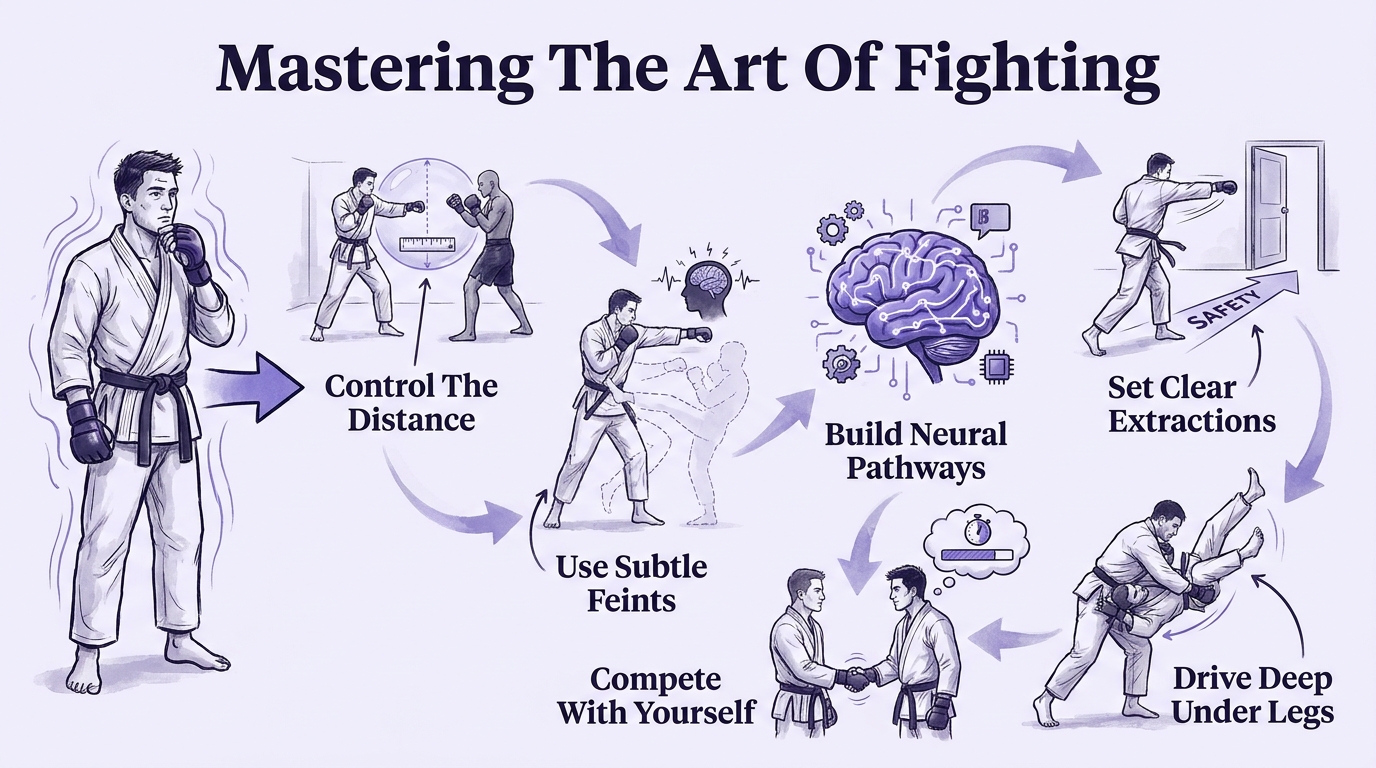
- 3:28Control the fight distance so you always engage strictly on your own terms rather than your opponent's
- 9:49Use subtle feints to burn out an explosive opponent's central nervous system and reaction speed over multiple rounds
- 26:41Visualization builds neural pathways, preventing panic when high-stress fight scenarios occur in real time
- 33:31True long-term success requires competing against who you were yesterday rather than constantly comparing yourself to others
Tap to enlarge
Most valuable section
For whom
MMA practitioners, combat sports enthusiasts, and athletes seeking mental performance strategies.
The Strategy to Deplete Energy8:20
GSP breaks down his famous fight against BJ Penn, showing how he used subtle feints to overload Penn's elite reaction time and drain his nervous system.
Detailed summary
1. Introduction & Karate Roots
0:00Georges St-Pierre begins by sharing how he initially took up karate as a child after being bullied at school and facing a difficult home life. Karate provided him with a structured environment where he felt confident, eventually leading him to win competitions and discover Royce Gracie's iconic performances in the early UFC events.
Inspired by the effectiveness of mixed martial arts, GSP committed himself entirely to combat sports. He explains how his foundational karate mindset continued to shape his striking, movement, and distance management throughout his championship MMA career.
2. The Superman Punch Technique
0:44GSP demonstrates the mechanics behind his famous Superman punch, explaining that the move relies on misdirection rather than telegraphic motion. By feinting a rear leg kick, he draws his opponent's focus down to his lower body before exploding forward with a straight right hand.
He clarifies that a successful Superman punch should be short, compact, and extended through the hip kickback. He also demonstrates how the technique can be adapted using the lead leg or against opponents who are actively retreating or pressing forward.
3. Distance Control & Tactical Safety
2:14Emphasizing safety as his highest priority in combat, GSP explains the concept of having a clear extraction plan whenever throwing a strike. He illustrates why fighters must exit toward their opponent's blind side to avoid counterpunches, citing Manny Pacquiao's footwork as a prime example of creating angles.
GSP compares his tactical positioning to a cobra, folding inward to create an illusion of distance before striking instantly. He stresses the importance of keeping more space behind himself than his opponent, ensuring he retains room to maneuver and reset.
4. The Energy Bar & Managing Nervous Systems
7:04GSP introduces his mental model of the fighter's energy bar, explaining that a fight doesn't begin when the bell rings, but when he decides to engage. By staying out of range and forcing opponents to constantly flinch at feints, he drains their central nervous system and depletes their energy reserve before taking damage.
He uses his championship fight against BJ Penn as a case study, detailing how Penn possessed the fastest reaction time in the UFC roster. By forcing Penn to react repeatedly to fake attacks, GSP wore down Penn's nervous system, causing him to fatigue heavily by the later rounds.
5. Proactive vs. Reactive Takedowns
10:42Transitioning to wrestling, GSP explains how he successfully took down elite wrestlers despite having no high school or college wrestling background. He contrasts proactive takedowns—using level changes and striking distractions to shoot deep—with reactive takedowns, where he uses an opponent's forward momentum against them.
He demonstrates how driving 'elbow-deep' under an opponent's legs prevents them from effectively sprawling. Additionally, GSP explains why he prefers leaping into double-leg shots rather than dropping to his knees, maintaining his ability to strike or alter directions mid-motion.
6. Feints, Levels, and Resetting Range
14:04GSP breaks down the art of feinting, distinguishing between single feints, double feints, and level-change fakes. He explains that if an opponent fails to react to a feint, a fighter should convert the fake directly into a real strike to punish their static defense.
He advises fighters to immediately disengage and reset the distance whenever an opponent's feints make them feel uncomfortable. By stepping completely out of range, a fighter disrupts the rhythm of an aggressive opponent and regains tactical control of the engagement.
7. The Oblique Kick: Lethal & Underrated
16:42GSP discusses the oblique kick (push kick to the knee), labeling it as one of the most effective yet underrated techniques in martial arts. Inspired by Bruce Lee's philosophy of targeting the closest vulnerable point with the longest weapon, GSP explains how pushing off the rear leg into the opponent's lead knee can cause severe damage or hyper-extension.
To counter or protect against oblique kicks, GSP demonstrates bending the knees slightly into a soft squat rather than standing tall with locked joints. He notes that while some consider the strike controversial due to career-ending injury risks, it remains a potent long-range defensive tool.
8. Sparring vs. Skill Acquisition
18:43GSP warns against the dangers of treating every gym session like an actual fight, pointing out that fighters who war in sparring dramatically shorten their athletic careers. He explains that off-season training should focus on fun, playful experimentation where athletes can try risky new techniques without anxiety.
He describes his practice of asking partners to 'play' rather than 'spar' to remove high-stakes ego from the session. By removing stress and fear of failure, fighters are far more likely to develop creative skills and expand their arsenal.
9. Visualization & Mindset Training
23:19GSP highlights mental visualization as the single most critical factor separating good fighters from legendary champions. He outlines three specific scenarios fighters must mentally rehearse before competition: the ideal outcome, the expected expert-consensus flow, and worst-case adversity scenarios.
By repeatedly mentally navigating worst-case situations, GSP explains that fighters experience a sense of déjà vu when real in-ring emergencies happen, allowing them to react instinctively without panicking. He recounts how visualizing his rematch with Matt Hughes gave him the psychological confidence needed to secure victory.
10. Embracing Fear and Humility
31:59Addressing the psychological burden of elite competition, GSP admits that he experienced intense fear, anxiety, and dread before every professional fight. He emphasizes that fear is completely natural, driving athletes to prepare meticulously in training camp out of concern for humiliation.
Rather than trying to suppress fear, GSP advises fighters to accept and channel it as a motivational tool. He explains that his fear of letting down his team and losing his title forced him to double-check every aspect of his physical preparation.
11. Continuous Self-Improvement & Giving Back
33:13GSP shares his core philosophy for staying at the top: constantly reinventing oneself and competing against who you were yesterday rather than against other people. He warns against getting comfortable at the top of the sport, noting that complacency allows the competition to catch up quickly.
In closing, GSP discusses the importance of giving back to causes and people he genuinely cares about. He explains that helping others rejuvenates his inner drive, creating a positive feedback loop that continues to inspire his personal growth beyond the Octagon.
Questions this video answers
How does Georges St-Pierre set up his signature Superman punch?
GSP sets up his Superman punch by first baiting his opponent using low kicks or movements with his rear leg to draw their eyes downward. Once the opponent's attention is focused on the leg, GSP extends his hip back while driving his punch straight forward without windup, creating a subtle, explosive strike from distance.
What is GSP's concept of controlling the fight's pace?
GSP believes that a fight only starts when he wants it to, meaning he will maintain distance and refuse to trade blows in the pocket until he chooses to engage. By dictating spatial control and making opponents flinch with feints, he drains their nervous energy while staying safe.
Why does GSP advocate for 'playing' during sparring rather than hard fighting?
GSP emphasizes that treating every sparring session like a war causes unnecessary wear and tear on the body, shortening a fighter's career. Off-season training should focus on playful skill acquisition where fighters feel safe attempting new, complex techniques without fear of getting hurt.
Ask a follow-up Premium
About this summary
SumTube AI wrote this recap from the video's words and chapters. Credit and the original belong to Jesse Enkamp.