
Free AI summary of this YouTube video by SumTube
The Quantum Experiment that Broke Reality | Space Time | PBS Digital Studios
TL;DR
This episode of PBS Space Time explores the single-particle double-slit experiment and its implications for our understanding of reality. Host Matt O'Dowd explains how particles like photons, electrons, and buckyballs demonstrate both wave and particle behaviors, highlighting the mysterious nature of the wave function and the Copenhagen Interpretation.
Key takeaways
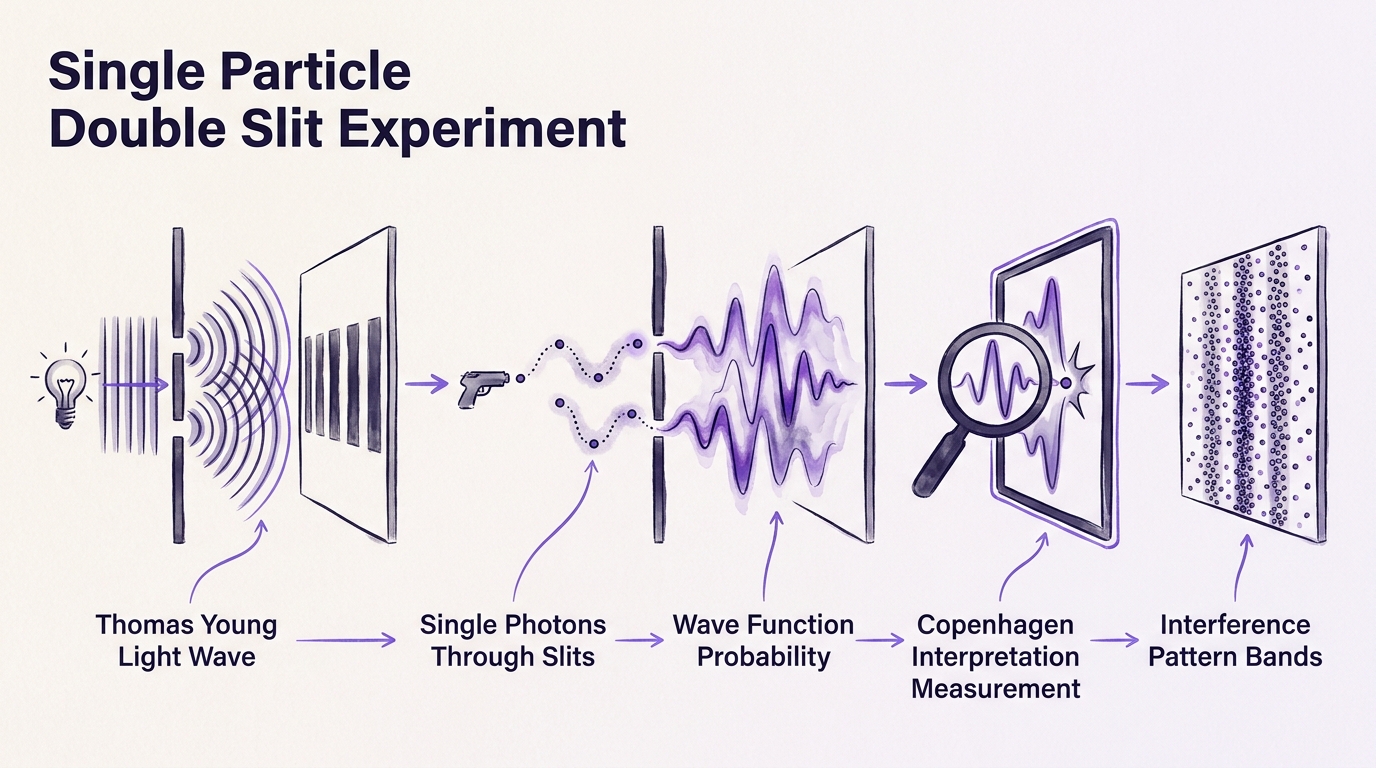
- 1:35Thomas Young first observed double-slit interference with light in 1801, showing alternating bright and dark bands
- 3:33When photons or other particles like electrons and buckyballs are sent through double slits one by one, each strikes a specific point on the screen
- 5:46The mathematical tool describing this probability distribution is the wave function, which represents a spectrum of possibilities rather than a physical wave
- 9:48The episode wraps up by noting alternative interpretations of quantum mechanics, such as the Many-Worlds Interpretation, which will be covered in future episodes
Tap to enlarge
Most valuable section
The Wave Function and Copenhagen Interpretation5:46
Prior to observation, particles exist as a range of potential realities.
Detailed summary
1. Introduction to the Double-Slit Experiment
0:00The single-particle double-slit experiment is introduced as one of the most intriguing experimental results in physics. It challenges our classical physical intuition and hints that fundamental reality might not be physical in the traditional sense.
To understand wave behavior, the concept of ripples created by a duck in a pool passing through two slits is used. The overlapping ripples create an interference pattern with alternating peaks (constructive interference) and troughs (destructive interference).
2. Light as Waves and Particles
1:35Thomas Young first observed double-slit interference with light in 1801, showing alternating bright and dark bands. James Clerk Maxwell later established that light is an electromagnetic wave, explaining this behavior.
However, work by Max Planck and Albert Einstein showed that light also consists of discrete energy packets called photons. This raises the question of how single photons interact to create interference.
3. Single-Particle Double-Slit Experiment
3:33When photons or other particles like electrons and buckyballs are sent through double slits one by one, each strikes a specific point on the screen. Over time, however, the accumulation of these individual impacts builds up a complete wave interference pattern.
This phenomenon shows that individual quantum entities behave as waves while traveling, exploring all possible paths, but collapse into distinct particles upon measurement.
4. The Wave Function and Copenhagen Interpretation
5:46The mathematical tool describing this probability distribution is the wave function, which represents a spectrum of possibilities rather than a physical wave. The transition from probability to a definite outcome is known as wave function collapse.
Formulated by Niels Bohr and Werner Heisenberg, the Copenhagen Interpretation asserts that physical properties do not exist until measured. Prior to observation, particles exist as a range of potential realities.
5. Conclusion and Viewer Comments
9:48The episode wraps up by noting alternative interpretations of quantum mechanics, such as the Many-Worlds Interpretation, which will be covered in future episodes.
Host Matt O'Dowd answers viewer questions from a previous video, discussing topics such as Jupiter's mass relative to stars, the Jeans mass required for gravitational collapse, and planetary resonant frequencies.
Questions this video answers
What does this video say about Introduction to the Double-Slit Experiment?
The single-particle double-slit experiment is introduced as one of the most intriguing experimental results in physics. It challenges our classical physical intuition and hints that fundamental reality might not be physical in the traditional sense. To understand wave behavior, the concept of ripples created by a duck in a pool passing through two slits is used. The overlapping ripples create an i
What does this video say about Light as Waves and Particles?
Thomas Young first observed double-slit interference with light in 1801, showing alternating bright and dark bands. James Clerk Maxwell later established that light is an electromagnetic wave, explaining this behavior. However, work by Max Planck and Albert Einstein showed that light also consists of discrete energy packets called photons. This raises the question of how single photons interact to
What does this video say about Single-Particle Double-Slit Experiment?
When photons or other particles like electrons and buckyballs are sent through double slits one by one, each strikes a specific point on the screen. Over time, however, the accumulation of these individual impacts builds up a complete wave interference pattern. This phenomenon shows that individual quantum entities behave as waves while traveling, exploring all possible paths, but collapse into di
What does this video say about The Wave Function and Copenhagen Interpretation?
The mathematical tool describing this probability distribution is the wave function, which represents a spectrum of possibilities rather than a physical wave. The transition from probability to a definite outcome is known as wave function collapse. Formulated by Niels Bohr and Werner Heisenberg, the Copenhagen Interpretation asserts that physical properties do not exist until measured. Prior to ob
What does this video say about Conclusion and Viewer Comments?
The episode wraps up by noting alternative interpretations of quantum mechanics, such as the Many-Worlds Interpretation, which will be covered in future episodes. Host Matt O'Dowd answers viewer questions from a previous video, discussing topics such as Jupiter's mass relative to stars, the Jeans mass required for gravitational collapse, and planetary resonant frequencies.
Ask a follow-up Premium
About this summary
SumTube AI wrote this recap from the video's words and chapters. Credit and the original belong to PBS Space Time.