
Free AI summary of this YouTube video by SumTube
The Paradox of Infinity: Why Everything Improbable Must Happen
TL;DR
This explainer explores the scientific and philosophical foundations of the multiverse, moving from the fine-tuning of our observable universe to advanced theoretical models. It details how concepts like cosmic inflation, string theory, and quantum mechanics independently suggest the existence of parallel realms. Finally, it addresses the intense debates over empirical testability and the humbling paradoxes that arise when dealing with an infinite cosmos.

Key takeaways
- 3:26The precise values of fundamental physical forces suggest our universe is either impossibly lucky or one of endless variations
- 5:09Cosmic inflation, brane cosmology, and quantum mechanics independently arrive at multiverse models through different mathematical pathways
- 12:14Multiverse theory risks blurring the line between science and unfalsifiable philosophy if it cannot be empirically tested
- In a mathematically infinite multiverse, every non-zero probability must repeat an infinite number of times
Tap to enlarge
Most valuable section
For whom
Anyone fascinated by theoretical physics, cosmology, and the boundary where mathematics meets philosophy.
Mechanisms of the Multiverse4:07
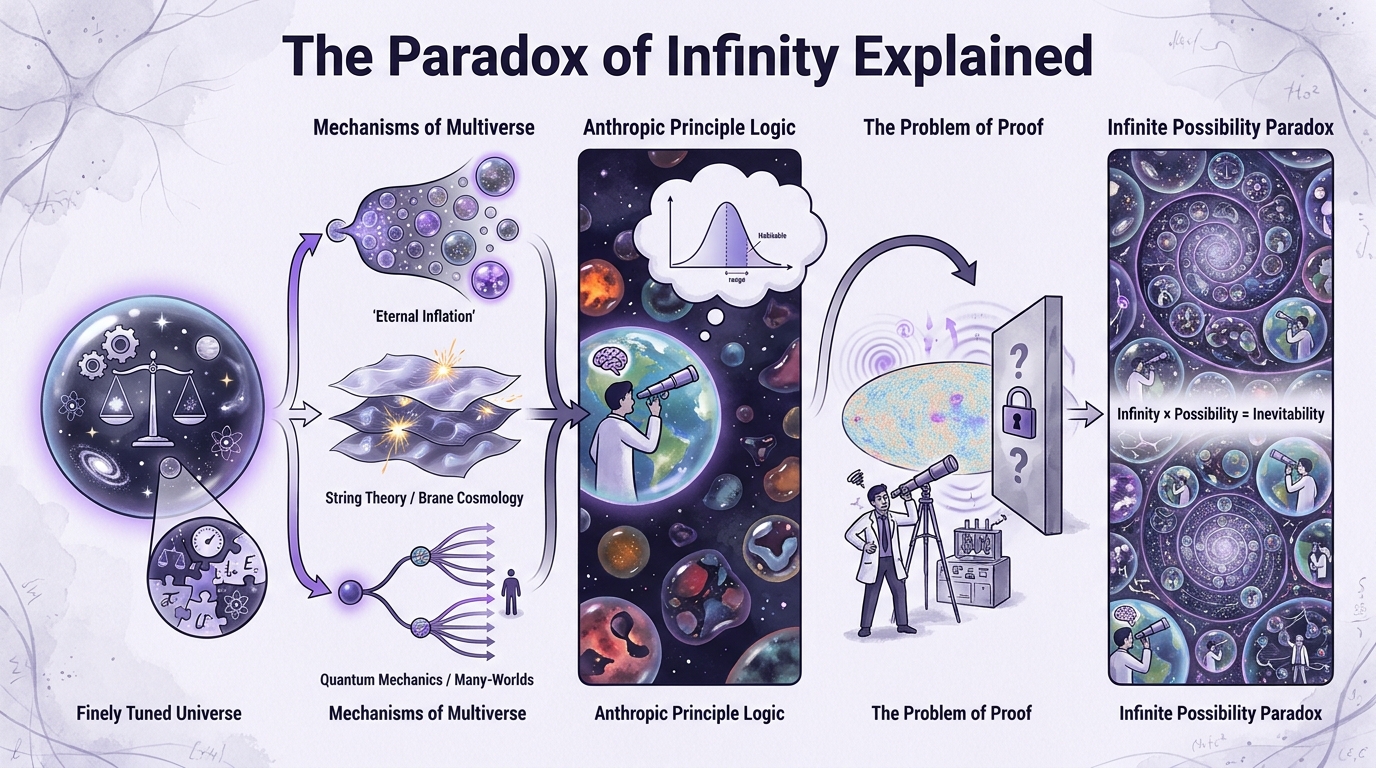
This chapter breaks down the three core scientific theories—cosmic inflation, brane cosmology, and quantum many-worlds—that distinctively build the mathematical foundation for parallel realities.
Detailed summary
1. Our Finely Tuned Universe
1:45Modern cosmology upended our view of the cosmos with the Nobel Prize-winning discovery that the expansion of the universe is accelerating, driven by dark energy. Rather than an explosion within space, the Big Bang was an expansion of space itself, bringing into existence finely balanced physical forces such as gravity and the strong nuclear force.
Because even minuscule adjustments to these fundamental forces would prevent stars from forming or cause the universe to collapse, scientists are left questioning whether our existence is sheer luck or the result of a larger cosmic mechanism.
2. Mechanisms of the Multiverse
4:07Three distinct theoretical frameworks in modern physics point toward the existence of multiple universes. Alan Guth's cosmic inflation theory suggests rapid early expansion led to eternal inflation, creating infinite 'bubble universes,' while brane cosmology from string theory envisions our universe as a three-dimensional slice existing alongside others in extra dimensions.
Additionally, quantum mechanics provides the many-worlds interpretation, where every quantum event splits reality into separate branching universes. Together, these different domains of physics independently support the multiverse hypothesis.
3. The Anthropic Principle Explained
8:32The weak anthropic principle resolves the universe's fine-tuning by pointing out that conscious observers can only exist in a universe capable of supporting life. Rather than our universe being custom-designed for us, we simply inhabit one of the rare bubble universes where physical laws permit complex matter and biology.
Taking this probabilistic logic to its extreme in an infinite multiverse implies that every possible physical configuration occurs somewhere. Consequently, countless variations of our world and entirely alternate histories must realistically exist.
4. The Problem of Proof
10:22Detecting empirical evidence for other universes remains a major scientific hurdle, though researchers look for faint clues like temperature bruises on the cosmic microwave background or gravitational leakage into hidden dimensions. However, the theoretical nature of these ideas creates a sharp divide within the scientific community.
Skeptics warn that if multiverse theories cannot be falsified or empirically observed, they risk becoming philosophical justifications that bypass the rigorous scientific method.
5. The Paradox of Infinity
12:32Combining physics with the vast mathematics of infinity introduces staggering statistical paradoxes. Considering the astronomical number of possible physical parameter combinations, an infinite multiverse dictates that every possible finite scenario occurs endlessly.
This realization reframes humanity's place in the cosmos, shifting our perspective from unique sole inhabitants to just one instance within an infinite spectrum of reality.
Questions this video answers
What evidence suggests our universe might be part of a multiverse?
While direct proof remains elusive, researchers look for subtle signatures like cosmic microwave background 'bruises' from bubble universe collisions. Additionally, the fine-tuned physical constants of our universe logically align with models where many diverse universes exist.
How do different theories of physics predict parallel universes?
Cosmic inflation implies eternal bubble universes forming in expanding space, while string theory suggests our universe is a 3D 'brane' among many in higher dimensions. Quantum mechanics' many-worlds interpretation further proposes that reality branches every time a quantum measurement is made.
Why do some scientists criticize multiverse theory?
Critics argue that because other universes cannot be directly observed or tested, the theory becomes unfalsifiable philosophy rather than empirical science. They warn it could serve as a 'get out of jail free card' to explain away physics mysteries without rigorous testing.
Ask a follow-up Premium
About this summary
SumTube AI wrote this recap from the video's words and chapters. Credit and the original belong to AltReality Science.