
Free AI summary of this YouTube video by SumTube
The Insane Biology of: The Tardigrade
TL;DR
This video provides a deep dive into the fascinating biology, anatomy, and extreme survival capabilities of tardigrades, commonly known as water bears. It explores their evolutionary history, unique locomotion mechanics, specialized adaptations in both terrestrial and marine environments, and their remarkable resilience through cryptobiosis. Additionally, the video examines how their genetic traits, such as damage suppressor genes, could have future applications in human space exploration and terraforming.

Key takeaways
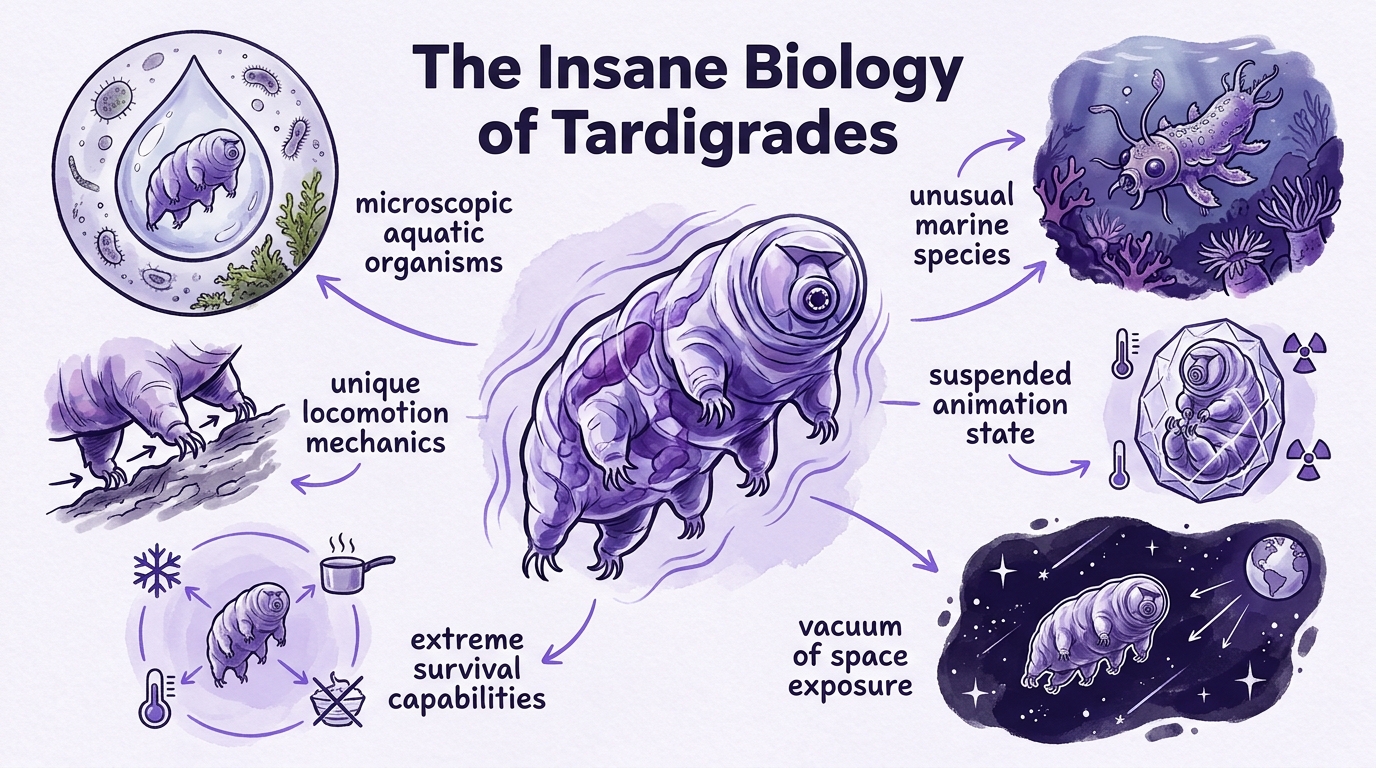
- 3:48Tardigrades are microscopic, aquatic organisms that require a thin film of water around their bodies to move and undergo gas exchange
- 21:39While terrestrial tardigrades are widely studied, marine tardigrades (Heterotardigrada) exhibit even more unusual and diverse morphological structures
- 33:24Tardigrades are renowned for their ability to survive environmental extremes through a state of suspended animation known as cryptobiosis
- 45:27Tardigrades were the first animals proven to survive combined exposure to the vacuum of space, cosmic radiation, and intense solar UV radiation during orbital missions such as ESA's Foton-M3
Tap to enlarge
Most valuable section
Despite fewer scientists focusing on marine tardigrades, new species are frequently discovered, suggesting vast unexplored biodiversity.
Detailed summary
1. Anatomy of a Tardigrade
3:48Tardigrades are microscopic, aquatic organisms that require a thin film of water around their bodies to move and undergo gas exchange. While they inhabit diverse environments globally, most identified species live in terrestrial mosses and lichens. Measuring between 100 and 500 microns in length, tardigrades possess a highly efficient body plan that includes a mouth equipped with piercing stylets used to feed on plants, algae, fungi, and sometimes other microscopic animals.
Their body structure consists of three main trunk segments, each bearing a pair of legs with specialized claws, and a fifth segment with backward-facing legs that act like prehensile tails for gripping. Unlike many other microscopic animals that swim or wriggle, tardigrades possess true legs and exhibit cell constancy (eutely), meaning adult individuals grow by enlarging existing cells rather than dividing them, which may reduce their risk of genetic mutations.
2. Marine Tardigrades
21:39While terrestrial tardigrades are widely studied, marine tardigrades (Heterotardigrada) exhibit even more unusual and diverse morphological structures. These organisms inhabit various oceanic zones, ranging from algal slime and intertidal beach sand to the deep ocean floor. Marine species are distinguished by complex cephalic sensory structures absent in terrestrial species, as well as distinct features like adhesive claws, wing-like cuticle extensions, and inflatable tail appendages.
Due to their microscopic size and benthic habitats, marine tardigrades are difficult to collect and analyze. Scientists often utilize techniques like the 'freshwater shock method'—triggering osmotic shock with fresh water to force tardigrades to release their grip on sediment—to isolate them for study. Despite fewer scientists focusing on marine tardigrades, new species are frequently discovered, suggesting vast unexplored biodiversity.
3. Invincible Microfauna?
33:24Tardigrades are renowned for their ability to survive environmental extremes through a state of suspended animation known as cryptobiosis. During cryptobiosis, they enter a compressed 'tun' state, shutting down their metabolic activity to near zero (as low as 0.01% of normal levels) and losing up to 98% of their body water content. They produce specialized proteins, such as Cytoplasmic Abundant Heat Soluble (CAHS) proteins, which condense into protective gel networks that preserve cell integrity when dehydrated.
This extreme tolerance allows tardigrades to endure extreme temperatures ranging from near absolute zero (-273°C) to over 150°C, as well as severe desiccation for decades. Evolutionary evidence suggests that this mechanism originally evolved as an osmotic response to changing salt concentrations in ancient intertidal environments rather than as a direct defense against extreme temperatures or space exposure.
4. Extraterrestrial Tardigrades
45:27Tardigrades were the first animals proven to survive combined exposure to the vacuum of space, cosmic radiation, and intense solar UV radiation during orbital missions such as ESA's Foton-M3. Their survival is heavily aided by the Damage Suppressor (Dsup) gene, which produces a protein that binds to DNA like a physical shield, minimizing radiation-induced damage. Laboratory experiments modifying human cells with Dsup genes showed a 40% reduction in X-ray radiation damage, hinting at potential protective therapies for human spaceflight.
Furthermore, tardigrades' pioneering capabilities raise intriguing possibilities for space colonization and terraforming. Since tardigrades and certain pioneer plants like moss can endure extreme dryness and radiation, researchers hypothesize that engineered pioneer ecosystems could eventually help establish biological footholds on planets like Mars, provided usable water can be accessed.
Questions this video answers
What does this video say about Anatomy of a Tardigrade?
Tardigrades are microscopic, aquatic organisms that require a thin film of water around their bodies to move and undergo gas exchange. While they inhabit diverse environments globally, most identified species live in terrestrial mosses and lichens. Measuring between 100 and 500 microns in length, tardigrades possess a highly efficient body plan that includes a mouth equipped with piercing stylets
What does this video say about Marine Tardigrades?
While terrestrial tardigrades are widely studied, marine tardigrades (Heterotardigrada) exhibit even more unusual and diverse morphological structures. These organisms inhabit various oceanic zones, ranging from algal slime and intertidal beach sand to the deep ocean floor. Marine species are distinguished by complex cephalic sensory structures absent in terrestrial species, as well as distinct fe
What does this video say about Invincible Microfauna?
Tardigrades are renowned for their ability to survive environmental extremes through a state of suspended animation known as cryptobiosis. During cryptobiosis, they enter a compressed 'tun' state, shutting down their metabolic activity to near zero (as low as 0.01% of normal levels) and losing up to 98% of their body water content. They produce specialized proteins, such as Cytoplasmic Abundant He
What does this video say about Extraterrestrial Tardigrades?
Tardigrades were the first animals proven to survive combined exposure to the vacuum of space, cosmic radiation, and intense solar UV radiation during orbital missions such as ESA's Foton-M3. Their survival is heavily aided by the Damage Suppressor (Dsup) gene, which produces a protein that binds to DNA like a physical shield, minimizing radiation-induced damage. Laboratory experiments modifying h
Ask a follow-up Premium
About this summary
SumTube AI wrote this recap from the video's words and chapters. Credit and the original belong to Real Science.