
Free AI summary of this YouTube video by SumTube
The Insane Biology of: The Saltwater Crocodile
TL;DR
The saltwater crocodile is not just a primitive, brute force predator; it is an exceptionally intelligent apex predator with advanced sensory systems and complex social dynamics. From incredible homing capabilities to intricate vocal and infrasonic communication, their biology reflects over 240 million years of evolutionary refinement. Recent research into their acoustics and cooperative behavior reveals a far more sophisticated creature than traditional reptile stereotypes suggest.

Key takeaways
- Saltwater crocodiles display remarkable intelligence, including the ability to plan hunts over months by studying their prey's routines
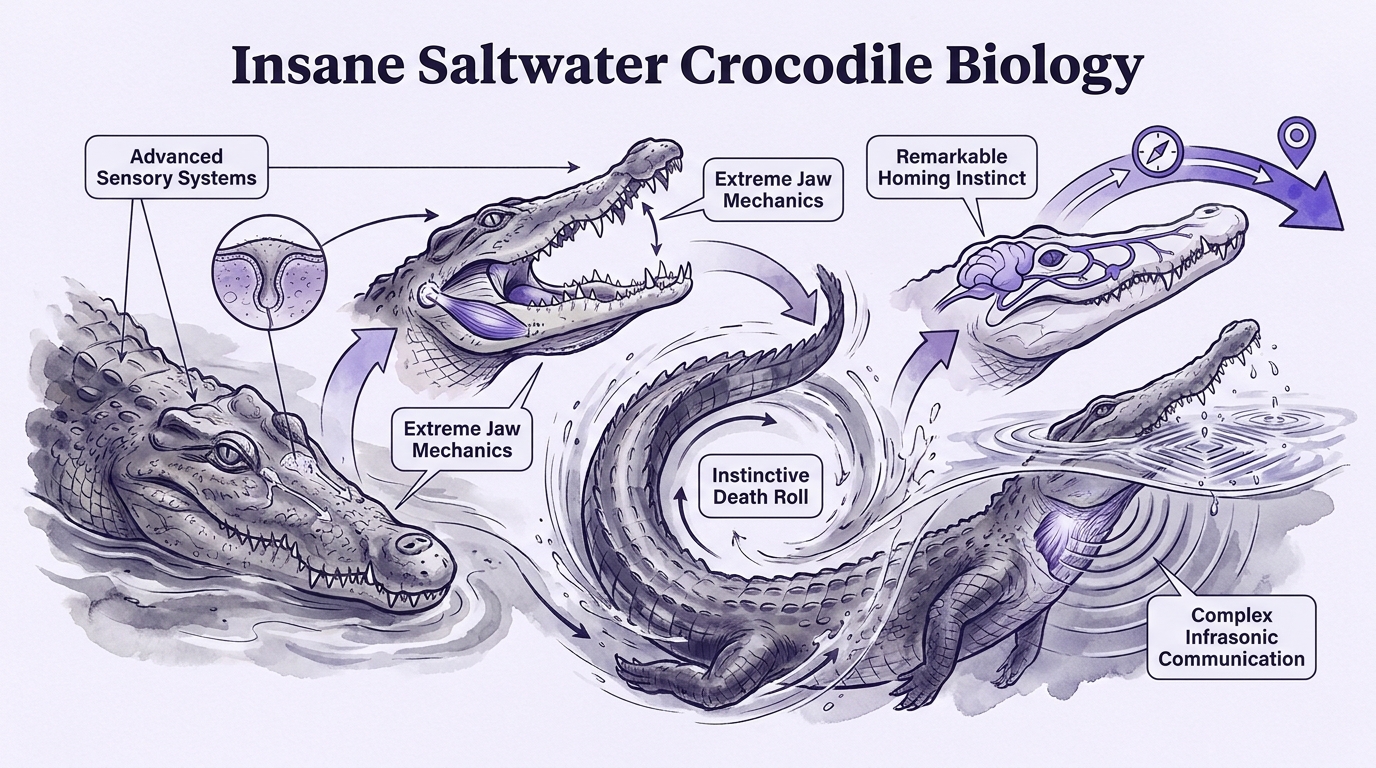
- Their thick skin is embedded with Integumentary Sense Organs (ISOs) that detect minute water vibrations, enabling them to hunt effectively in pitch darkness
- Crocodilian communication extends into low-frequency infrasound that travels up to 1.5 km underwater, causing water to ripple across their backs in 'Faraday waves.'
- Evidence shows crocodiles engage in complex social behaviors, such as maternal care, embryonic learning in the egg, and potential cooperative hunting
Tap to enlarge
Most valuable section
For whom
Reptile enthusiasts, evolutionary biology fans, and anyone curious about apex predator intelligence.
Infrasound and Faraday Waves25:30
It showcases how crocodiles generate low-frequency infrasound vibrations that cause water to dance across their backs, illustrating a visual and acoustic phenomenon rarely seen in the animal kingdom.
Detailed summary
1. Introduction & Crocodile Intelligence
0:00The video opens with a look at the formidable saltwater crocodile and challenges the common misconception that reptiles are simple, instinct-driven creatures. Experts like Dr. Bryan Fry detail real-world observations of crocodiles showing calculated, long-term planning, such as intentionally positioning themselves over months to catch zoo keepers off guard. This cognitive ability makes them far more dangerous and adaptable than simple instinct would allow.
Beyond their reputation as lethal predators, saltwater crocodiles possess surprising social lives. Their intelligence is applied to maternal care, vocal communication, and territorial dominance, establishing them as one of the most sophisticated apex predators on Earth.
2. Anatomy, Habitat & Size
3:16Saltwater crocodiles are the largest living reptiles, ranging from Southeast Asia to Northern Australia. They inhabit diverse environments, including mangrove swamps, brackish estuaries, rivers, and the open ocean, displaying incredible physiological tolerance for different salinity levels.
Anatomically, they are built for extreme durability and power. Averaging 17 feet in length and 1,000 pounds, record-breaking specimens like 'Lolong' have reached over 20 feet and exceeded 2,300 pounds. Their armor includes osteoderms—bony plates embedded in their skin—capable of deflecting small-caliber bullets, protecting them during territorial fights and hunting.
3. Sensory Systems and Teeth
10:52To locate prey in murky water, crocodiles rely on Integumentary Sense Organs (ISOs) scattered across their bodies, particularly on their snouts. These micro-sensors detect tiny mechanical pressure changes and vibrations in the water, allowing them to accurately target prey in pitch darkness.
Their teeth are specialized for holding onto struggling prey rather than chewing. Because teeth frequently break during intense hunts, crocodiles are polyphyodonts, constantly replacing lost teeth throughout their lives—generating upwards of 5,000 teeth over a lifetime.
4. Jaw Mechanics & The Death Roll
13:36A crocodile's bite is the strongest measured in the living animal kingdom, registering over 3,700 pounds per square inch. This massive force is generated by a specialized scissor-like arrangement of jaw muscles that snap shut with incredible speed and power, making escape virtually impossible once prey is seized.
When dealing with prey too large to swallow whole, crocodiles employ the 'death roll'—spinning rapidly underwater to dismember their catch. This behavior is instinctive, observed even in newly hatched crocodilians.
5. The Homing Instinct
15:58Relocating 'problem' crocodiles rarely works because of their remarkable homing abilities. Satellite tracking studies, including research conducted with Steve Irwin, demonstrated that adult males relocated hundreds of kilometers away swam back to their precise original capture points, navigating complex ocean currents and coastlines.
While the exact sensory mechanism behind this navigation remains under investigation—potentially involving magnetic fields, celestial cues, or olfactory memory—it highlights their advanced spatial awareness and problem-solving skills.
6. Communication and Vocalizations
18:01Crocodiles are the most vocal of all reptiles, using a wide range of sounds to communicate across different contexts. Hatchlings use high-pitched contact calls to signal to their mothers, while adults utilize grunts, roars, and respiratory 'hisses' that resemble air brakes to signal aggression or courtship.
Researchers like Sonnie Flores are actively compiling auditory dictionaries to pair specific acoustic signals with corresponding behaviors. This work aims to decipher whether crocodile communications carry context-specific meanings or dialects across different regions.
7. Embryonic Learning and Maternal Care
21:27Crocodilian maternal care is remarkably nurturing, resembling birds or mammals more than typical reptiles. Mother crocodiles guard their nests fiercely, unearth hatchlings when they vocalize from inside the shell, and carry them gently in their jaws to the safety of the water, staying nearby for months.
Fascinating experiments show that crocodilian learning begins before hatching. Embryos exposed to specific scents like strawberry while still inside the egg showed a clear preference for strawberry-flavored food after hatching, proving pre-birth sensory conditioning.
8. Infrasound and Faraday Waves
25:30One of the most extraordinary aspects of crocodile communication is their production of infrasound—low-frequency vibrations below human hearing. During display behaviors, crocodiles vibrate their body cavities, causing the water surrounding their back to form standing ripples known as 'Faraday waves.'
These infrasonic signals travel over 1.5 kilometers underwater. Scientists believe these low-frequency hums convey critical information about body size and dominance to nearby rivals or mates, allowing them to assess competitors from a safe distance.
9. Cooperative Hunting Evidence
31:09Although long considered solitary hunters, historical and modern reports suggest crocodilians can engage in coordinated, cooperative hunting. Documented cases describe larger crocodiles intentionally driving prey into shallow waters where smaller crocodiles wait in ambush, demonstrating role differentiation and tactical coordination.
While proving intent scientifically is difficult, independent observations across multiple continents suggest that crocodilians share sophisticated social hunting tactics previously thought to belong only to mammals like wolves, dolphins, and primates.
10. Crocodile Brains & Human Misconceptions
33:22Neurologically, the crocodile brain shares key architectural similarities with bird brains, particularly in regions handling sensory processing and complex behavior. Because birds are widely recognized for their intelligence, this evolutionary link supports the idea that crocodilians possess higher cognitive function than traditionally assumed.
However, human perceptions often misinterpret their actions. Viral videos claiming crocodiles 'mimic drowning human hands' actually depict natural fishing postures or signs of distress, proving that while crocodiles are intelligent, human anthropomorphism often obscures their true biological behaviors.
Questions this video answers
How intelligent are saltwater crocodiles?
Saltwater crocodiles possess remarkably high intelligence, outperforming typical reptilian standards. Studies and direct observations show they can observe prey routines over months to execute calculated ambushes, display high spatial memory, and engage in complex social communications.
How do crocodiles communicate underwater?
Crocodiles produce low-frequency infrasonic sounds below the human hearing threshold. These low-vibration sounds travel extremely well through water and can be detected by other crocodiles over a kilometer away, possibly using specialized inner ear structures or skin sensors.
Can crocodiles find their way back home if relocated?
Yes, saltwater crocodiles have an extraordinary homing instinct. Studies tracking relocated 'problem' crocodiles revealed individuals traveling hundreds of kilometers through unfamiliar open ocean and around landmasses to return to their exact original capture sites.
Ask a follow-up Premium
About this summary
SumTube AI wrote this recap from the video's words and chapters. Credit and the original belong to Real Science.