
Free AI summary of this YouTube video by SumTube
The Insane Biology of: The Pangolin
TL;DR
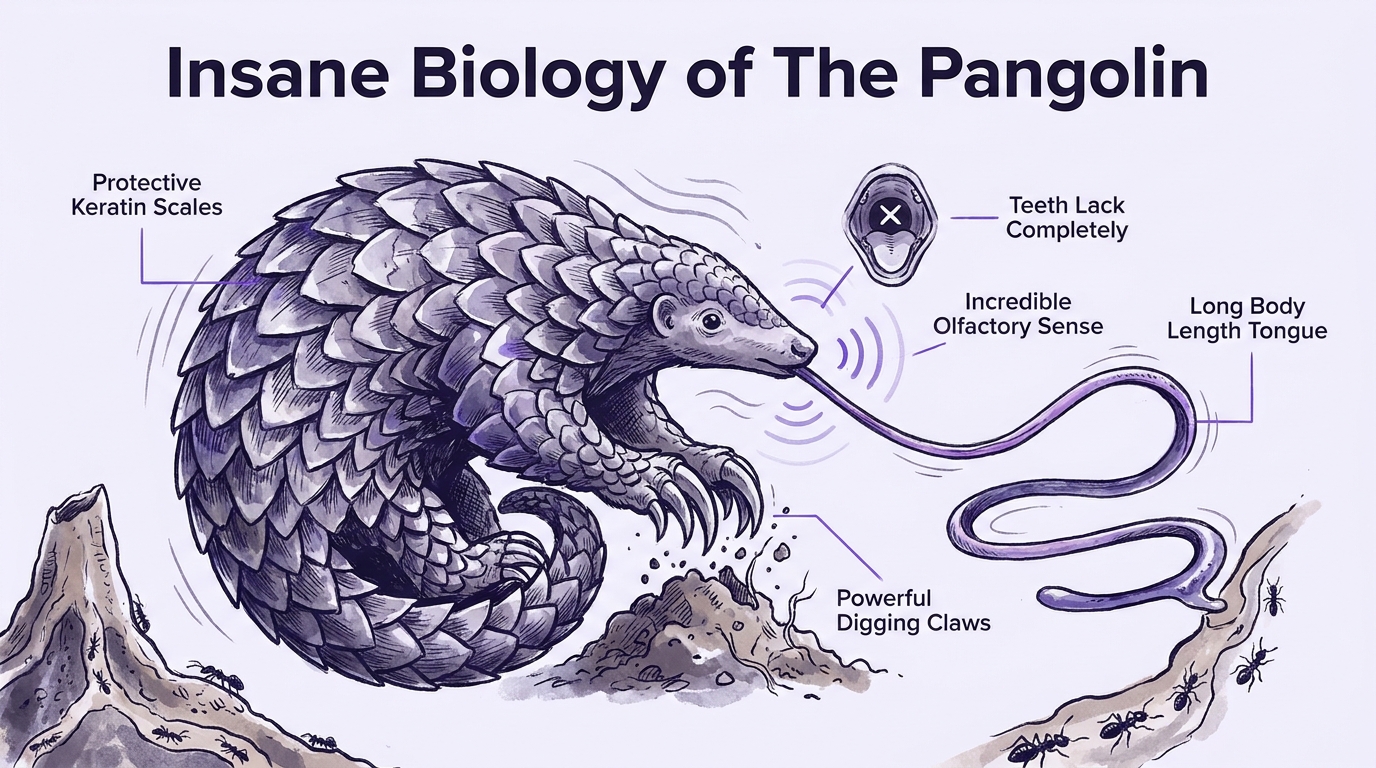
Pangolins are uniquely specialized mammals characterized by their keratin scale armor, extraordinarily long body-length tongues, and powerful digging claws. Despite being closely related to carnivores, they have evolved into dedicated insectivores that perform critical ecological roles like soil aeration and ant control. However, their defense mechanism of rolling into a ball makes them uniquely vulnerable to illegal human trafficking, driving all eight species toward endangerment.

Key takeaways
- 11:22Pangolins are the only mammals with true keratin scales, which possess a cross-lamellar structure that makes them tougher than steel against crushing or piercing force
- 4:19Despite looking like armadillos or anteaters, pangolins are closely related to carnivores like cats, dogs, and bears
- 7:09Pangolins rely on an incredible olfactory sense to locate underground prey, trailing ant pheromones in pitch darkness
- 16:21DNA tracking of confiscated scales has revealed that illegal pangolin poaching is heavily concentrated in specific national parks in Central and West Africa
Tap to enlarge
Most valuable section
For whom
Wildlife enthusiasts interested in evolutionary biology and biomechanics
Scale Anatomy and Defense Mechanisms11:22
This segment breaks down the fascinating microscopic cross-lamellar architecture of pangolin scales, explaining how simple keratin becomes stronger than chainmail armor.
Detailed summary
1. Introduction to the Pangolin
0:00Pangolins are among Africa and Asia's most unique mammals, famous for being the only mammals covered in protective keratin scales. While apex predators like leopards fail to chew through their armor, pangolins remain gentle, non-aggressive animals equipped with long tongues and heavy claws for foraging.
2. The Eight Pangolin Species
2:18There are eight distinct species of pangolins divided equally between Asia and Africa. Asian species include the Chinese, Sunda, Indian, and Philippine pangolins, while African species comprise the Ground, Giant, White-bellied, and Black-bellied pangolins. They vary greatly in size and habits, ranging from tiny tree-dwelling species to massive ground dwellers.
3. Evolution and Unexpected Lineage
4:19Although long believed to be related to anteaters and armadillos due to morphological similarities, modern genetic sequencing reveals pangolins belong to Pholidota, making them close evolutionary relatives to Carnivora (cats, dogs, and bears). Their insectivorous traits are a striking example of convergent evolution.
4. Anatomy of the Pangolin Tongue
4:58Pangolins lack teeth completely, relying instead on a muscular, sticky tongue rooted near their pelvis and ribs that extends the length of their entire body. Stored along their abdominal wall when resting, this extraordinary tongue is engineered to swiftly sweep thousands of ants and termites out of narrow underground crevices.
5. Ecological Importance and Senses
6:22Pangolins consume up to 70 million insects annually, keeping ant and termite populations in check while aerating soil through digging. Experimental studies demonstrate that pangolins rely primarily on an advanced sense of smell, rather than sight or hearing, to track insect pheromone trails in total darkness.
6. Scent Marking and Maternal Care
8:49Being solitary creatures, pangolins use potent anal gland secretions to mark burrows and broadcast their reproductive status. Mothers raise a single pup at a time, carrying the baby safely on their back or tail during nightly foraging trips.
7. Claws, Burrows, and Locomotion
9:46Pangolins feature three oversized claws on each front paw, used to tear open rock-hard termite mounds and construct deep underground shelters. Because their massive claws prevent flat-footed walking, ground pangolins walk on their knuckles or adopt a semi-bipedal stance.
8. Scale Anatomy and Defense Mechanisms
11:22When threatened, a pangolin rolls into a tight, impenetrable ball protected by overlapping keratin scales arranged in a precise hexagonal pattern. Microscopically, these scales feature a cross-lamellar structure of alternating cell orientations that dissipates kinetic energy, preventing cracks from spreading and resisting bites better than chainmail.
9. The Illegal Wildlife Trade Crisis
14:01While effective against big cats and hyenas, the pangolin's curl-up defense makes it helpless against human poachers, who simply pick them up. Highly prized on the black market for traditional medicine and luxury meat, over one million pangolins have been trafficked in the past decade, pushing all Asian species to critically endangered status.
10. Genetic Tracking and Discovery of a New Species
16:21Researchers recently developed genomic mapping techniques using DNA extracted from confiscated scales to trace poached pangolins back to their exact origin within 70 kilometers. This research pinpointed poaching hotspots in Central African national parks and surprisingly uncovered evidence of a previously unknown ninth pangolin species, dubbed Manis mysteria.
11. Policy Changes and Conservation Efforts
19:43International trade bans were enacted in 2017, and China removed pangolin scales from official traditional medicine lists while elevating their protection status. Organizations like Planet Wild and Save Vietnam's Wildlife work directly on the ground to rescue, rehabilitate, and reintroduce pangolins into protected habitats.
Questions this video answers
Are pangolins related to anteaters or armadillos?
Despite their physical similarities, pangolins are not closely related to anteaters or armadillos. Genetic analysis shows that pangolins belong to the order Pholidota, making their closest living relatives members of the order Carnivora, such as bears, cats, and dogs. Their similarities to anteaters are the result of convergent evolution.
Why are pangolins the most trafficked mammals in the world?
Pangolins are heavily poached because their scales are used in traditional medicine systems, particularly Traditional Chinese Medicine, despite consisting only of keratin with no proven medicinal benefits. Additionally, when threatened, pangolins roll into a defensive ball, making them extremely easy for human poachers to simply pick up and carry away.
How do pangolins eat without teeth?
Pangolins use an exceptionally long, sticky tongue attached near their pelvis that extends almost the full length of their body. They locate ant and termite nests using a powerful sense of smell, tear open mounds with giant front claws, and quickly lap up thousands of insects using their specialized salivary glands.
Ask a follow-up Premium
About this summary
SumTube AI wrote this recap from the video's words and chapters. Credit and the original belong to Real Science.