
Free AI summary of this YouTube video by SumTube
The Frog That Unleashed the World’s Most Lethal Pathogen
TL;DR
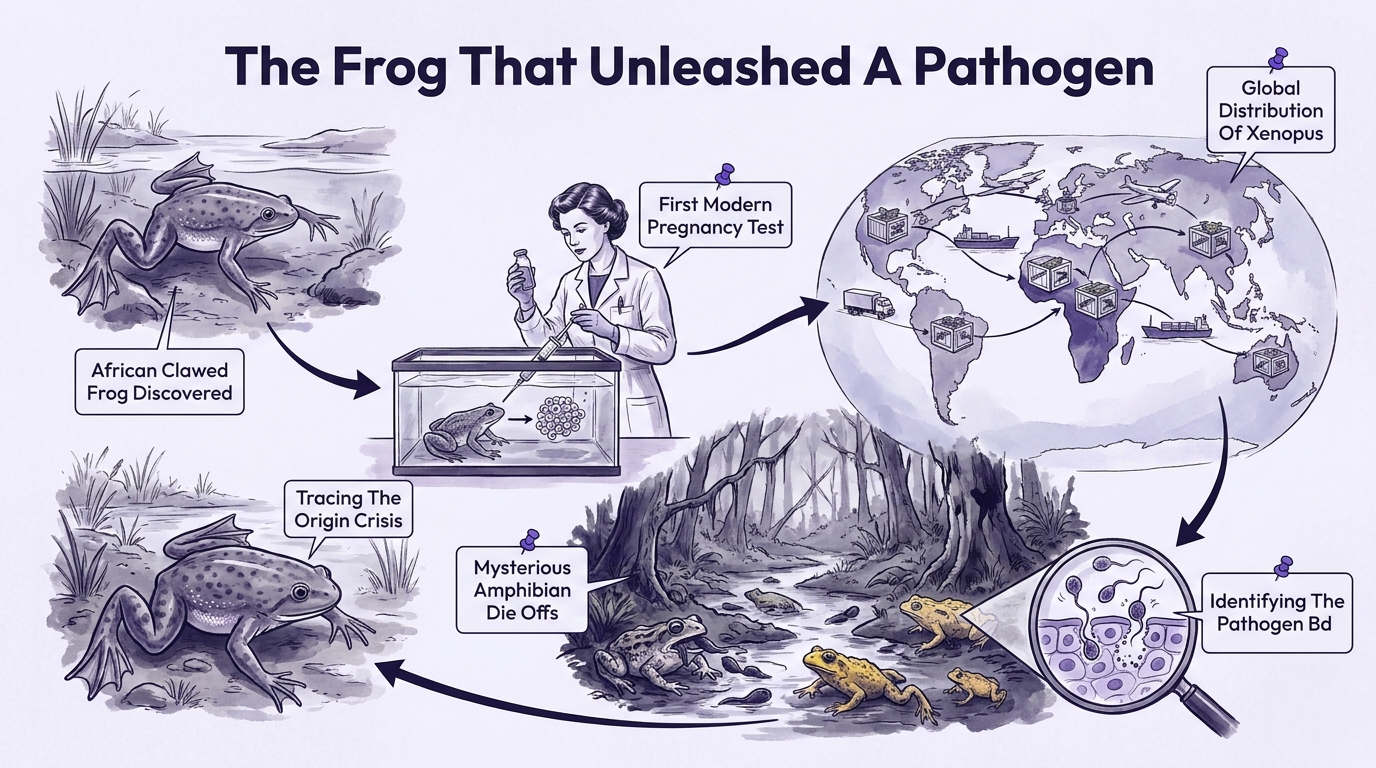
In the 1930s, Lancelot Hogben discovered that the African clawed frog (Xenopus laevis) lay eggs when injected with human pregnancy hormones, revolutionizing reproductive diagnostics. However, the global shipment of these frogs unintentionally spread Batrachochytrium dendrobatidis (Bd), a deadly chytrid fungus to which Xenopus was immune but which has since caused the decline or extinction of hundreds of amphibian species worldwide. Scientists are now racing to develop solutions, including heat-based 'frog saunas' and breeding for genetic resistance, to save remaining populations.

Key takeaways
- 4:33African clawed frogs were globally distributed as the first reliable, live-animal pregnancy test, replacing lethal rabbit and mouse assays
- 12:48The international trade of Xenopus laevis inadvertently spread the deadly chytrid fungus (Bd), causing a global amphibian apocalypse
- 15:09Because Bd is heat-sensitive, artificial 'frog saunas' allow wild amphibians to clear their infections naturally
Tap to enlarge
Most valuable section
For whom
Science enthusiasts interested in ecology, epidemiology, and historical unintended consequences in medical discovery.
It showcases a clever, low-tech conservation breakthrough where scientists build solar-heated refuges that exploit the fungus's vulnerability to heat to cure wild frogs.
Detailed summary
1. The Strange History of the African Clawed Frog
0:00The African clawed frog (Xenopus laevis) is a unique, fully aquatic amphibian native to sub-Saharan Africa. Lacking a tongue or teeth, it feeds via suction and possesses specialized skin capable of altering pigment based on light levels in its surrounding environment.
In the 1920s, scientist Lancelot Hogben began researching the frog's skin-changing abilities, discovering that the pituitary gland regulated this process by releasing melanocyte-stimulating hormones. By removing the gland, he created a hormonal blank slate ideal for laboratory testing.
2. The First Modern Pregnancy Test
2:44Hogben's research team discovered that injecting pituitary extracts from an ox into female African clawed frogs caused them to lay eggs within hours. They soon realized that human pregnancy urine contained human chorionic gonadotropin (hCG), which produced the exact same egg-laying response in the frogs.
This discovery led to the Xenopus pregnancy test published in 1938. Unlike previous animal tests involving mice or rabbits, the frog test did not require dissecting or killing the specimen, provided results in less than 24 hours, and boasted a 98% accuracy rate.
3. Global Distribution of Xenopus
4:56Following the success of the frog pregnancy test, demand for Xenopus laevis exploded globally. South African suppliers captured hundreds of thousands of wild frogs and shipped them to medical labs and research facilities across Europe, the Americas, Asia, and Australia.
By the 1950s, Xenopus became the most widely kept laboratory amphibian in the world. Although synthetic urine test strips replaced frog testing in the 1960s, millions of frogs remained in research facilities worldwide or were released into local habitats.
4. The Mysterious Amphibian Die-Offs
6:11In the late 1970s and 1980s, biologists in Australia began discovering massive die-offs of rainforest frogs, including the extinction of the unique gastric-brooding frog. Entire populations vanished along a migrating wave advancing roughly 100 kilometers per year.
A similar crisis emerged in Panama in 1996, where streams were found littered with dead and dying amphibians. Experiments confirmed that the mystery disease was water-borne, but the responsible pathogen remained unidentified for years.
5. Identifying the Pathogen: Bd
8:36Researchers examining infected frog skin samples isolated a novel chytrid fungus in 1999, naming it Batrachochytrium dendrobatidis (Bd). Bd is an obligate parasite that infects keratinized tissue on amphibian skin, releasing motile zoospores into freshwater environments to infect new hosts.
The fungal infection causes skin thickening and peeling, disrupting the critical exchange of electrolytes and oxygen through the skin. Bd has since spread worldwide, impacting over 700 amphibian species and causing at least 90 extinctions.
6. Tracing the Origin of the Crisis
11:58In 2004, researchers examining preserved museum specimens dated the earliest known proliferation of Bd back to 1933 in South Africa. The primary host was identified as Xenopus laevis, which harbored the pathogen without developing fatal symptoms.
Because Xenopus co-evolved with Bd, it possessed natural immunity and skin peptides that suppressed fungal overgrowth. When millions of these frogs were exported worldwide for pregnancy testing, they unknowingly carried the deadly fungus to vulnerable, non-resistant amphibian populations across the globe.
7. Innovative Solutions & Hope for the Future
13:59To combat the ongoing chytrid crisis, scientists are exploring targeted antifungal treatments, though large-scale wild application remains impractical. A promising 2024 study deployed solar-heated 'frog saunas,' allowing wild frogs to warm their bodies sufficiently to kill off the heat-sensitive Bd fungus.
Additionally, researchers are studying frog populations that survived outbreaks to identify genetic markers and microbiomes associated with natural resistance. These findings are guiding selective breeding and reintroduction programs aimed at saving endangered species.
Questions this video answers
How did frogs used to be used as pregnancy tests?
In the 1930s, scientists discovered that injecting a pregnant woman's urine into a female African clawed frog triggered the frog to lay eggs within hours due to the presence of hCG hormones. Unlike previous tests using mice or rabbits, the frog test did not require killing the animal and provided rapid, highly accurate results.
What is chytridiomycosis and why is it so deadly to amphibians?
Chytridiomycosis is a skin disease caused by the aquatic fungus Batrachochytrium dendrobatidis (Bd). It infects the keratinized outer layers of amphibian skin, disrupting their ability to breathe, absorb nutrients, and balance electrolytes, which frequently leads to heart failure and death.
Why didn't African clawed frogs die from the fungus?
Because the fungus originated in Africa, African clawed frogs co-evolved alongside it over thousands of years. They developed natural immune defenses, including antimicrobial peptides in their skin, allowing them to harbor the pathogen symptomlessly while spreading it to non-resistant species around the world.
Ask a follow-up Premium
About this summary
SumTube AI wrote this recap from the video's words and chapters. Credit and the original belong to Real Science.