
Free AI summary of this YouTube video by SumTube
The Birth of Civilization (12,000 BC - 2300 BC) | The Human Chronicle (Episode 1)
TL;DR
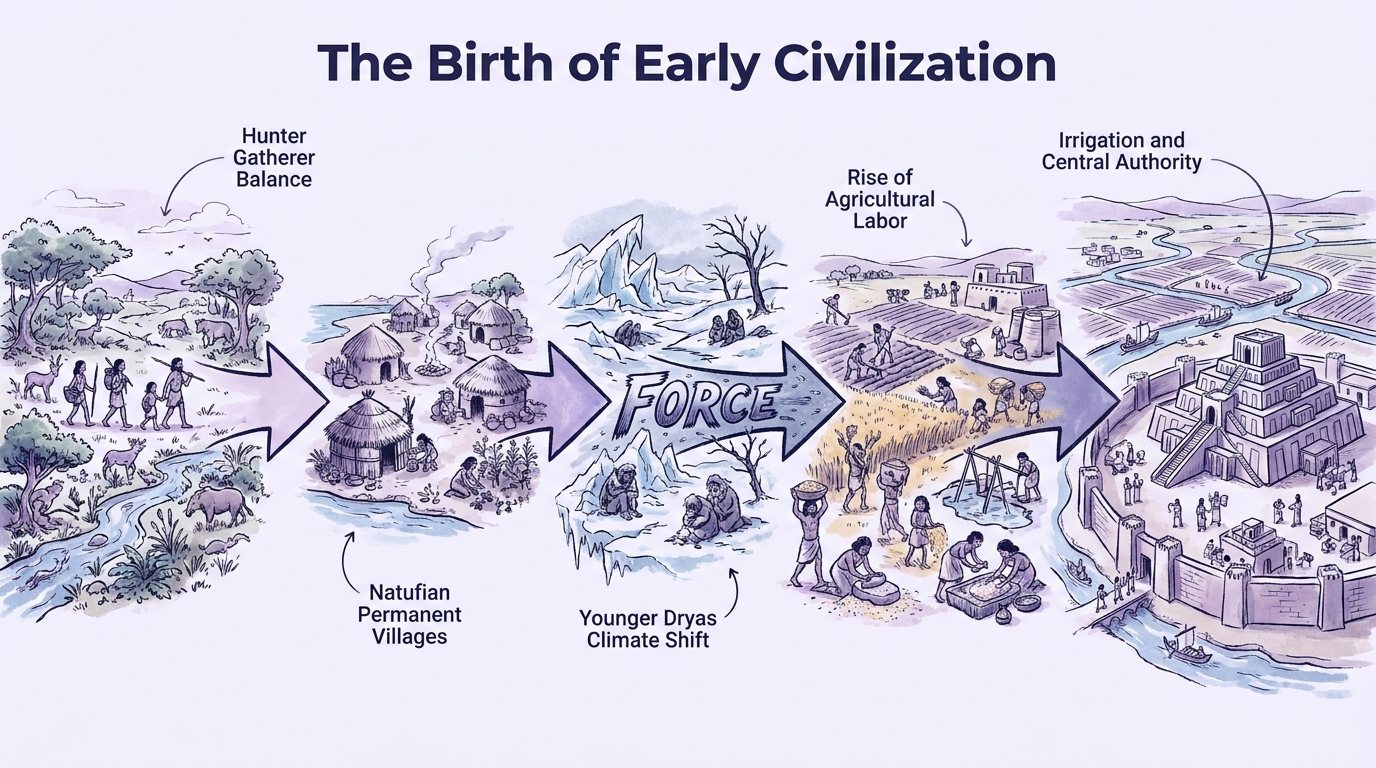
This video explores how humanity transitioned from mobile hunter-gatherer bands to dense, agricultural state societies. It traces how environmental shifts and sedentism led to population growth, forced the adoption of farming and irrigation, and ultimately birthed complex social hierarchies, urban centers like Uruk, and early systems of writing and state control.

Key takeaways
- 7:36Agriculture was born out of crisis, not choice: climate shifts forced settled populations to cultivate crops to avoid collapse
- 5:16Sedentism preceded farming, causing population growth that rendered foraging unsustainable
- 16:24Large-scale irrigation required centralized coordination, giving rise to political authority and class division
- 20:22Writing originated not for literature or myth, but as an administrative tool to count rations, labor, and taxes
Tap to enlarge
Most valuable section
For whom
History enthusiasts and anthropology students seeking a structural, environmental explanation for how human societies evolved into states.
The Urban Explosion: Uruk and the State17:26
It vividly details how mass urbanization transformed human interactions from personal trust to institutional governance, illustrated through standardized ration bowls and bureaucratic oversight.
Detailed summary
1. The Foraging Equilibrium
0:00For roughly 97% of human history, Homo sapiens lived in small, mobile foraging bands in quiet balance with the natural world. Skeletal analysis reveals these populations enjoyed robust health, diverse diets, and physical stature unmatched until the modern era, leaving minimal impact on the surrounding environment.
Socially, these groups maintained an egalitarian structure supported by an 'immediate-return' economy. Because wealth could not be accumulated or stored, dominance hierarchies were actively resisted, and individuals retained the freedom to leave conflicting groups in a world without fixed borders.
2. The Natufians: Sedentism Before Agriculture
4:05At the start of the Holocene epoch around 12,000 years ago, a warm, stable climate created rich wild grain stands and abundant game in the Fertile Crescent. The Natufian culture took advantage of this natural surplus by establishing permanent stone villages long before planting seeds.
Living in permanent settlements eliminated the physical burden of carrying infants during migration, causing birth intervals to drop from five years to two. This demographic explosion strained local resources, creating a population size that could no longer return to a mobile lifestyle.
3. The Younger Dryas and the Forced Birth of Farming
6:54Around 10,800 BCE, a sharp global cooling event known as the Younger Dryas disrupted the Levant's ecosystem, shrinking wild food sources. Unable to support their enlarged populations through foraging alone, settled communities faced starvation.
To survive, humans began manipulating plant environments—clearing weeds, selecting seeds, and diverting water. Agriculture emerged not as a conscious step toward progress, but as a desperate strategy to feed overcrowded villages that could no longer migrate.
4. The Biological and Social Cost of Agriculture
8:43The shift to farming severely compromised human physical well-being. Monotonous grain diets caused nutritional deficiencies and reduced adult stature, while hours of repetitive grinding stone labor caused joint degeneration and chronic spinal issues, particularly among women.
Furthermore, high-density village living alongside domesticated livestock created ideal conditions for zoonotic diseases like smallpox and tuberculosis. Despite poorer individual health, agriculture yielded more calories per acre, allowing population growth to outstrip that of hunter-gatherers.
5. Fixed Property and the Rise of Inequity
10:59Agriculture tied human survival directly to specific plots of land, turning territory into an indispensable resource. Because fields required months of upfront labor, abandoning a site meant losing future sustenance, giving birth to the concepts of private property and land defense.
With stored surpluses came vulnerability to raiding, prompting the construction of defensive walls and watchtowers, such as those at early Jericho. Coordinating large-scale defense and surplus distribution gradually eroded social equality, creating structured social hierarchies.
6. Mesopotamia and the Command of Water
13:50Around 5000 BCE, growing populations moved into the arid southern alluvial plain of Mesopotamia between the Tigris and Euphrates rivers. While rich in river-deposited silt, the land suffered from intense heat, scarce rainfall, and unpredictable flooding.
To farm effectively, communities built extensive irrigation canals and levees. Managing these massive water networks demanded centralized oversight and compulsory labor, empowering a managerial elite who controlled water access and, consequently, human survival.
7. The Urban Explosion: Uruk and the State
17:26By 3800 BCE, Uruk grew into humanity's first true city, housing up to 50,000 residents within fortified walls. This unprecedented concentration of strangers meant personal relationships could no longer maintain order, necessitating formal state institutions.
Central temple complexes managed the economy, distributing standardized food rations in mass-produced 'beveled-rim bowls.' Independent producers became dependent laborers, exchanging their work for institutional protection and daily food allocations.
8. The Technology of Control: Invention of Writing
20:16As Uruk's economic transactions outgrew human memory, administrators developed cuneiform writing on clay tablets around 3200 BCE. The earliest texts were not literature, but financial ledgers tracking grain supplies, taxes, labor hours, and livestock.
Writing centralized power in the hands of a new professional class: scribes. By recording obligations in unyielding clay, state institutions gained unprecedented oversight over production, permanently transforming labor into a quantifiable commodity.
9. The Monarch and the Monopoly on Force
22:42By 2500 BCE, competition over land and irrigation water among Mesopotamian city-states fueled chronic warfare. Power shifted from temple priests to military leaders, giving rise to kings ('Lugals') who established permanent standing armies.
States instituted a monopoly on physical force, exchanging military protection for taxes and forced labor. War captives were integrated into city economies as slaves, establishing institutional coercion as a foundational element of early statehood.
10. Global Convergence: Patterns of Civilization
25:12Similar trajectories unfolded independently across the globe, from the Nile Valley and Indus River to the Yellow River and Mesoamerica. Though each region domesticated different staples—rice, maize, millet, or potatoes—the structural outcome remained identical.
Surplus food enabled population growth, requiring organized coordination that produced social stratification, urban centers, and centralized state power. Across continents, human societies converged on the same structural framework.
11. The Legacy of the First Cities
26:28Modern global society remains deeply rooted in the structural choices made during the Neolithic transition. The trade-offs initiated thousands of years ago—centralized authority, resource competition, and environmental manipulation—continue to define urban life today.
Civilization did not eliminate human dependence on nature; rather, it enclosed nature within engineered systems, trading personal autonomy and environmental balance for collective scale, technological complexity, and institutional stability.
Questions this video answers
Were hunter-gatherers less healthy than early farmers?
Contrary to modern assumptions, skeletal evidence shows Upper Paleolithic hunter-gatherers were taller, stronger, and suffered from fewer chronic illnesses or repetitive stress injuries. Early farmers experienced a noticeable decline in physical health, driven by nutrient-deficient grain diets, grueling manual labor, and close contact with domesticated animals.
Did farming cause humans to settle down, or did settling down lead to farming?
Archaeological evidence from the Natufian culture demonstrates that humans settled into permanent villages before they began cultivating crops. The abundant wild resources of the Fertile Crescent allowed for fixed housing, which subsequently caused a population boom that forced communities to actively manage and farm plants when wild supplies faltered.
Why was writing invented in ancient Mesopotamia?
Writing was invented in Uruk around 3200 BCE as an administrative necessity when city populations grew too large for memory-based record-keeping. The earliest cuneiform tablets recorded economic data such as crop yields, worker rations, tax collections, and livestock counts.
Ask a follow-up Premium
About this summary
SumTube AI wrote this recap from the video's words and chapters. Credit and the original belong to Tim - Reborn History.