
Free AI summary of this YouTube video by SumTube
The Assyrian Empire: The Ancient Kings Who Ruled Through Fear
TL;DR
This video explores the rise and fall of the ancient Assyrian Empire, examining how it built its dominance in Northern Mesopotamia through military innovation, strategic intimidation, and efficient administration. It highlights key rulers like Ashurnasirpal II, Sennacherib, and Ashurbanipal, who commemorated their conquests through propaganda-driven stone reliefs while also preserving vast cultural knowledge, such as the Library of Nineveh. Ultimately, the video demonstrates how overextension and reliance on ruling through fear led to the empire's rapid collapse when unified enemies breached Nineveh in 612 BCE.

Key takeaways
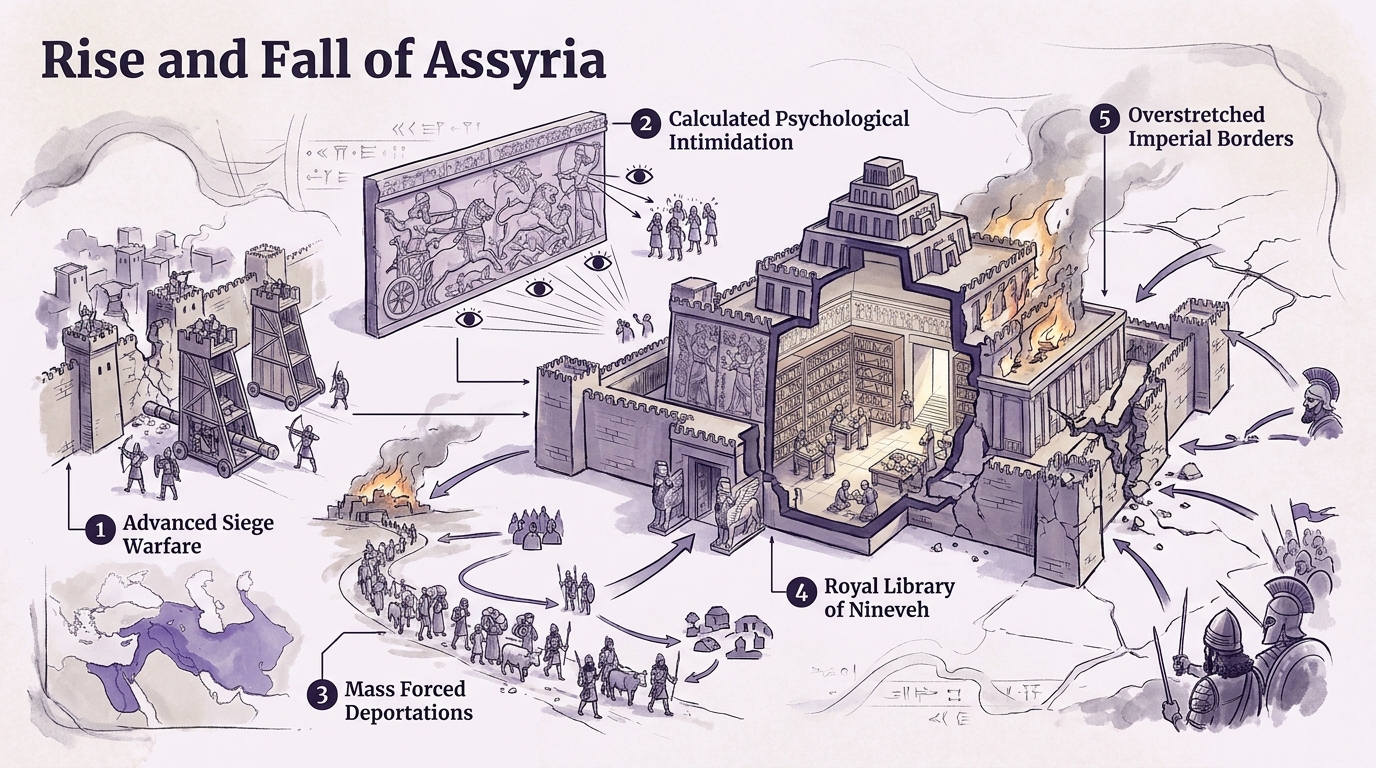
- 0:32Assyria combined advanced siege warfare with psychological intimidation, carving terrifying conquest scenes into palace walls to break enemy morale before battles began
- 5:44Imperial expansion relied heavily on forced deportations to dismantle local identities and minimize rebellions in conquered territories
- 9:14Despite their reputation for brutality, Assyrian kings preserved critical ancient knowledge, most notably through Ashurbanipal's vast Library of Nineveh
- 12:13Ruling through fear proved unsustainable long-term, as resource overextension left Assyria vulnerable to unified regional coalitions
Tap to enlarge
Most valuable section
For whom
History enthusiasts interested in ancient Mesopotamian warfare, empire-building strategies, and historical propaganda.
Cultural Contributions of Ashurbanipal8:53
This section contrasts the empire's ruthless military reputation with its profound scholarly legacy, detailing the discovery and impact of Ashurbanipal's famous clay tablet library.
Detailed summary
1. Introduction to the Assyrian Empire
0:00Over 2,700 years ago, the Assyrian Empire emerged as one of the most powerful military forces of the ancient world. Kings established control through formidable battlefield tactics, strategic intimidation, and detailed visual records of their conquests crafted into palace walls to send a clear message to all observers.
Historians trace Assyria's rise to Northern Mesopotamia, within modern-day Iraq. Between the 9th and 8th centuries BCE, the state developed sophisticated systems of military engineering, administrative oversight, and intelligence gathering, enabling its armies to breach fortified cities across the Near East.
2. Military Strategy and Psychological Warfare
1:54Assyria's success stemmed from combining advanced siege equipment—such as battering rams, ladders, and siege towers—with calculated psychological intimidation. Rulers recognized that subduing enemies through fear before reaching their walls was just as valuable as defeating them in direct combat.
King Ashurnasirpal II (883–859 BCE) exemplified this approach by establishing Nimrud as a grand capital. His palace walls featured carved stone reliefs illustrating lion hunts, military victories, and tribute submission, serving as constant reminders of royal supremacy to visitors and subjects.
3. Propaganda and Imperial Administration
3:48Assyrian royal inscriptions and palace reliefs documented military campaigns and harsh punishments inflicted on rebellious territories. While these visual and written records served as official propaganda to glorify the king rather than neutral accounts, they provide historians with valuable evidence of imperial management strategies.
Under rulers like Tiglath-Pileser III in the 8th century BCE, Assyria expanded rapidly by establishing strong provincial governance. To suppress resistance and reorganize conquered lands, the empire frequently utilized forced deportations, forcibly relocating populations across vast distances.
4. The Grandeur of Nineveh under Sennacherib
6:52King Sennacherib (705–681 BCE) transformed Nineveh into a magnificent capital equipped with expanded fortifications, advanced water supply networks, and a massive royal palace. The palace walls featured intricate reliefs capturing key campaigns, including the detailed siege of the Judean city of Lachish.
These elaborate stone carvings served a dual purpose: documenting complex siege tactics and captives for posterity while broadcasting imperial dominance. However, maintaining control over such an expansive territory created logistical burdens, requiring constant resources for garrisons and supply line protection.
5. Cultural Contributions of Ashurbanipal
8:53Assyria reached its territorial peak in the 7th century BCE under kings like Esarhaddon and Ashurbanipal, briefly extending control into Egypt. Ashurbanipal (668–631 BCE) is famous for creating the Royal Library of Nineveh, which housed thousands of cuneiform clay tablets.
This vast collection preserved literature, omen texts, scientific studies, and scholarly works from across Mesopotamia. This intellectual legacy demonstrates that Assyria was not merely a destructive force, but a complex civilization with deep administrative and cultural traditions.
6. The Fall and Legacy of Assyria
10:33Despite its military capability, Assyria could not sustain its overstretched borders indefinitely. In the late 7th century BCE, a combined coalition of Babylonian and Median forces launched a massive campaign against the empire, culminating in the destruction of Nineveh in 612 BCE.
Following Nineveh's collapse, Assyrian political power rapidly vanished, leaving its palaces buried until modern archaeological excavations uncovered them. Today, these ruins offer a compelling lesson on both the heights of ancient military engineering and the inherent fragility of empires sustained primarily by fear.
Questions this video answers
How did the Assyrian Empire expand its territory so effectively?
Assyria built a formidable military state using organized armies, skilled engineers, and advanced siege weapons such as battering rams and towers. They complemented physical force with psychological tactics, recording graphic accounts of victory on palace walls to intimidate potential opponents into surrendering without prolonged combat.
Why did Assyrian rulers carve detailed scenes of violence and war into palace walls?
Palace reliefs served as official propaganda designed to glorify the king and assert unquestioned authority over both subjects and foreign envoys. These artworks preserved a permanent message of royal power, warning that resistance would bring devastating consequences.
What contributions did the Assyrians make to preserving history and literature?
King Ashurbanipal established a massive royal library at Nineveh containing thousands of cuneiform clay tablets. This collection preserved Mesopotamian literature, scientific works, scholarly texts, and political records, providing modern historians with invaluable insights into ancient Near Eastern life.
What led to the ultimate downfall of the Assyrian Empire?
The empire became overextended as every conquest required garrisons, protected supply lines, and resource-heavy suppression of rebellions. In the late 7th century BCE, a coalition of Babylonian and Median forces capitalized on this strain, capturing and destroying Nineveh in 612 BCE.
Ask a follow-up Premium
About this summary
SumTube AI wrote this recap from the video's words and chapters. Credit and the original belong to Civilization Evolution.