
Free AI summary of this YouTube video by SumTube
Syllabus of aptitude for GATE
TL;DR
This overview outlines the full 15-mark General Aptitude syllabus for GATE aspirants, emphasizing its higher weightage compared to any individual Computer Science subject. The instructor explains the strategic approach to mastering topics across quantitative ability, logical reasoning, and verbal comprehension through multibranch GATE past-year questions. A flexible, step-by-step teaching plan is established to ensure complete syllabus coverage alongside core technical subjects.

Key takeaways
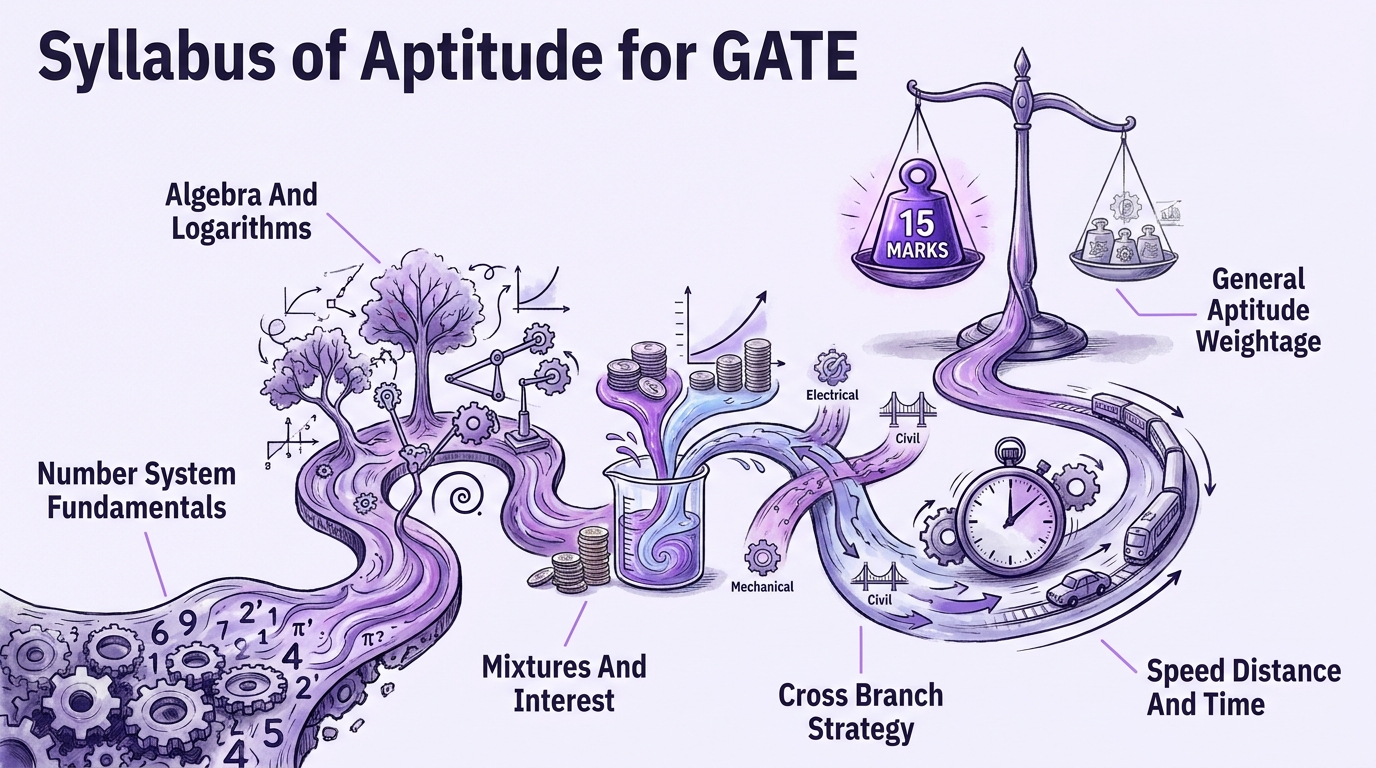
- 2:22General Aptitude carries 15 marks in GATE, exceeding the weightage of core technical subjects like Algorithms or Data Structures
- 20:15Questions will be sourced across all engineering branches (Mechanical, Electrical, Civil) rather than limiting practice to Computer Science alone
- 11:50Even topics that have not appeared recently in GATE (referred to as 'Karan Arjun' topics) must be prepared for potential future exams
- GATE Aptitude focuses on intuitive problem-solving and approach techniques rather than CAT-level extreme difficulty
Tap to enlarge
Most valuable section
For whom
GATE aspirants looking to maximize their score through practical aptitude tips and real-world mathematical applications.
Interest Calculations & GATE Strategy17:30
It illustrates real-life financial traps in compound interest calculations while laying out the strategy of using multi-branch GATE questions over CAT-level material.
Detailed summary
1. Aptitude Syllabus Weightage & Teaching Plan
0:04The instructor introduces the 15-mark General Aptitude section for the GATE exam, highlighting that its total weightage surpasses individual core Computer Science subjects such as Data Structures or Algorithms. Modern GATE English questions focus primarily on passage comprehension and logical derivation rather than rote memory of antonyms or grammar rules, effectively making English an extension of core analytical aptitude.
To prevent burnout, the Aptitude syllabus will be covered systematically alongside technical subjects like Theory of Computation, Graph Theory, and C Programming. The goal is to complete the full syllabus comfortably before December 2022, ensuring students gain steady proficiency through step-by-step video uploads.
2. Number System & Quantitative Fundamentals
6:42The first major module is the Number System, covering fundamental concepts such as prime factors, composite factors, trailing zeros in factorials, and cyclicity for determining the last digit of large powers. Crucial topics like LCM and HCF are highlighted through practical scenarios, including blinking lights, circular running tracks, and rod-cutting problems.
Additional topics include remainder theorems and basic base conversions. Advanced number base arithmetic (such as Base-2 to Base-10 or Base-8 addition) will be seamlessly integrated with Digital Logic to ensure complete clarity without redundant overlap.
3. Algebra, Logarithms & Arithmetic Concepts
10:57The overview transitions to topics like Calendars and Logarithms. Logarithmic properties are stressed as vital foundations for Computer Science, particularly for asymptotic notation and complexity analysis in Algorithms. The module also details Arithmetic and Geometric Progressions, Quadratic Equations, and Averages.
Percentage calculations, Ratios, Proportions, and Profit and Loss are outlined with trick examples, such as non-symmetric percentage changes. The practical math of commercial transactions, discounts, and basic business arithmetic forms a core component of this section.
4. Mixtures & Interest Calculations
15:28Mixtures and Alligations cover practical mathematical models, including liquid dilution, replacement formulas, and concentration adjustments commonly seen in GATE quantitative questions. Simple and Compound Interest topics follow, highlighting practical applications like loan interest frequencies.
The instructor demonstrates how compounding quarterly can cost more than a higher annual interest rate. This section emphasizes understanding mathematical mechanics over simple formula memorization.
5. Cross-Branch Question Strategy & Logical Reasoning
20:01The strategy for solving practice questions relies on using previous GATE questions across all engineering streams (Mechanical, Electrical, Civil, and CS) rather than excessively difficult CAT material. Logical topics such as Blood Relations, Reasoning, Data Interpretation (Pie Charts and Line Graphs), Geometry (Volumes and Surface Areas), and Set Theory (Principle of Inclusion-Exclusion) are outlined.
Although some topics appear infrequently in Computer Science papers, preparing for them ensures students are ready for potential format updates or surprise question patterns.
6. Speed, Time, Work, Clocks & Final Syllabus Wrap-Up
25:36The remaining syllabus topics include Time & Work, Time-Speed-Distance (average speeds, train crossing problems), and Clock angles (calculating 90-degree and 180-degree hand alignments). Reasoning modules like Cubes, Syllogisms, and Number/Letter Series complete the 21-topic checklist.
The instructor wraps up by promising clear theoretical overviews followed by extensive problem-solving. This approach builds intuitive elimination strategies and exam confidence across both familiar and novel questions.
Questions this video answers
How important is General Aptitude compared to core Computer Science subjects in GATE?
General Aptitude carries a total of 15 marks, which makes it more valuable in terms of score weightage than any single core CS topic like Data Structures or Programming. Mastering this section provides a high-return opportunity to boost overall GATE ranks.
What is the instructor's delivery schedule for the Aptitude module?
Rather than teaching Aptitude in one continuous stretch, the instructor releases videos periodically alongside core subjects like TOC, Graph Theory, and Computer Networks. The entire syllabus is committed to be finished before the final GATE timeline.
What type of practice questions will be covered in the course?
The course primarily focuses on official GATE questions collected across all engineering branches, including Civil, Mechanical, and Electrical. This cross-branch approach offers diverse problem types while keeping the difficulty aligned with GATE standard rather than CAT levels.
Ask a follow-up Premium
About this summary
SumTube AI wrote this recap from the video's words and chapters. Credit and the original belong to GATE CSE LECTURES BY AMIT KHURANA.