
Free AI summary of this YouTube video by SumTube
Sveriges sista koloni - Saint Barthélemy
TL;DR
A travel journey to Saint Barthélemy explores both the island's modern identity as an ultra-exclusive Caribbean luxury resort and its complex history as a former Swedish colony. Through historical research, local interviews, and sightseeing, the hosts examine remnants of Swedish rule, such as street names and tax-haven status, while confronting the dark legacy of colonial slavery. The film highlights the stark contrast between today's hyper-wealthy tourism and the displacement felt by long-term residents whose culture and language have been marginalized.

Key takeaways
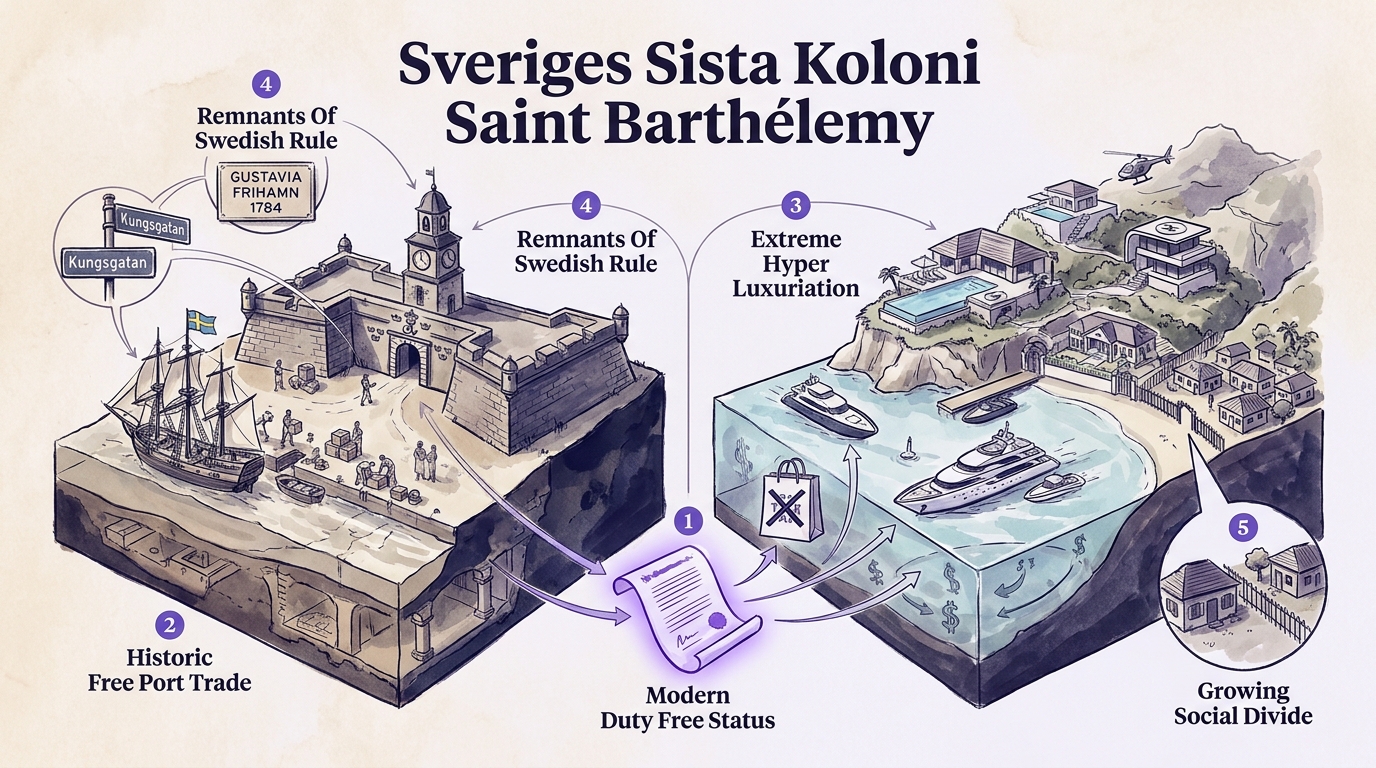
- 47:47St. Barths' modern status as a duty-free tax haven stems directly from an 1878 treaty clause created when Sweden sold the island back to France.
- 28:24During Swedish rule, Gustavia served as a major Caribbean free port reliant on slave labor and illegal human trafficking rather than plantation agriculture
- 49:56Rapid hyper-luxuriation over recent decades has displaced local Caribbean culture and made the island unaffordable for everyday residents
Tap to enlarge
Most valuable section
For whom
History enthusiasts and travelers interested in colonial history and luxury Caribbean culture.
Swedish Colonial History & Modern Tax-Haven Origins47:47
This segment connects Sweden's 19th-century colonial treaty directly to the island's modern transformation into an ultra-wealthy tax haven, offering a surprising insight that bridges past and present.
Detailed summary
1. Arrival in Saint Barthélemy
0:00The creators arrive in Saint Barthélemy, taking in the picturesque views of superyachts and pristine beaches. They introduce the core premise of the journey: exploring an island famous for ultra-luxury living while uncovering its forgotten history as a former Swedish colony.
Walking into the capital city of Gustavia, the team notices immediate traces of Sweden, including a welcome sign in Swedish, historic street names like Kungsgatan, and three-crown symbols. The island resembles the French Riviera, setting up the contrast between European luxury and Caribbean geography.
2. The Founding of Gustavia and Colonial Infrastructure
5:10The video outlines how France traded Saint Barthélemy to Sweden in 1784 in exchange for trading rights in Gothenburg. Gustav III established Gustavia as a free port exempt from tariffs, turning the dry, non-agricultural island into a bustling commercial transit hub.
Exploring historic bastions like Fort Karl and Fort Oscar, the hosts reflect on the physical construction of the city. Enslaved people quarried stone and built the heavy stone walls and infrastructure that still stand today, establishing the forced labor behind Sweden's colonial footprint.
3. Uncovering Forgotten History with Historian Fredrik Thomasson
12:04Historian Fredrik Thomasson from Uppsala University discusses his research on 'Black Saint Barthélemy.' He explains that colonial archives were kept in France rather than Sweden, contributing to a Swedish national self-image that selectively forgot its colonial past.
Thomasson detail how Swedish governance enforced harsh slave laws and corporal punishment. Because Sweden lacked massive sugar plantations, colonial authorities profit-driven focus turned toward human trafficking and illegal slave auctions, acting as wholesale brokers in the wider Caribbean trade.
4. Life in 19th-Century Gustavia
19:13The narrative explores Gustavia's golden era around 1810, when its population grew to 5,000 residents—making it as large as major Swedish towns at the time. It was a cosmopolitan, chaotic port town filled with taverns, sailors, and intense merchant activity.
The hosts examine remaining architectural landmarks, such as the historic clock tower and an old Swedish jail house, highlighting how physical remnants of 19th-century Scandinavian rule persist amid the island's tropical environment.
5. Exploring the Modern Ultra-Rich Lifestyle
31:38The hosts transition back to present-day St. Barths, highlighting the eye-watering costs of luxury villas, superyacht charters, and high-end dining. The island deliberately chose a high-end tourism model without mass-market resorts, effectively pricing out average travelers.
While enjoying a rented villa and local beaches, the team notes the absurd economic bubble that surrounds the island, contrasting high-rolling vacationers with the high cost of basic goods and services.
6. Local Perspectives and Cultural Displacement
49:56Local elder residents share memories of growing up on a simple, quiet island before the influx of continental European wealth. They describe how the rapid shift toward extreme luxury has marginalized local traditions, family heritage, and regional dialects.
The interviews expose a growing social divide between long-term island residents and the ultra-wealthy newcomers, illustrating how hyper-gentrification has altered the island's community fabric.
7. The Swedish Treaty and Tax-Haven Status
47:29Historian Fredrik Thomasson returns to explain how St. Barths became a tax haven. When Sweden sold the island back to France in 1878, a specific treaty clause guaranteed that France could not worsen the economic conditions of the local population.
Island residents later used this historical Swedish clause in French courts to maintain special tax-exempt privileges. This unique legal heritage directly enabled St. Barths to transform into today's duty-free destination for luxury shoppers and high-net-worth individuals.
8. Historic Le Select Bar and Final Reflections
1:03:39The creators visit Le Select, a historic bar opened in 1949 by Marius Stackelborough, who maintained strong ties with Sweden and received the Order of the Polar Star. The bar stands as one of the few remaining local gathering spots that preserves historical memorabilia, including Swedish flags and monarchy photos.
The video closes with final reflections on Saint Barthélemy's dual identity. The island remains one of the world's most beautiful and exclusive travel destinations, yet its foundation is deeply linked to Swedish colonial ambition, economic pragmatism, and human exploitation.
Questions this video answers
Why did Sweden own an island in the Caribbean?
King Gustav III was eager to gain a overseas colony to participate in Caribbean trade, and France traded Saint Barthélemy to Sweden in 1784 in exchange for commercial trading rights in Gothenburg. Sweden converted its port, Gustavia, into a duty-free haven to profit from incoming and outgoing goods across the region.
What role did slavery play in Swedish Saint Barthélemy?
Although St. Barths lacked major sugar plantations, enslaved people physically built Gustavia's infrastructure, fortresses, and roads under severe laws. Furthermore, during the 1820s, the island functioned as a major wholesale hub for illegal human trafficking and slave smuggling across the Caribbean.
Why are luxury goods and taxes different on St. Barths than in France?
When Sweden handed the island back to France in 1878, the treaty included a clause promising that France would not worsen the economic conditions of the islanders. Local residents successfully defended this right in the French Supreme Court, making St. Barths France's only duty-free tax haven.
How do local residents feel about the ultra-rich tourism on the island?
Many long-time locals feel pushed out and culturally marginalized by the recent wave of extreme luxury development. Older residents express sadness that traditional local languages and simpler ways of life have been largely replaced by hyper-exclusive resorts and soaring living costs.
Ask a follow-up Premium
About this summary
SumTube AI wrote this recap from the video's words and chapters. Credit and the original belong to Random Making Movies.