
Free AI summary of this YouTube video by SumTube
STUXNET: The World's First Digital Weapon
TL;DR
This video details the history and mechanics behind Stuxnet, widely regarded as the world's first digital weapon. Jointly developed by the United States and Israel, the cyberwarfare malware was specifically engineered to sabotage Iran's Natanz Nuclear Facility by manipulating uranium-enriching centrifuges. The narrative covers how the worm evolved from early targeted versions to an aggressive update that escaped into global networks, ultimately prompting international exposure and escalating geopolitical tensions.

Key takeaways
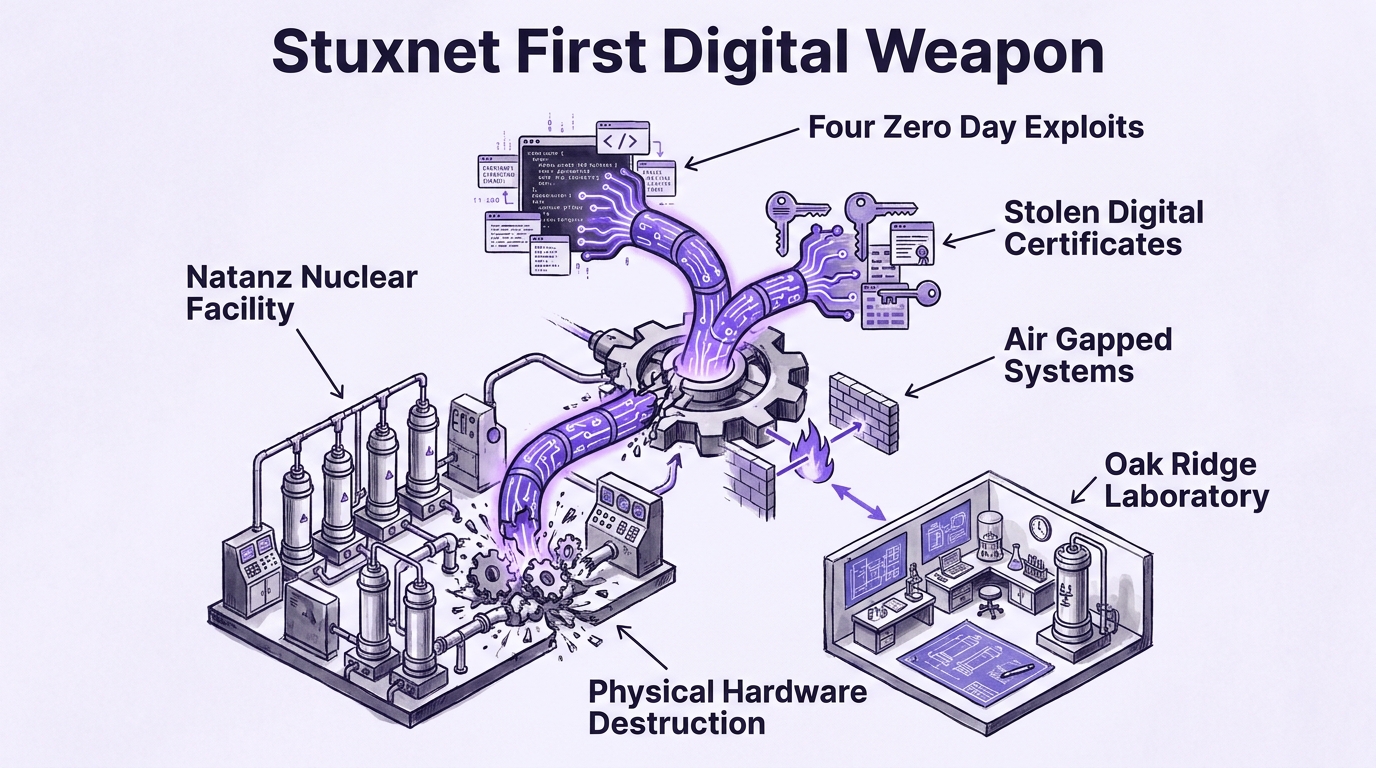
- 4:12Stuxnet was the first malware designed specifically to cause physical destruction to industrial hardware
- 8:29The US tested and perfected the malware by building a full-scale replica of Iran's centrifuges in Tennessee
- 15:00Stuxnet v2 relied on a record-breaking four zero-day exploits and stolen digital certificates to bypass air-gapped systems
- 20:43The wild spread of Stuxnet v2 led to Symantec uncovering the cyberweapon, exposing the operation to the world
Tap to enlarge
Most valuable section
For whom
Cybersecurity enthusiasts, history buffs, and anyone interested in espionage and state-sponsored cyber warfare.
Stuxnet's Technical Operation9:08
It breaks down the precise technical brilliance of how the malware manipulated uranium centrifuges while feeding fake normal data back to control monitors.
Detailed summary
1. June 2009: Protests in Iran
0:00In June 2009, widespread protests erupt across Iran following a controversial presidential election. Demonstrators fill the streets of Tehran in protest of the reported results. During the chaos, Neda Agha-Soltan steps out of a car stuck in traffic and is fatally shot by a sniper, turning her into an international symbol for the Iranian protest movement.
Her death amplifies political turmoil across the nation and draws global media coverage. Amidst these growing civil unrests and political tension, covert intelligence operations against Iran's nuclear program gain urgent momentum behind closed doors.
2. Approval of the Cyberwarfare Operation
2:23Located 300 kilometers south of Tehran, the Natanz Nuclear Facility serves as the primary hub for Iran's nuclear enrichment efforts. Shortly after Neda's death, the US government approves covert action to infiltrate the Natanz facility using advanced cyberwarfare tactics.
The CIA, working in close collaboration with Israeli intelligence, prepares to deploy a sophisticated digital weapon known as Stuxnet. This government-sponsored cyber program represents a new frontier in warfare, designed explicitly to target and sabotage Iranian nuclear hardware.
3. Proof of Physical Destruction
5:13In 2006, an official carrying a briefcase filled with broken metal debris enters the White House Situation Room after returning from Oak Ridge National Laboratory in Tennessee. Dumping the shredded components onto the desk, he announces that a test centrifuge was successfully destroyed using software alone.
This marks the first time in history that a computer program directly caused physical destruction to physical hardware. Seeing the proof of concept, the US President approves Stuxnet as the primary strategy for sabotaging Iran's uranium enrichment infrastructure.
4. Building the Replica and Stuxnet V1
7:31Years earlier, the US intercepted centrifuges destined for Libya that were supplied by A.Q. Khan. Learning that Iran utilized the exact same equipment, American intelligence built a complete replica of the Natanz facility at Oak Ridge to test cyber sabotage techniques.
In 2007, Stuxnet Version 1 is deployed. Its primary function is to covertly manipulate the valves of centrifuges spinning at supersonic speeds, causing enriched uranium gas to solidify and ruin the equipment while tricking operators into seeing normal diagnostic readings.
5. Evasion Tactics and Technical Hurdles
11:40Because Natanz's network is air-gapped from the internet, Stuxnet requires physical insertion via USB drives, relying on compromised insiders. Once inside, the malware uses a hidden rootkit to mask its code from security systems and runs quietly in the background.
Additionally, Stuxnet utilizes stolen digital certificates from Taiwanese tech companies to sign its software commands. This tricks system diagnostics into logging physical hardware failures rather than detecting a software attack. Despite these measures, early versions only moderately slow down Iranian progress.
6. Development of Stuxnet V2
13:56By 2009, US researchers at Oak Ridge work to increase the malware's efficiency. Stuxnet V2 is crafted using an unprecedented four zero-day exploits along with stolen private cryptographic keys, making it one of the most complex cyber weapons ever created.
This upgraded version is engineered to override the industrial control systems managing centrifuge speeds, forcing them to spin beyond safe limits and destroy the equipment from the inside.
7. Deployment and Global Outbreak
17:18An insider at Natanz introduces Stuxnet V2 into the facility's local network via an infected computer. Designed to propagate rapidly, the new worm infects every connected device within the facility in record time.
However, the aggressive spread backfires when infected laptops leave the facility and connect to external networks. Stuxnet escapes Natanz, rapidly spreading across Iran and eventually infecting hundreds of thousands of computers worldwide.
8. Discovery and Geopolitical Aftermath
20:07As Stuxnet spirals out of control, emergency meetings are held in Washington, but officials realize the propagation cannot be stopped. Shortly after, cybersecurity firm Symantec discovers the malware and publishes a comprehensive 64-page report detailing its inner workings.
With the secret exposed, Iran publicly acknowledges the attack, takes measures to protect its systems, and vows to continue its nuclear ambitions. In the following years, key Iranian nuclear scientists face targeted assassinations, cementing Stuxnet's place as a landmark moment in cyberwarfare history.
Questions this video answers
What made Stuxnet unique compared to traditional computer viruses?
Unlike typical malware that steals data or disrupts software operations, Stuxnet was the world's first cyberweapon engineered to inflict physical damage on industrial infrastructure. It targeted programmable logic controllers (PLCs) controlling centrifuges in Iran's nuclear program, altering their rotation speeds until the machinery physically tore itself apart.
How did Stuxnet infect Iran's air-gapped Natanz nuclear facility?
Because the Natanz facility was air-gapped and disconnected from the internet, Stuxnet had to be physically introduced via infected USB drives. Intelligence agencies relied on insider assets—facility contractors and employees—to plug infected drives into internal networks, allowing the worm to bridge the physical security gap.
Why did Stuxnet eventually get discovered by cybersecurity firms?
In 2009, developers updated Stuxnet with a much more aggressive propagation mechanism (Stuxnet v2) to ensure it reached every target machine. This aggressive spread caused the worm to jump onto laptops that left the facility, rapidly infecting systems worldwide and catching the attention of cybersecurity firm Symantec, which published a detailed dossier exposing it.
Ask a follow-up Premium
About this summary
SumTube AI wrote this recap from the video's words and chapters. Credit and the original belong to Disrupt.