
Free AI summary of this YouTube video by SumTube
ஏமாறாமல் Second Hand கார் வாங்குவது எப்படி? உண்மை எது..? உருட்டு எது..? Car Experts பேட்டி
TL;DR
A panel of automotive experts and pre-owned car dealers discuss the hidden risks, extra costs, and common scams involved in buying used cars from Delhi. They detail how initial purchase savings often vanish due to re-registration taxes, transit overheads, hidden mechanical issues, and clever cosmetic concealments.

Key takeaways
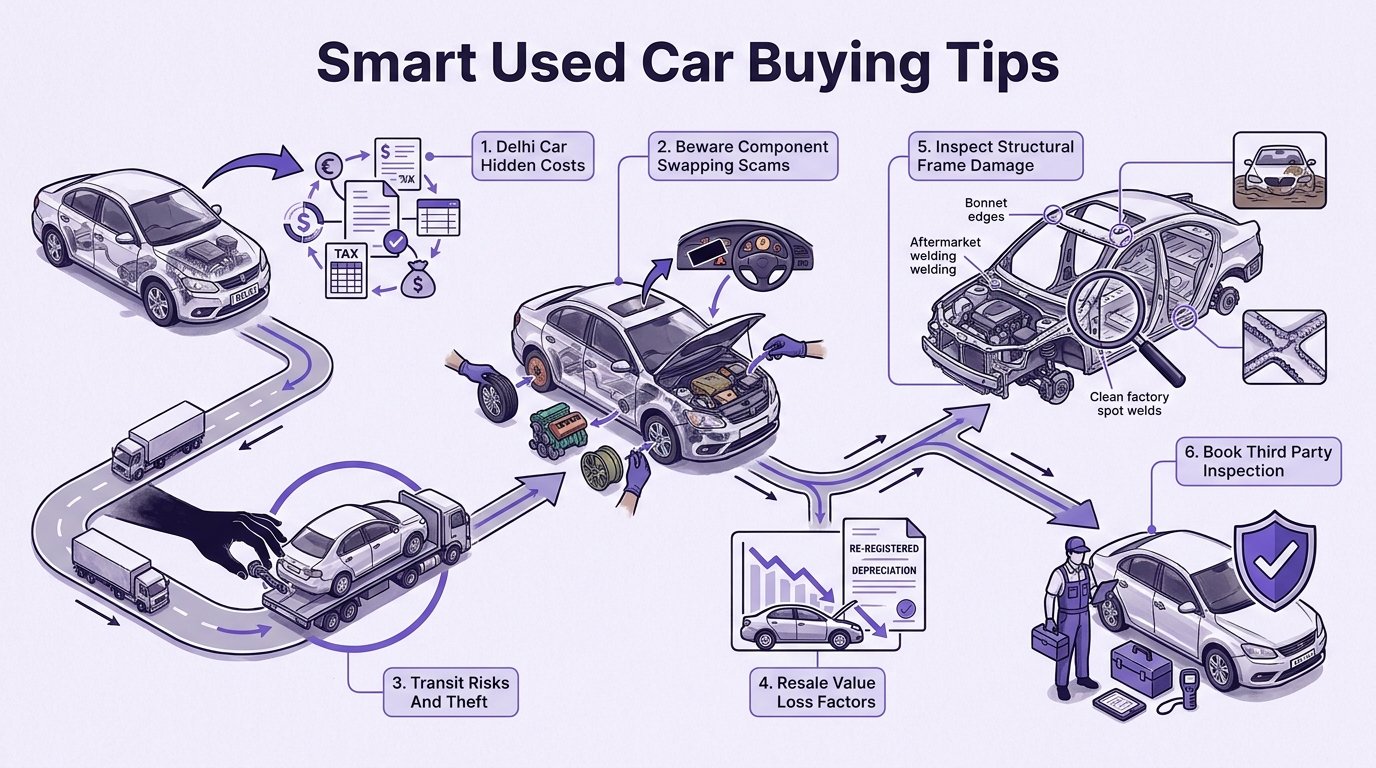
- 2:24Delhi's low purchase prices are often offset by re-registration taxes, transport costs, and rapid resale depreciation
- 3:44Sellers frequently swap original car components and disguise dashboard warning lights to hide major defects
- 10:09Parts can be swapped or stolen during long-distance transit before reaching the buyer
- 13:29Opting for a third-party pre-delivery inspection (PDI) helps uncover disguised accident damage and flood history
Tap to enlarge
Most valuable section
For whom
Anyone considering purchasing a pre-owned luxury or inter-state vehicle.
Exposing Hidden Scams: Component Swapping & Warning Light Tricks3:44
It reveals shocking real-world scams like black stickers inside gauge clusters to hide warning lights and component swaps during transit.
Detailed summary
1. The Delhi Used Car Market Craze & Hidden Costs
0:00The discussion opens on the high demand for second-hand cars sourced from Delhi, driven by Delhi's strict 10-year vehicle lifespan regulations. While luxury vehicles like Benz and BMW appear available at nearly half price compared to local market rates, buyers often overlook the hidden expenses involved in bringing them to states like Tamil Nadu.
Panellists highlight that calculating state re-registration taxes based on original invoice values drastically cuts into initial savings. When transport costs and re-registration overheads are added, the final price ends up remarkably close to local market rates while carrying significantly higher buyer risk.
2. Exposing Hidden Scams: Component Swapping & Warning Light Tricks
3:44The experts detail dishonest practices common in cheap used-car deals, such as removing genuine factory parts and replacing them with worn-out components before sale. Buyers frequently face maintenance bills ranging from 5 to 10 Lakhs shortly after taking delivery of high-end vehicles.
A striking example shared by the panel involves a Volkswagen Polo showing no dashboard warning lights despite active engine faults. Upon disassembly, the mechanic discovered black stickers pasted inside the gauge cluster to physically block the check engine LED.
3. Part Swapping During Transit & Logistics Risks
10:09Transporting vehicles via long-distance cargo trucks introduces another layer of risk. The panel explains how cars inspected and approved in Delhi often arrive with different tires, painted alloy wheels instead of diamond-cut ones, or missing spare parts upon delivery.
In extreme cases, transport contractors or transit mechanics dismantle premium components along highway stops. Because neither the seller nor the buyer directly oversees transit, proving where component theft occurred remains extremely difficult.
4. Resale Value & Re-Registration Depreciation Issues
12:16The panellists examine the long-term financial downside of owning re-registered inter-state vehicles. On paper, an inter-state transfer lists the buyer as a subsequent owner, automatically triggering higher depreciation when trying to resell locally.
Prospective buyers in the secondary market tend to offer substantially lower prices once RC cards reveal a vehicle originated from Delhi or another district. This double-depreciation hit negates any upfront cost advantage.
5. How to Inspect Used Cars for Major Accident Damage
16:40The panellists offer actionable advice for evaluating a used car's structural integrity before purchase. They explain how factory sealant lines on bonnet edges, door frames, and boot lids indicate whether panels have been replaced or repaired after major crashes.
They emphasize checking structural apron areas and front engine bays for original spot welds versus aftermarket line welding. While minor bumper replacements are acceptable, major chassis or engine bay impacts render a car unsafe and unfit for long-term ownership.
6. Advanced Cover-Ups & Professional Pre-Delivery Inspections
17:23The panel warns that sophisticated body shops now replicate factory spot welds and silicone lines using specialized rubber stamps. Consequently, visually inspecting welds is no longer foolproof for average buyers attempting to detect past structural damage.
To counter these deceptive practices, the experts strongly recommend hiring third-party inspection services. Utilizing coating thickness gauges, ECU diagnostic scans, and detailed underbody checks provides buyers with an unbiased assessment of a vehicle's true condition.
7. Flood-Damaged Car Indicators & Mechanical Health Checks
21:46Identifying flood-affected vehicles requires inspecting hidden interior components that detailing crews miss. Pulling seatbelts out to their maximum length often reveals mud stains, silt deposits, or mildew odors deep within the retractor mechanism.
Evaluating the powertrain's health is equally critical. Checking oil dipsticks for white smoke, listening for irregular engine knock, and verifying smooth torque delivery during road tests help ensure the car's engine and transmission remain mechanically sound.
8. Vehicle Service History & Real-World Resale Examples
23:17The discussion concludes with advice on verifying service records and managing buyer expectations. The panellists note that buying 4- to 5-year-old cars with verifiable dealer service histories offers the safest balance between price and reliability.
They share case studies where minor cosmetic repairs led to misleading accident reports in official system databases, underscoring the importance of photographic evidence from sellers. Ultimately, buyers must prepare for maintenance risks inherent to pre-owned cars while relying on thorough inspections to minimize costly surprises.
Questions this video answers
Why are second-hand cars from Delhi cheaper initially?
Delhi enforces a strict 10-year rule for diesel vehicles, forcing owners to sell earlier than in other states. This creates a high supply of luxury and SUV vehicles at seemingly attractive base prices.
What extra costs offset the savings when buying a Delhi car?
Buyers must pay state transfer taxes based on the car's original invoice value, local re-registration fees, and transport costs. Additionally, re-registered vehicles suffer higher resale depreciation, making the net savings minimal.
How do sellers conceal car defects and warning lights?
Unscrupulous sellers sometimes open the instrument cluster and place black stickers over warning LEDs so check engine indicators remain dark. They may also swap out premium tires, diamond-cut alloys, or internal components for cheaper parts.
How can buyers spot flood damage or accidental repairs?
Buyers should fully unspool seatbelts to check for mud residue in hidden crevices and inspect under-floor padding for mold. Professional third-party inspections using paint gauge meters and diagnostic scans can reveal hidden repairs and factory-seam cover-ups.
Ask a follow-up Premium
About this summary
SumTube AI wrote this recap from the video's words and chapters. Credit and the original belong to Behindwoods O2.