
Free AI summary of this YouTube video by SumTube
Scientists Created Ice That Is Stronger Than Concrete
TL;DR
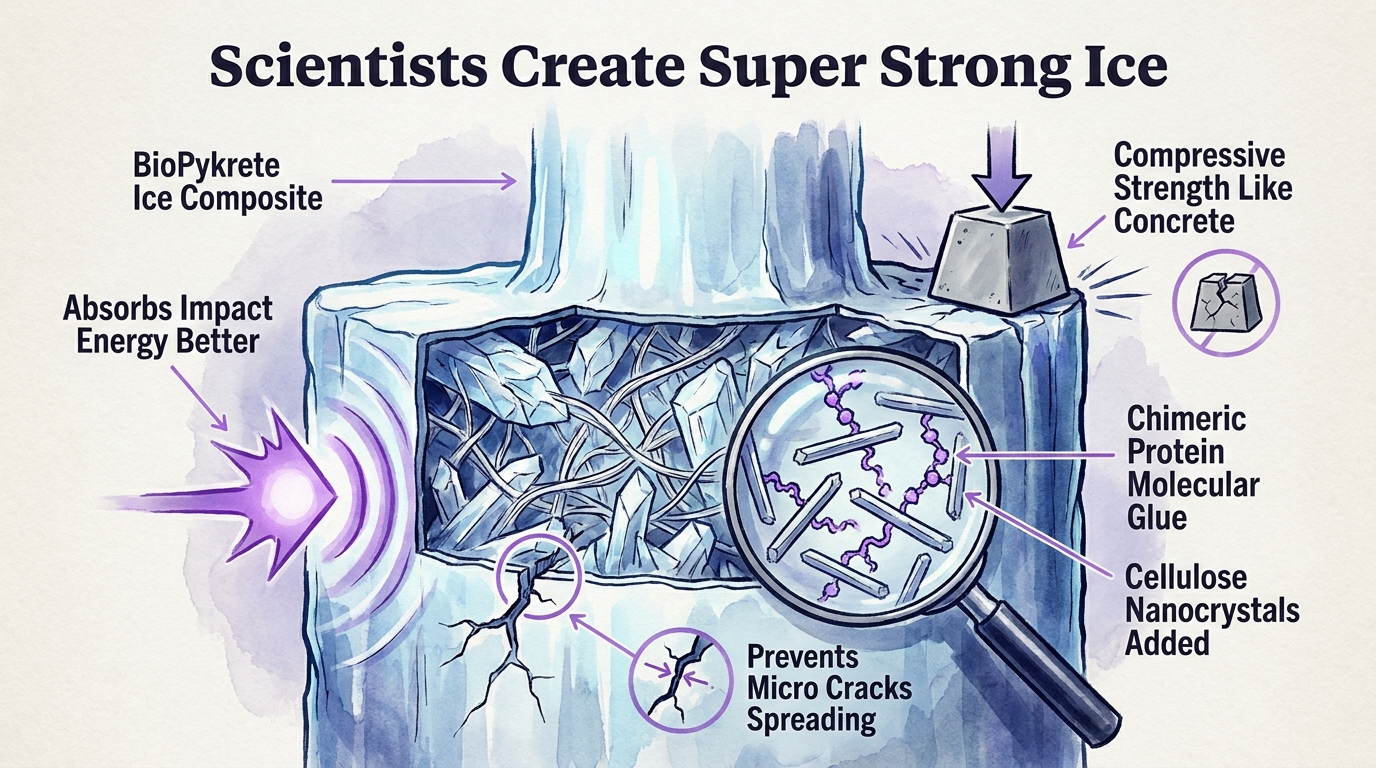
Researchers have engineered "BioPykrete," a bio-inspired ice composite created by combining water, cellulose nanocrystals, and a custom chimeric protein. This novel material exhibits a tenfold increase in compressive strength and 70 times more energy absorption than standard ice, mimicking the mechanical properties of concrete. Additionally, recent studies in soft nanoconfinement demonstrate that water can be converted directly into amorphous (glassy) ice, opening new possibilities for eco-friendly cold-climate construction and advanced biological cryopreservation.

Key takeaways
- 2:08BioPykrete combines plant cellulose, water, and engineered proteins to create a sustainable ice composite with compressive strength comparable to concrete
- 8:10The chimeric protein acts as a molecular glue, bridging ice crystals to cellulose fibers to prevent micro-cracks from rapidly spreading
- 17:10Confining water inside sub-nanometer lipid channels prevents crystal formation, allowing direct real-time observation of liquid-to-glass transitions
- 19:01Understanding amorphous ice formation could revolutionize long-term cryopreservation of organs, vaccines, and food without structural cell damage
Tap to enlarge
Most valuable section
For whom
Materials scientists, structural engineers, and space/polar exploration enthusiasts interested in sustainable construction technologies.
Molecular Mechanics of BioPykrete5:43
It explains the precise bio-engineering mechanism behind combining fish antifreeze proteins and bacterial cellulose binders to eliminate ice brittleness.
Detailed summary
1. Introduction to Engineered Ice
0:00Water covers roughly 70% of Earth's surface and makes up 60% of the human body, making it the most familiar liquid on our planet. However, despite its abundance, the physical behavior of water ice under extreme conditions continues to surprise scientists. Recent breakthrough studies in 2026 have introduced entirely new forms of laboratory-engineered ice that challenge conventional physics.
This video explores the creation of a new bio-engineered super-ice named BioPykrete. Engineered to deliver exceptional compressive strength similar to concrete, this material offers potential solutions for structural engineering in polar environments, alongside other recent discoveries regarding glassy amorphous ice.
2. Historical Context: Project Habakkuk and Pykrete
2:19Standard water ice is notoriously brittle; microscopic cracks quickly propagate through its crystalline structure, causing large blocks to shatter instantly under tension or compression. During World War II, British inventor Geoffrey Pyke and chemist Max Perutz proposed mixing 86% water with 14% wood pulp to form 'Pykrete,' a tough, bullet-resistant material intended for low-cost Arctic construction.
The Allied military even planned 'Project Habakkuk,' a massive 2,000-foot floating aircraft carrier constructed from Pykrete to hunt German U-boats in the Atlantic Ocean. Although a 1,000-ton prototype was built in Alberta, Canada, the project was ultimately scrapped due to high steel requirements for internal refrigeration systems and logistics constraints.
3. Molecular Mechanics of BioPykrete
5:43Modern researchers have reinvented Pykrete on a nanometer scale by combining nanocellulose crystals with custom-engineered chimeric proteins. Instead of crude wood fibers, this method uses stiff microscopic plant cell wall fibers combined with a synthetic protein created by fusing genes from two distinct organisms.
The chimeric protein links type-III antifreeze protein (AFPIII) from the ocean pout fish—which naturally attaches to ice crystals—with CBM3a, a bacterial protein that adheres tightly to plant cellulose. Acting as a molecular bridge or glue, this protein anchors the ice crystal lattice directly to the cellulose network during freezing.
4. Structural Performance and Environmental Impact
8:35Mechanical testing reveals that BioPykrete achieves a 10-fold increase in compressive strength compared to pure water ice, performing on par with standard concrete. Furthermore, it absorbs up to 70 times more energy before cracking, deforming gradually under load rather than shattering instantaneously.
This material offers significant environmental benefits over concrete, which is one of the world's largest industrial sources of carbon emissions. BioPykrete is fully biodegradable, low-carbon, and can be manufactured locally in sub-zero environments using water and agricultural waste, eliminating the curing failures typical of cold-weather concrete.
5. Limitations and Real-World Challenges
11:43Despite impressive laboratory results, BioPykrete remains a proof-of-concept tested only on tiny 2-centimeter samples. Scaling up to real-world structural applications requires resolving several long-term engineering hurdles, including material creep—the slow, permanent deformation ice experiences under sustained load.
Historical ice bases built in Greenland suffered severe sagging and deformation over time, leading to their eventual abandonment. Further research is necessary to evaluate how BioPykrete withstands multi-year freeze-thaw cycles and whether melted material can be effectively recycled.
6. Forming Amorphous Glassy Ice
13:28Beyond structural composites, a 2026 study in Nature Communications demonstrated how pure liquid water can be transformed into a solid glassy state without forming ice crystals. Known as amorphous ice, this non-crystalline solid is actually the most common form of ice in the universe, found on comets, asteroids, and distant dwarf planets like Pluto.
On Earth, water naturally freezes into an ordered, hexagonal crystal lattice. Achieving an amorphous state requires preventing molecules from organizing into crystals as temperatures drop, a process that normally occurs rapidly between -45°C and -135°C.
7. Nanoconfinement and Real-Time Observation
16:44To observe liquid water transition into glass in real time, researchers confined water molecules within sub-nanometer channels created by phytantriol lipid membranes. Restricted to layers under one nanometer thick, the water molecules were physically hindered from arranging into crystal patterns.
Using high-intensity X-ray beams from a particle accelerator, scientists recorded the step-by-step vitrification process. Between -21°C and -35°C, molecular motion slowed dramatically, and by -74°C, the liquid fully locked into a rigid, amorphous solid glass.
8. Applications in Cryopreservation and Beyond
18:54The ability to control and understand amorphous ice formation holds major implications for biological cryopreservation. Traditional freezing creates jagged ice crystals that puncture cell membranes, rendering organ storage impossible; glassy freezing avoids crystal formation entirely, preserving cellular structure.
Mastering non-crystalline ice transitions could advance long-term organ banking, vaccine stabilization, food preservation, and atmospheric ice research. Ultimately, these breakthroughs demonstrate that even simple water holds complex physical secrets with far-reaching scientific applications.
Questions this video answers
What is BioPykrete and how is it made?
BioPykrete is an engineered ice composite made by mixing water with microscopic plant cellulose crystals and a dual-functioning chimeric protein. The custom protein binds tightly to both ice crystals and cellulose fibers, acting as a molecular bridge that dramatically improves the structural integrity of the ice.
How does BioPykrete compare to standard ice and concrete?
BioPykrete achieves a tenfold increase in compressive strength over normal water ice, matching the compressive resilience of traditional concrete. Additionally, it absorbs up to 70 times more impact energy before fracturing because its internal fibrous network traps micro-cracks and prevents catastrophic shattering.
What are the practical applications of BioPykrete?
BioPykrete offers a low-carbon, fully biodegradable structural material for construction in polar regions. Because concrete cures poorly in sub-zero temperatures and generates high carbon emissions, BioPykrete provides an eco-friendly alternative for temporary cold-climate infrastructure using local water and plant waste.
How does observing glassy or amorphous ice benefit scientific research?
Amorphous ice lacks a rigid crystalline lattice, meaning it formed solid water without creating sharp ice crystals. Controlling this state enables major breakthroughs in cryopreservation, allowing biological tissues, organs, and vaccines to be frozen and stored long-term without cell walls rupturing.
Ask a follow-up Premium
About this summary
SumTube AI wrote this recap from the video's words and chapters. Credit and the original belong to Anton Petrov.