
Free AI summary of this YouTube video by SumTube
Reunião Bruno Rossi - Estúdio Rossi
TL;DR
Architect Bruno Rossi shares practical insights into establishing and managing a successful architecture firm based on over two decades of professional experience. The lecture details the operational realities of running a practice, from moving beyond design work to implementing data-driven pricing, structuring workflow transitions, and coordinating technical consultants. Rossi also outlines strategies for effective client communication, brand authenticity, and maintaining administrative clarity for long-term practice sustainability.

Key takeaways
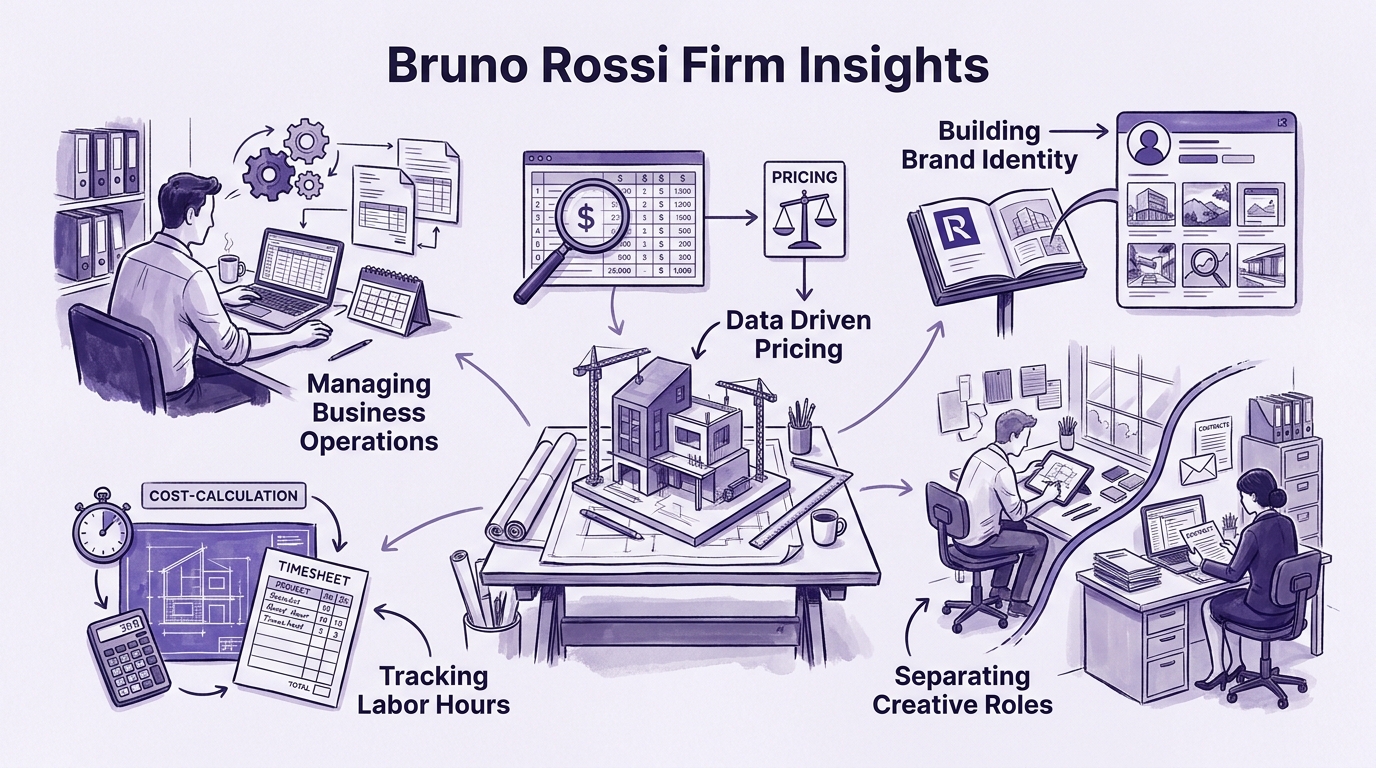
- Running a successful architecture office requires managing business operations, administrative tasks, and finances alongside design work
- Data-driven pricing based on tracked labor hours replaces arbitrary per-square-meter estimates to ensure project profitability
- Social media serves to build brand identity and credibility rather than just generating direct sales leads
- Separating creative responsibilities from administrative management helps architects focus on project execution and client relationships
Tap to enlarge
Most valuable section
For whom
Early-career architects and design practice owners seeking to improve their business operations and pricing models.
Overhauling project pricing and workflow management0:00
It explains how tracking actual labor hours and adjusting for modern tools like BIM enables firms to price projects accurately and avoid unprofitable discounts.
Detailed summary
1. Introduction and Bruno Rossi's Background
0:00In this introductory segment of a professional practice lecture hosted by Estúdio Rossi Arquitetos, the speaker introduces Bruno Rossi, a former classmate and colleague who currently leads Estúdio Rossi alongside his wife, Marília. With over 20 years of experience managing an architectural office, Rossi brings a wealth of practical knowledge regarding the different stages of operating a well-structured and consistent architectural firm. The host highlights the studio's accomplished background, noting its numerous published works and its experience spanning custom residential projects, architectural competitions, and large-scale collaborations with other firms.
Following the introduction, the host officially welcomes Bruno Rossi to the session to share his professional trajectory and provide insight into his firm's current operations. The stage is set for an in-depth conversation covering the evolution of their practice, the dynamics of managing a design office, and key lessons learned from decades of active involvement in the architecture industry.
2. Early Career and Founding the First Office
2:01The speaker reflects on starting their first architecture firm, "Entre Arquitetos," during their fourth year at PUC Campinas alongside friends and classmates, a venture that lasted roughly five years from 2007 to 2011. Initially driven by a passion for design, the founders held the common student belief that delivering good projects was all it took to run a successful office. However, they quickly realized that design work is only a small fraction of managing a practice. To bridge their knowledge gaps, they took management and business courses through institutions like SENAC and SEBRAE, learning the complexities of company registration, tax structures, and service-based business operations while gradually taking on projects in Campinas and São Paulo.
Addressing current architecture students, the speaker emphasizes that establishing a viable career is a long, step-by-step journey that requires patience and resilience. Historically referred to in the industry as a field where one is considered a "young architect" up until age 50, it often takes decades to build the reputation and client trust needed for steady success. The speaker cautions against modern traps such as promises of instant fame, quick fortunes, or miraculous technological shortcuts, advising young professionals to remain skeptical of easy solutions and instead embrace the gradual, challenging, yet rewarding process of growing their practice.
3. Working at Piratininga Arquitetos in São Paulo
8:24After leaving their small three-person practice due to difficult clients and career re-evaluations, the speaker moved
4. Working at Piratininga Arquitetos in São Paulo (2)
15:31The speaker discusses the challenges of lead generation through social media, noting that while platforms can attract a large volume of leads, many are unqualified or driven by impulse, often leading to uncontactable prospects. Over time, the office realized that social media serves a different purpose: building a strong brand identity. This digital presence acts as a validation tool when potential clients discover the firm through other channels, forming a gradual, step-by-step process of establishing credibility rather than relying on a single, overnight marketing solution.
This identity-building approach helps attract the right type of client who already aligns with the firm's aesthetic and understands their specific work process. Rather than treating clients as mere numbers, the office prioritizes individuals who are open to a collaborative dialogue and mutual exchange of ideas. When asked about their operations, the speaker addresses whether they rely on external professionals, such as PR or marketing agencies, to guide their social media strategy and manage their brand identity development.
5. Returning to Campinas and Evolving into Estúdio Rossi
18:50After commuting between São Paulo and Campinas, the architect eventually decided to return to Campinas around late 2017 to re-establish an independent practice. Transitioning from a large, long-established firm structure down to a small single-person cell, he initially worked from home before renting an office space. His wife Marília, who ran an interior design studio, eventually joined him as a business partner. Between 2018 and the pandemic, the firm went through a highly experimental phase focused on unique, non-traditional structures—such as lake decks and custom brickwork—which allowed for material exploration without the daily pressures of a standard residential client. As the office gradually expanded, it eventually evolved into a more structured firm (Estúdio Rossi) balancing custom architectural projects with steady team growth.
The practice matured by adapting its approach to project management, content creation, and administrative operations. The architect views his role as a "maestro" who coordinates technical consultants—ranging from structural specialists to HVAC experts—early in the preliminary design phase to ensure accurate, feasible solutions. To maintain authenticity in their public identity, the firm abandoned rigid external marketing agencies in favor of controlling their own content internally while bringing in specialized production teams only for execution. Operationally, the firm separated design responsibilities from business tasks by hiring a dedicated remote administrative manager for contracts, invoicing, and financial tracking, allowing the primary partners to focus on client relationships and architectural design without getting overwhelmed by back-office management.
6. Managing Complex Projects and Technical Consultants
26:54To improve client understanding and streamline project onboarding, the firm transformed its sales proposal into a detailed presentation that clearly explains each phase of the design process. They walk clients through the preliminary study—where initial concepts are formed around site conditions, sun exposure, and regulations—followed by the preliminary design phase and the final executive documentation stage. Throughout this process, the architects take full responsibility for coordinating all third-party technical consultants, including structural, hydraulic, electrical, lighting, and solar power specialists, ensuring the client only deals with decisions affecting their daily use rather than technical engineering specifics. Furthermore, administrative duties such as handling contracts, billing, client payment tracking, and managing tax compliance are handled by dedicated operational staff, allowing the lead architects to focus entirely on design and technical execution.
The firm also overhauled its project pricing strategy by replacing traditional per-square-meter estimates with a precise, data-driven cost structure. By tracking the exact hours spent by team members across different roles and project phases over several years, they determined how labor demands shift—from heavy partner involvement in
7. Commercial Proposals and Client Expectation Management
35:34The commercial proposal phase plays a critical role in managing client expectations and justifying the cost of architectural projects. Moving away from simple, one-page estimates to detailed, visual proposals allows clients to clearly understand the scope of work and the predictability of the outcome. This transparency helps clients recognize that architecture is a long-term service and process rather than a quick product, which justifies a higher price point by highlighting the extensive team effort and months of dedicated labor required for execution.
Additionally, refining the internal workflow and understanding operating costs is essential for maintaining profitability and healthy client relationships. Transitioning to BIM (Building Information Modeling) alters the distribution of project hours by requiring a significant investment of time and staff early in the design process to establish parameters and make key decisions, which ultimately reduces hours needed during the final execution phase. Recognizing these shifts prevents firms from offering unsustainable discounts, ensuring that proposals accurately account for the total labor hours required to complete a project without operating at a loss.
8. Client Qualification and Attracting the Right Projects
38:45Over time and through experience, the firm learned that not every prospective client is a suitable fit for their specific architectural approach.
9. Office Operations and Administrative Management
45:21In discussing the office's administrative and public presence, Bruno explains the distinct roles of their website and Instagram account for Studio Rossi Architects. While Instagram serves as the primary, fast-paced entry point for initial contact through short snippets of work, the website acts as a comprehensive, organized archive. Unlike standard commercial sites that rely heavily on direct "call to action" buttons, their website provides a complete view of projects from start to finish by incorporating detailed texts, floor plans, sections, and complete photo galleries. Although maintaining a website requires continuous effort and updates can lag behind social media, it remains a vital tool for presenting a deeper, structured portfolio of the firm's architectural output.
Reflecting on office operations and professional development, the discussion highlights that running an architecture practice
Questions this video answers
How should an architecture firm price its services accurately?
Firms should transition away from simple per-square-meter estimates to a data-driven cost structure based on tracked labor hours across different roles and project phases. By understanding exact time investments and shifts in workload—such as increased early-stage hours when using BIM—offices can calculate sustainable pricing that reflects their true operating costs.
What is the role of social media and websites in attracting architectural clients?
Social media platforms like Instagram act as fast-paced entry points to build brand identity and establish public credibility. In contrast, an official website serves as an organized, detailed archive with floor plans, sections, and photo galleries that validate the firm's expertise for serious clients.
How does Estúdio Rossi handle project management and technical consultants?
The lead architect acts as a coordinator who brings in technical specialists (structural, electrical, HVAC, and lighting) during the preliminary design phase. The firm manages all consultant coordination directly so that clients only need to focus on functional design decisions rather than complex technical details.
Ask a follow-up Premium
About this summary
SumTube AI wrote this recap from the video's words and chapters. Credit and the original belong to Fabrício Linardi.