
Free AI summary of this YouTube video by SumTube
این کتاب بهم یاد داد چطور فکر کنم و بسازم!
TL;DR
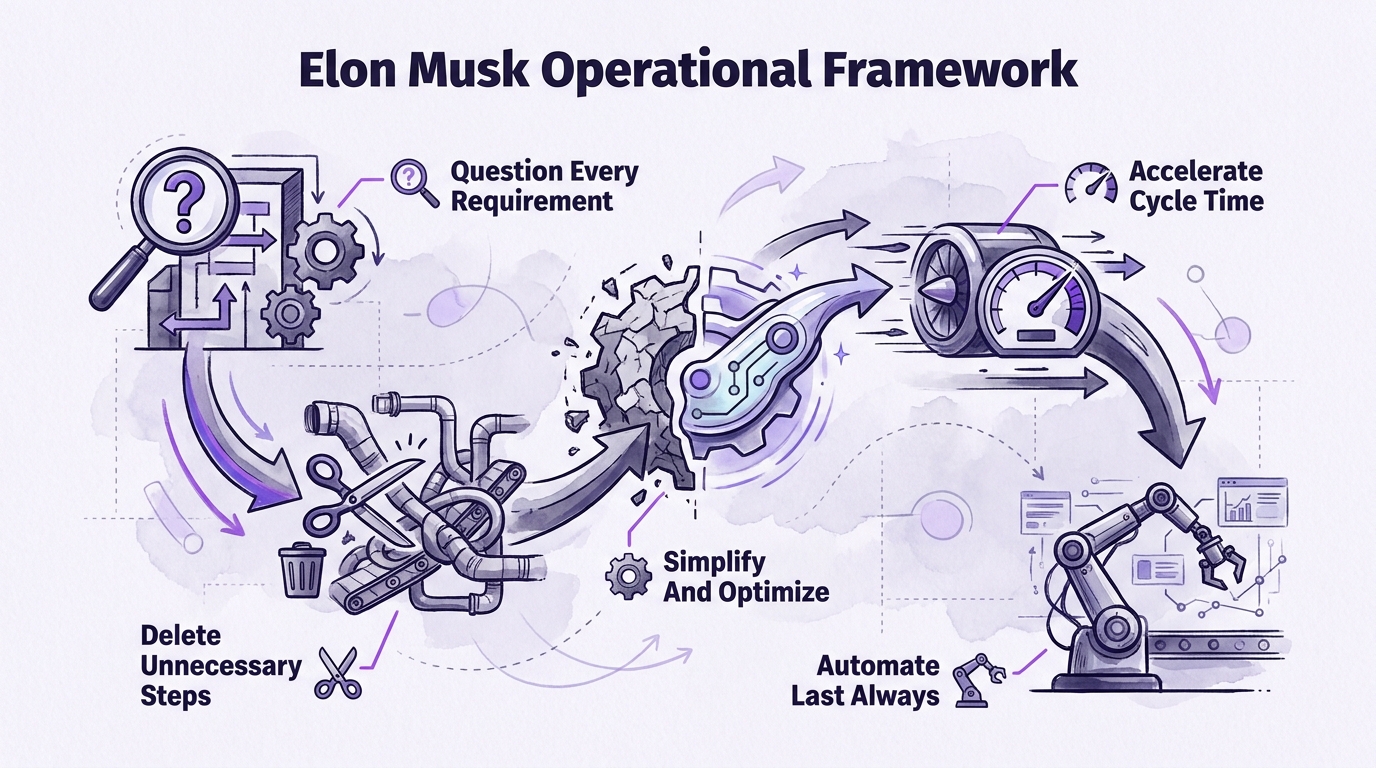
This video breaks down Jon McNeill's book, "The Algorithm," which outlines the 5-step operational framework used by Elon Musk to scale companies like Tesla and SpaceX. The speaker details each step—question assumptions, delete unnecessary steps, simplify and optimize, accelerate cycle times, and automate—providing practical business examples and real-world applications.

Key takeaways
- 20:25Before automating any process, you must question assumptions, delete unnecessary steps, simplify, and accelerate, as automating a bad process amplifies inefficiency
- 19:05True efficiency comes from closing the gap between 'cycle time' (total time taken) and 'touch time' (actual work done)
- 16:01Complex employee training can often be distilled into a single core outcome, such as delivering an unforgettable customer experience
Tap to enlarge
Most valuable section
For whom
Entrepreneurs, product managers, and team leaders looking to streamline operations and scale processes efficiently.
It explains the common trap of premature automation using Tesla's 2017 Model 3 production breakdown as a caution story.
Detailed summary
1. Introduction & Author Background
0:00The host introduces the book "The Algorithm" by Jon McNeill, who served as the President of Tesla from 2015 to 2018 alongside Elon Musk. McNeill documented the operational framework used at Tesla and SpaceX that converts raw ideas into massive, scalable enterprises. The book's core principles apply not only to tech giants but to any business or personal workflow.
Jon McNeill wrote the book after discussing these operational habits with other Silicon Valley leaders and realizing that top-tier companies implicitly or explicitly follow the exact same five steps. The speaker promises to break down these five key stages in simple terms.
2. Step 1: Question Every Requirement
2:26The first step in the algorithm is questioning every requirement and assumption, often referred to as First Principles Thinking. Most companies follow existing rules simply because a predecessor established them, without asking whether physics or true necessity requires them. True innovation starts when leaders challenge established industry standards.
Examples include Tesla establishing its own factory in China without a required local partner by challenging government policies, and redesigning the Model 3 body underbody from 300 separate parts down to just 3 cast pieces. The host also shares a personal story of how reducing YouTube editing complexity freed up time without impacting viewer retention.
3. Step 2: Delete Unnecessary Steps
10:41The second step mandates deleting any process, part, or requirement that isn't strictly necessary. Managers should aggressively cut steps until they are forced to add back at least 10% of what was deleted; otherwise, they didn't delete enough. Removing friction from customer touchpoints directly drives business performance.
To illustrate this, the speaker references how Tesla streamlined its online car ordering process by analyzing every required click. By eliminating unnecessary steps related to loans and insurance during the initial buying flow, Tesla reduced the checkout process from 64 clicks down to just 12, dramatically increasing online sales conversion rates.
4. Step 3: Simplify & Optimize
13:47Once extra steps are deleted, the remaining process must be simplified and optimized around its core purpose. The goal is to convey the fundamental outcome of a process in the clearest, simplest format possible, eliminating overly rigid corporate guidelines that restrict employee initiative.
Instead of subjecting new Tesla sales staff to a full month of videos, classroom lectures, and complex handbooks, the onboarding objective was simplified to a single North Star sentence: 'Be so great that they talk about you at dinner.' This empowerment led employees to take initiative during customer emergencies, yielding better results than rigid manuals ever could.
5. Step 4: Accelerate Cycle Time
18:22Step four focuses on speeding up the remaining, simplified workflow. Speed isn't achieved by pushing workers to work harder, but by identifying friction points and shortening the gap between 'Cycle Time' (total elapsed time) and 'Touch Time' (time spent actively working on the task).
The host uses a car repair example where a vehicle sat at a shop for 4 weeks (Cycle Time), even though mechanics spent only 8 hours actively repairing it (Touch Time). Minimizing this idle waiting gap across production and service workflows significantly speeds up overall business velocity.
6. Step 5: Automate
20:25The final step of the algorithm is automation. A major mistake many business leaders make is attempting to automate a process before questioning, deleting, simplifying, and accelerating it. Automating an unoptimized system only leads to automated inefficiency and costly failures.
Tesla learned this lesson during the 2017 'Model 3 production hell.' The company heavily automated its assembly line with complex robots that frequently broke down, bringing production to a near standstill when Tesla was weeks away from bankruptcy. Elon Musk and his team had to set up a manual assembly line inside a massive tent outside the factory to stabilize production before selectively re-automating key steps.
7. Core Cultural Pillars of Tesla
23:54The video concludes by summarizing three overarching cultural secrets that make 'The Algorithm' work inside high-performing organizations. First, leaders must view the product continuously through the eyes of the customer experience. Second, there must be a relentless sense of urgency in responding to issues and customer needs.
Finally, team members and executives must actively use their own products every day (dogfooding). Living with the product firsthand allows leaders to catch defects, feel friction points, and continuously refine their business processes using the 5-step algorithm.
Questions this video answers
What is 'The Algorithm' framework described in Jon McNeill's book?
The Algorithm is a 5-step operational method popularized by Elon Musk at Tesla and SpaceX. It consists of questioning assumptions (first-principles thinking), deleting unnecessary steps, simplifying and optimizing, accelerating cycle times, and finally automating.
Why should automation be the final step in business optimization?
Automating a process before deleting unnecessary steps or optimizing it only leads to automating flaws, resulting in massive wasted investment. As seen in Tesla's 2017 Model 3 production crisis, over-automating an unproven process caused severe bottlenecks.
What is the difference between Cycle Time and Touch Time?
Cycle Time refers to the total duration elapsed from the start to the finish of a process, whereas Touch Time is the actual active work time spent by humans or machines. High efficiency is achieved by reducing the idle gap between the two.
Ask a follow-up Premium
About this summary
SumTube AI wrote this recap from the video's words and chapters. Credit and the original belong to KhashayarTalks.