
Free AI summary of this YouTube video by SumTube
פרופ' יוסי דהאן מדבר על אי שוויון בחינוך בישראל
TL;DR
Prof. Yossi Dahan explores the concept of educational justice and inequality within the Israeli education system. He examines key theoretical perspectives—specifically the egalitarian, equal-opportunity approach versus the threshold approach—and critically evaluates how socio-economic background, parental funding, and policy mechanisms perpetuate disparities.

Key takeaways
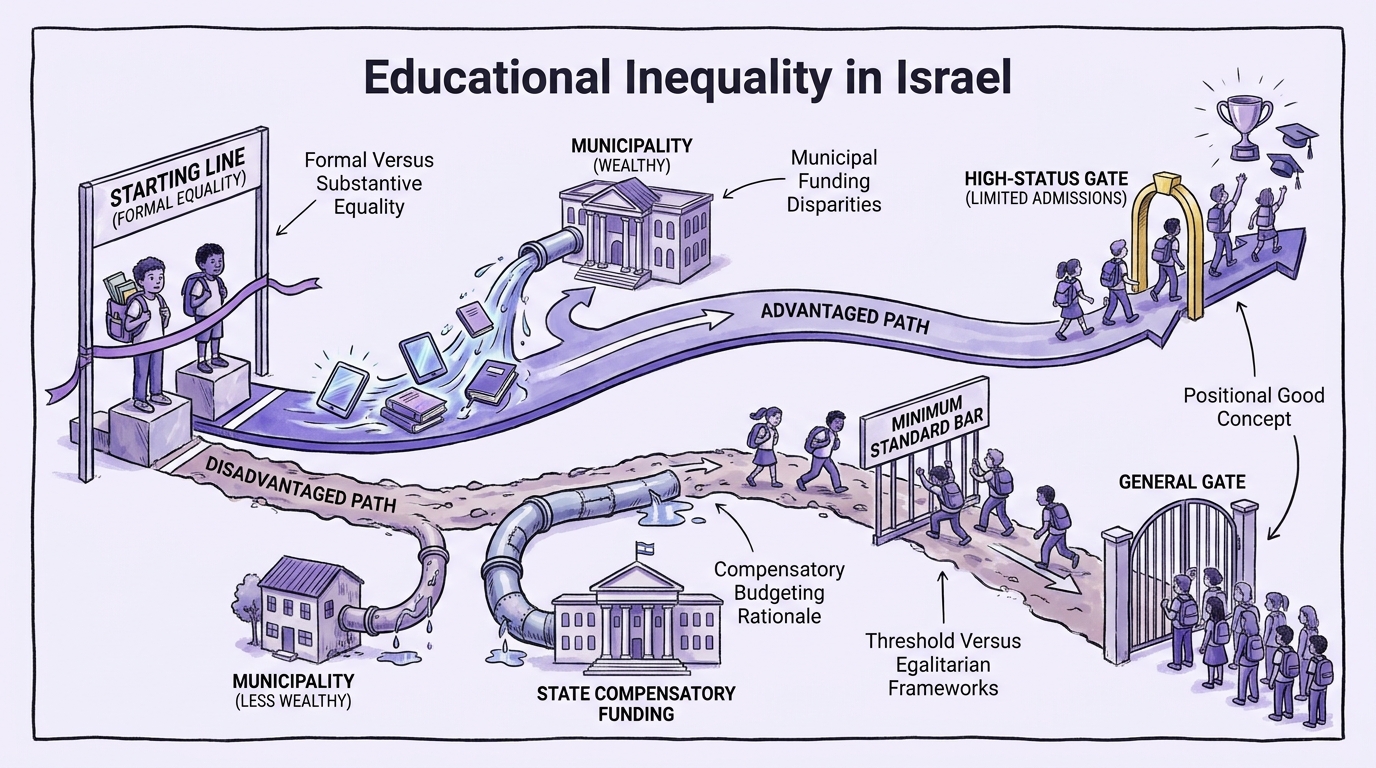
- Education functions as a positional good, meaning its value is inherently relative to the educational achievements of others in a competitive landscape
- Formal equality of opportunity (non-discrimination) fails to address structural socio-economic disadvantages that dictate student outcomes from an early age
- Israeli state resource allocation historically favored stronger educational tracks and wealthier municipalities, exacerbating systemic inequality
- High-performing alternative models, such as the Kedma school, demonstrate that systemic barriers, rather than student ability, drive educational underachievement
Tap to enlarge
Most valuable section
For whom
Educators, policy makers, and sociology students interested in educational equity and social mobility.
The Positional Nature of Education and Socio-Economic Disparities0:46
It clearly explains why education is a relative, positional good and how structural inequities begin well before children enter the classroom.
Detailed summary
1. Introduction to Educational Justice
0:00Prof. Yossi Dahan introduces the core theme of the lecture: educational justice and inequality in Israel. He outlines the two primary theoretical frameworks that define educational fairness—the egalitarian equal-opportunity approach and the sufficiency or threshold approach—which will form the basis of the discussion.
He emphasizes the need to understand how educational credentials function in society before evaluating policies. Understanding whether education is treated as an absolute right or a competitive asset shapes how policy decisions impact social stratification.
2. Education as a Positional Good
0:46Prof. Dahan explains that education is a 'positional good,' meaning its value is relative rather than absolute. An individual's degree or qualification is judged in direct competition with the qualifications held by others in the labor market and higher education admissions.
Because admissions to prestigious fields like medicine or high-tech are limited, educational success depends on outperforming peers. Consequently, unequal access to quality instruction—such as advanced math or physics classes in peripheral towns—directly disadvantages students regardless of their personal talent or effort.
3. Egalitarian vs. Threshold Approaches
3:50The lecture contrasts the egalitarian framework with the threshold approach to educational justice. The threshold approach asserts that as long as all students reach a minimum educational standard—such as basic literacy or a simple matriculation certificate—unequal outcomes above that line are acceptable.
Prof. Dahan critiques this view, arguing that in a meritocratic society, leaving upper-tier educational advantages unchecked allows affluent families to monopolize high-status career paths, rendering the egalitarian focus on gap-reduction far more compelling.
4. Formal vs. Substantive Equality of Opportunity
5:48This section examines the difference between formal non-discrimination laws and substantive equality. While Israeli law prohibits explicit discrimination based on race, religion, or gender, Prof. Dahan cites landmark Supreme Court cases showing that subtle and covert discrimination still occurs in school admissions.
He argues that formal prohibition of discrimination is insufficient because it ignores the unequal starting lines caused by family background, socio-economic status, and early childhood enrichment opportunities.
5. Compensatory Budgeting and Affirmative Action
11:52Prof. Dahan discusses the moral and economic rationale for affirmative action and compensatory funding in education. Since children do not choose their family background, moral fairness requires the state to allocate additional resources to disadvantaged students to level the playing field.
He reviews the history of Israeli affirmative funding policies, such as the 'nurture index' (Te'un Tipuach). Despite these mechanisms, actual budget distributions have often fallen short, delivering only marginal additions rather than the substantial reallocations needed to bridge socio-economic divides.
6. Municipal and Parental Funding Disparities
14:58The lecture details how local municipality budgets and parental payments drive educational inequality. Wealthy municipalities generate substantial revenue from commercial property taxes, allowing them to invest significantly more per student than poorer local authorities.
Furthermore, private parental contributions for special enrichment programs create two-tiered public schooling. Supreme Court rulings that permitted parental funding in public schools effectively institutionalized economic privilege within the state system.
7. Tracking, Integration, and Vocational Education
25:00Prof. Dahan analyzes structural mechanisms that segregate students, including academic tracking, ability grouping, and vocational education. He reviews the 1968 reform intended to foster social integration through middle schools and explains why its implementation was compromised.
He critiques vocational education, highlighting how it historically diverted working-class and Mizrahi students away from academic matriculation. He argues that modern rapid technological change makes narrow vocational training counterproductive compared to foundational academic literacy.
8. Alternative Educational Models and Conclusion
42:17In the concluding segment, Prof. Dahan highlights successful alternative educational initiatives like the Kedma school in Jerusalem. By rejecting early tracking, believing in student potential, and offering a culturally inclusive curriculum, Kedma demonstrated that marginalized students can achieve high matriculation rates.
He closes by calling on educators and citizens to challenge systemic biases, push for equitable state budgeting, and actively work toward a more just educational system in Israel.
Questions this video answers
What is the difference between egalitarian educational justice and the threshold approach?
The egalitarian approach focuses on equalizing opportunities and closing gaps between different social groups, recognizing education as a competitive positional good. In contrast, the threshold approach argues that justice is achieved as long as every student reaches a baseline standard of education, regardless of disparities above that line.
How do local municipalities contribute to educational inequality in Israel?
Municipalities fund local schools largely through commercial property taxes (Arnona). Wealthier cities with strong commercial zones invest thousands of Shekels more per student annually than poorer municipalities, creating vast disparities in resources, extracurriculars, and learning conditions.
Why does Prof. Dahan criticize vocational education tracks?
Historically, vocational tracks channeled marginalized students—particularly Mizrahi youth and peripheral residents—into low-wage technical labor rather than academic higher education. Dahan notes that as technology changes rapidly, narrow vocational training quickly becomes obsolete compared to broad analytical skills.
Ask a follow-up Premium
About this summary
SumTube AI wrote this recap from the video's words and chapters. Credit and the original belong to הקריה האקדמית אונו.