
Free AI summary of this YouTube video by SumTube
Real SUMO Is TERRIFYING
TL;DR
A Karate practitioner visits Japanese Sumo champion Takeshi Amitani to learn the fundamental techniques and cultural significance of Sumo wrestling. After practicing basic stances, footwork, and conditioning drills, the two test their skills against each other in traditional Sumo matches and a free-style sparring session.

Key takeaways
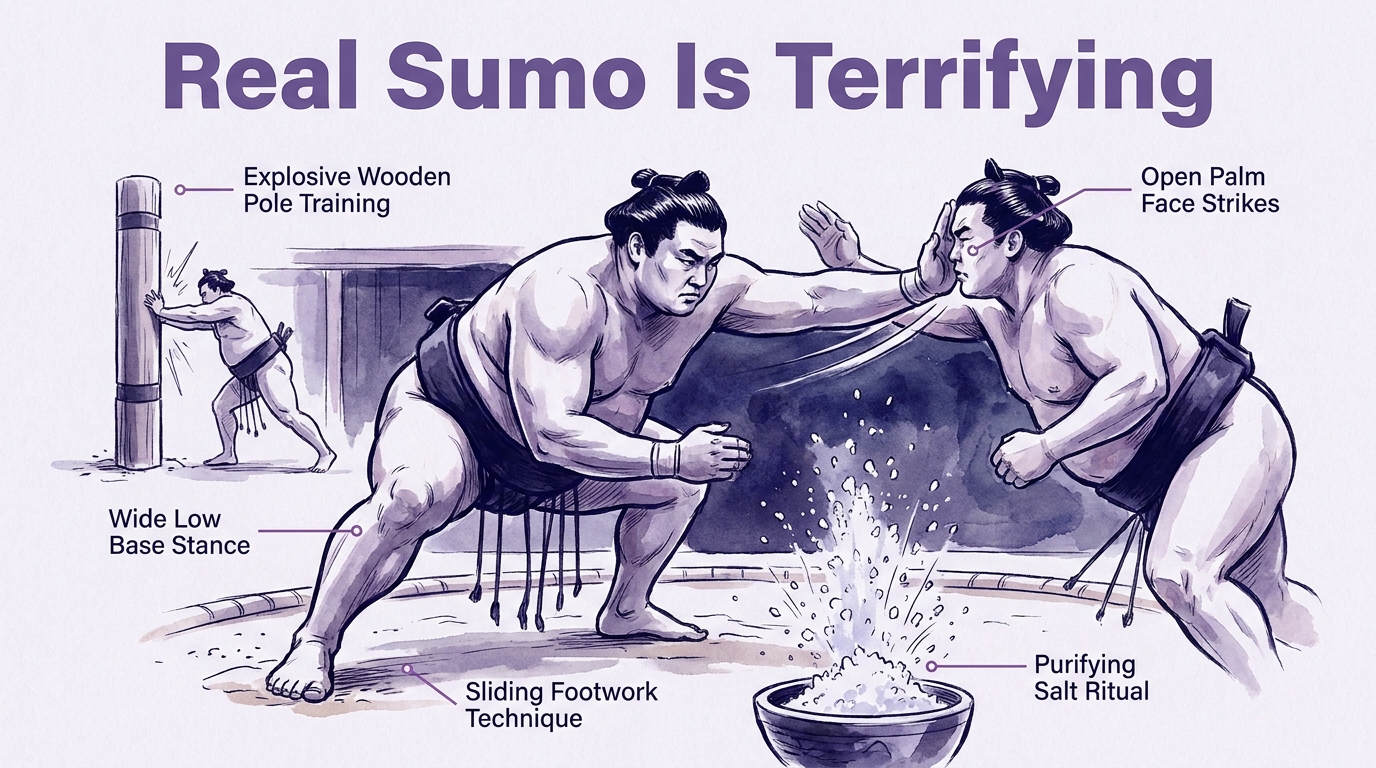
- 1:18Sumo footwork (suriashi) and wooden pole striking drills (teppo) require extreme lower-body strength and repetition to master
- 0:47Traditional Sumo rituals, like foot stomping and salt throwing, originate from ancient Japanese beliefs about purifying the ground and blessing harvests
- 9:11Distance management creates a stark contrast between Karate and Sumo, as Sumo eliminates space immediately, neutralizing long-range striking
Tap to enlarge
Most valuable section
For whom
Martial arts enthusiasts interested in how grappling and striking arts compare in live practice
Karate Striking vs Sumo Wrestling8:43
It showcases how a Sumo champion neutralizes long-range Karate strikes by instantly closing the distance and applying wrestling control.
Detailed summary
1. Introduction to Sumo Stance and Culture
0:00The Karate practitioner meets five-time Japanese Sumo champion Takeshi Amitani to learn the fundamentals of Sumo. They begin by practicing the wide, low-center-of-gravity stance that forms the baseline for all Sumo movement.
Amitani explains the cultural and spiritual roots of the Sumo foot stomp (shiko). Historically, ancient Japanese farmers believed Sumo wrestlers possessed sacred power, so stomping the ground purified the land of bad spirits and blessed future crop harvests.
2. Sumo Footwork and Open-Hand Strikes
2:03Amitani demonstrates suriashi, a sliding footwork technique designed to maintain balance and prevent stepping outside the ring. The host tries the movement and discovers how demanding it is on the legs despite its simple appearance.
They discuss striking rules in Sumo, noting that professional Sumo allows open-handed palm strikes to the face to break an opponent's balance. In contrast, amateur and international Sumo competitions ban open-hand face strikes for safety.
3. Teppo Wooden Pole Training
4:12The host examines the solid wooden pillar in the training room, which is used for traditional teppo training. Amitani demonstrates how wrestlers push and hit the pillar using coordinated body movements, executing hundreds of repetitions daily.
The host attempts the exercise with resistance from Amitani, experiencing the strenuous conditioning required. Amitani explains that 'teppo' translates to gun in Japanese, reflecting the explosive sound created by proper striking technique.
4. Sumo Rules and Pushing Practice
8:48Amitani outlines the core rules of Sumo: touching the area outside the ring or allowing any body part other than the soles of the feet to hit the ground results in an immediate loss. He then guides the host through pushing drills within the dohyo.
The host attempts to push the Sumo champion out of the ring, but finds Amitani virtually immovable due to his solid base and balance. After several attempts, the host learns the physical demands of maintaining drive while sliding feet across the dirt.
5. Ritual Practice and Salt Throwing
10:39Before commencing match play, Amitani teaches the pre-bout ritual movements, including hand-washing gestures in the air to symbolize body purification and open-palm displays to show no weapons are held.
They conclude pre-match rituals by throwing salt into the ring. Amitani notes that salt holds spiritual cleansing power in Japanese culture, preparing the ring for competition.
6. Traditional Sumo Matches
12:02The two engage in official Sumo matches following traditional rules and starting positions. Amitani easily controls the engagements, using precise leverage and weight distribution to drive the host out of the ring.
In the second match, the host attempts to push harder, but Amitani executes a quick reversal throw to win cleanly. The host acknowledges how seamlessly the Sumo champion controls the distance and balance.
7. Karate Striking vs Sumo Wrestling
13:53The host puts on protective shin guards and gloves to test how Karate kicks and punches fair against Sumo wrestling. They engage in sparring where the host uses ranged kicks while Amitani attempts to close the distance.
While the host lands a few high kicks, Amitani quickly clinches, absorbs the strikes, and lifts the host for a throw. They conclude by discussing how distance management dictates the outcome between striking and grappling styles.
Questions this video answers
What is the cultural history behind Sumo foot stomping?
The foot-stomping ritual (shiko) originates from ancient Japanese spiritual beliefs. People believed that Sumo wrestlers possessed special power, and stomping purified the ground by driving away evil spirits to ensure a good harvest.
What is the purpose of the wooden pole training in Sumo?
The wooden pole drill, known as teppo training, builds upper-body power and lower-body coordination through repetitive pushing and striking. Sumo wrestlers perform this movement up to 300 to 500 times daily to develop essential force.
Are strikes allowed in Sumo wrestling?
In professional Sumo, open-handed slashes and pushes to the face are permitted, primarily used to disrupt an opponent's balance by driving their chin up. However, face strikes are prohibited in amateur and international Sumo competitions.
Ask a follow-up Premium
About this summary
SumTube AI wrote this recap from the video's words and chapters. Credit and the original belong to Jesse Enkamp.