
Free AI summary of this YouTube video by SumTube
Real Judo Is TERRIFYING
TL;DR
In this video, karate practitioner Jesse Enkamp trains with Olympic Judo Champion Satoshi Ishii to learn four essential judo throws: Tai Otoshi, O Soto Gari, O Uchi Gari, and De Ashi Barai. Following technical instruction and sparring, Ishii shares insights on training discipline, the Japanese mindset of continuous improvement, and the importance of mentorship in martial arts.

Key takeaways
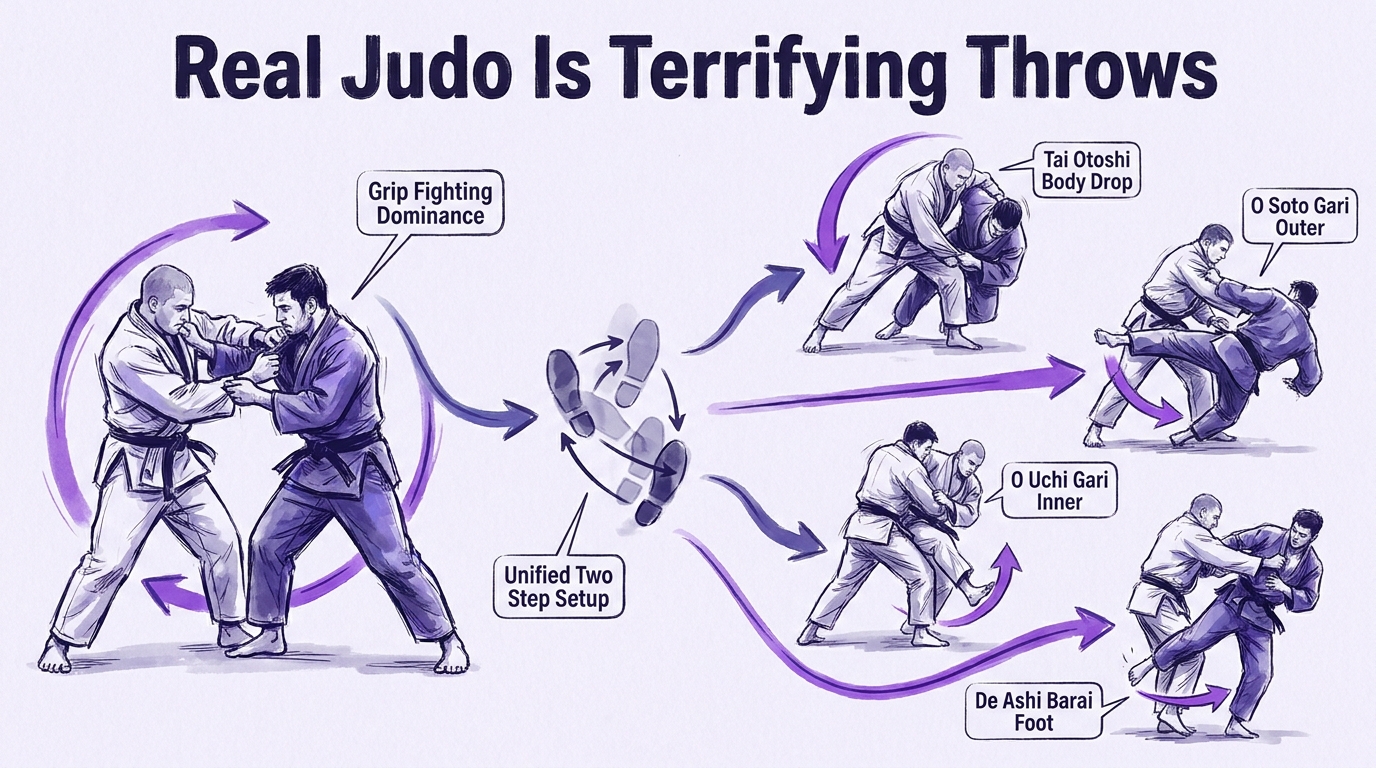
- 2:1770% of success in Judo comes down to grip fighting rather than the throw itself
- 3:24Satoshi Ishii uses a unified two-step setup to disguise multiple throws (Tai Otoshi, O Soto Gari, and O Uchi Gari) to keep opponents guessing
- 9:12High-level athletes require mentors who can enforce rest, as their drive often leads to severe overtraining
- 10:01Traditional Japanese judo culture stresses humility, prohibiting post-victory celebrations out of respect for opponents
Tap to enlarge
Most valuable section
For whom
Martial artists seeking practical judo breakdown techniques and philosophy from an Olympic champion
It breaks down how a top-tier athlete generates immense throwing power using grip fighting mechanics and resistance-band warmups.
Detailed summary
1. Introduction & Warm-Up
0:00Jesse Enkamp introduces Satoshi Ishii, an Olympic Judo Gold Medalist and professional MMA fighter. The session begins with a specialized rubber band warm-up used by judo practitioners to build throwing power, posture control, and rotational endurance.
Ishii demonstrates how the band exercises mirror real throwing movements, highlighting the specific 90-degree arm positioning and pulling mechanics required to off-balance heavy opponents effectively.
2. Tai Otoshi (Body Drop)
0:45Ishii teaches Tai Otoshi, one of his main throwing techniques. He demonstrates how to break an opponent's balance by pulling them forward while creating space through pivoting footwork. He shows how the throw relies on driving the body down into the mat rather than using pure upper-body strength.
To adapt the move for self-defense or no-gi situations, Ishii explains how to substitute gi lapel grips with underhooks, shoulder cupping, and wrist control. He also demonstrates post-throw control using underhooks to establish ground positioning for ground-and-pound or joint submissions.
3. O Soto Gari (Major Outer Reap)
3:19The second technique presented is O Soto Gari, an outer leg sweep. Ishii highlights the importance of driving the hips forward and arching the back to engage the entire body during the execution. He emphasizes that grip fighting accounts for 70% of judo success, as proper hand placement breaks opponent posture before any leg entry.
Ishii demonstrates his specific grip setup: keeping the control hand (hikite) pulling down while driving the power hand (tsurite) under the opponent's chin. This breakdown of posture creates ideal leverage for executing a high-impact outer reap.
4. O Uchi Gari (Major Inner Reap)
4:01Ishii showcases O Uchi Gari, an inside leg sweep that served as his signature throw during his Olympic championship run. He explains how this throw allows smaller fighters to take down larger opponents by driving weight backward and sweeping the inner leg directly behind the opponent's heels.
Jesse notes how Ishii uses a standardized two-step setup for Tai Otoshi, O Soto Gari, and O Uchi Gari. By entering every throw with identical initial footwork, Ishii confuses opponents, making it impossible to predict whether he will push, pull, or circle until the throw is initiated.
5. De Ashi Barai (Advanced Foot Sweep)
6:37The final throw taught is De Ashi Barai, an advanced timing-based foot sweep. Ishii breaks down his modified technique, sweeping along the direction of the opponent's big toe rather than across the side of the foot. He explains how to off-balance the opponent by shifting their body weight onto a single leg before initiating the sweep.
Jesse tests the technique and notes its striking-like impact, pointing out that even when the sweep does not result in a full throw, it disrupts opponent rhythm and opens up striking opportunities.
6. Karate vs. Judo Sparring
7:18Jesse and Ishii engage in a light sparring match combining karate strikes with judo grappling. Jesse attempts to stay at distance using kicks and punches, but Ishii demonstrates patient defense, waiting for a single opportunity to secure a grip and execute immediate throws.
Jesse reflects on the intense pressure of fighting an Olympic champion, describing Ishii's gripping strategy as relentless and inescapable once established.
7. Interview: Mindset of a Champion
10:55Following sparring, Jesse interviews Ishii regarding his training philosophy and psychological approach to competition. Ishii explains the traditional Japanese martial arts mindset, emphasizing continuous learning, extreme work ethic, and humility over personal glory.
Ishii discusses the role of coaches and mentors in an elite athlete's life. He points out that top-level competitors often struggle with overtraining due to their high drive, making it essential to have mentors who force them to rest and maintain long-term physical well-being.
8. Respect & Martial Arts Philosophy
16:38In the concluding segment, Ishii details the core lesson Judo has taught him: prioritizing respect and empathy for one's opponent. He explains why Japanese judoka do not celebrate after winning matches, noting that victory is only possible through the opponent's participation and effort.
The session ends with mutual bows of respect as Jesse thanks Ishii for sharing his technique and philosophy.
Questions this video answers
Who is Satoshi Ishii?
Satoshi Ishii is an Olympic Judo Gold Medalist (+100kg category) from Japan who became the youngest heavyweight Olympic champion in judo history. He has also competed extensively in professional Mixed Martial Arts (MMA), fighting high-profile opponents like Mirko Cro Cop and Fedor Emelianenko.
What four judo throws are demonstrated in the video?
The four featured throws are Tai Otoshi (Body Drop), O Soto Gari (Major Outer Reap), O Uchi Gari (Major Inner Reap), and De Ashi Barai (Advanced Foot Sweep). Ishii breaks down the grip mechanics, footwork setups, and body positioning for each technique.
How does judo adapt to street fighting or no-gi situations?
When an opponent isn't wearing a jacket or gi, Ishii adapts his grips by taking an underhook and cupping the opponent's shoulder while securing their wrist. This retains full control over the opponent's upper body posture and leverage for effective throws.
Ask a follow-up Premium
About this summary
SumTube AI wrote this recap from the video's words and chapters. Credit and the original belong to Jesse Enkamp.